Showing posts with label Elvis Presley. Show all posts

08 January 2015

Caught in a trap

If you’re looking for the real Elvis, you’ve come to the right place.

LAST TRAIN TO MEMPHIS: The Rise of Elvis Presley, by Peter Guralnick (Little, Brown).

elvis mourns momA photograph captures the teen idol on the steps of his newly bought mansion, hugging his father: both men are utterly bereft. Gladys Presley is dead. Vernon Presley has just lost his wife; Elvis, his mother.

What follows makes a heartbreaking con­clusion to Last Train to Memphis, the first volume of Peter Guralnick’s two-part bio­graphy of Elvis Presley. While fans keep a vigil at the gates of Graceland, in the kitchen, Elvis’s cousins and cronies get drunk. In the music room, Elvis sobs and keeps hugging and kissing his mother’s body in its silver casket. A doctor adminis­ters a sedative so Elvis can sleep before the funeral, for which Hollywood stars fly in from the coast. Elvis has to be helped into the church; he sobs as his mother’s favourite gospel group sings hymns. At the cemetery he leans over the coffin and cries out, “Goodbye, darling, goodbye.” Four friends drag him to his limo, where he declares, “Oh God, everything I have is gone.”

That night, he tells his childhood sweet­heart that his life is getting out of control. He is surrounded by new friends, they depend on him now, he can’t walk away. “I’m in too far to get out.” A few weeks later, Private Elvis Presley, serial number 53 310 761, is on a troopship to Germany. The rollercoaster ride of the past three years is over. Elvis is 23.

Guralnick is the leading historian of American roots music: blues, country, R&B and soul. Unlike many pop writers, who rely on hyperbole or ego, he writes with the sober eye of a musicologist and the ear of a true fan. As a consequence, his prose sings with authenticity. And his books – among them Lost Highway, Feel Like Going Home and Sweet Soul Music – have always been in print, unlike most pop books.

Elvis dances 1950sSince the late 1960s, Guralnick has been leading the battle to have Presley discussed as a serious artist. If a campaign was neces­sary then – when Presley was lost in his own genre of B-movies – now, it’s long overdue. Albert Goldman’s 1981 book Elvis was a ground-breaking necrography that dripped with malice; heavily marketed, it changed the world’s image of Presley to a sad joke with a cheeseburger in both hands.

Since then, the running joke that “Elvis is Alive” has only shifted the myth away from the music. And no one could have predicted last year’s marriage between Michael Jackson and Lisa-Marie Presley. That’s what happens when you start reading the tabloids. When it comes to Elvis, it’s best to keep a sense of humour and perspective -and return to the primary sources.

Guralnick has compiled his biography like a detective, interviewing first-hand observers and comparing their stories to sort out the accurate from the apocryphal. Contemporary news reports and previously published accounts are quoted when the par­ticipants are no longer available (ie, dead). Guralnick also consults archive tapes of Presley interviews and recording sessions, TV shows and concert film footage.

The closing scenes described above may sound melodramatic, but Guralnick’s fastidious research makes them utterly credible. The difference is in his attitude -he knows that what drives musicians is often not a quest for stardom, but a sense of vocation. The biography is not hagiography. He delivers the evidence, not a verdict, and avoids speculation, sensationalism and pop psychology.

Elvis and Col Tom ParkerGuralnick’s Presley is a complex character. At school he’s desperately shy, but wears flamboyant clothes. He speaks to no one, but explodes with energy when encouraged to sing. He loves gospel music, but also schmaltzy ballads and raunchy R&B. He lives by the Bible in public, but in private doesn’t turn away any women. He’s an odd mix of awk­ward humility and supreme self-confidence. Above: Elvis and the Colonel.

The story is familiar, but never before has it been told in such evocative detail (Guralnick fills in the facts behind Greil Marcus’s intellectual flights of fancy in Mystery Train). It takes off with Presley’s metamorphosis from misanthrope to musician. The moment in which Elvis, Scotty and Bill discover the sound – by countrifying “That’s All Right [Mama]” – is pure magic. Guralnick’s style is almost novelistic, but scrupulously sourced.

Certain themes recur: Presley’s awareness of his image (every outfit is lovingly described) and of every nuance of his perfor­mance – hiccup, hip shake or “affable sneer”. Meanwhile, dark clouds loom overhead: the growing Memphis mafia of hangers-on, the increasing crassness of Colonel Parker’s management hustle, the increasing mail from Presley’s draft board – while his mother sits at home drinking beer, missing her baby.

Elvis armyLast Train to Memphis finally tells the story properly, with sensitivity and insight. It answers the simple questions, the ones that have been hardest to answer: why Elvis sang the way he did, and why his music affected the world so profoundly. And, crucially, what affect fame had on him. Guralnick has re-established the credibility of the early career. Now we can trust him with the vital question of the second volume: did Elvis die when he went into the army?

First published in the NZ Listener, 28 January 1995. If he is alive, Elvis is 80 today. I was going to link to his version of Dylan’s ‘Tomorrow’s a Long Time’ but this is a lot more fun …

09 October 2013

Southern Moonlight 2

A Mississippi Journey, 1989

Part two of a six-part series. Part one here.

Memphis in the Meantime

Memphis has so much history, they don’t know what to do with it. Once the city was notorious as a rough-and-tumble frontier-town, a haven for Mississippi flatboatmen wanting to party on their way down to New Orleans. Now, immortalised for nurturing the blues and rock’n’roll, it is a musical Mecca legendary for Beale Street, the Sun Studios and Stax Records.

Musicians around the world have sung about going to Memphis, falling in love there, leaving it, or not being able to get a f1ight.

Chuck Berry wanted long distance information to give him Memphis, Tennessee. The Rolling Stones met a gin-soaked barroom queen there, and Little Feat a Southern belle under a street lamp. Paul Simon was drawn to Graceland. Meanwhile Bob Dylan couldn’t make it, being stuck in Mobile (Alabama) with the Memphis blues again.

These are just the most obvious examples. But when you see the position of the city, it’s easy to understand why it’s been so romanticised. Situated just 400 miles north of New Orleans, it’s a gateway to the South, or out of it. You can get there by boat on the Mississippi, or by driving along Highway 61. Or go by rail, using the same route thousands of Southern blacks took when migrating north to St Louis and Chicago, taking their blues and jazz with them. That train is called the Midnight Special, and I feel another song coming on.

The locals are at once bemused but respectful of their heritage. When they talk of the Elvis phenomenon, they separate the music from “the deity.” The former revolutionised the world, the latter draws 1.5 million visitors to Graceland each year. Underground musicians who revere more contemporary local heroes such as Alex Chilton relate with affection anecdotes about living legends. “I bumped into Al Green last week at Ardent Studios, talking to Willie Mitchell. Manic as ever.” “Did you hear Jerry Lee’s neighbours complained again? He keeps shooting off guns in his fancy apartment.”

During the heyday of Beale Street, Memphis was known as the “murder capital of the US.” A police station on the street contains a museum that recalls the lawlessness that went with the saloons, casinos, brothels, and pawn shops. One gets the feeling that the only problems the police deal with now are lost tourists. For Beale Street, like much of America that has a past, has been “historified.” Anything still standing from its sordid past has received a lick of paint and a bronze plaque. There are statues of Elvis and W C Handy, and the barrooms have been renovated into chintzy but still funky juke joints.

“It was the greatest place on earth,” said an old blues musician, “until they rurnt it.” But some symbols still remain untouched. Schwab’s department store is like a five-and-dime from the age when things did cost five or ten cents, and you can still find on its chaotic shelves voodoo powders, magic potions, clerical collars and handcuffs. And across the street stands Lansky’s Menswear, the place Sam Phillips of Sun Records sent Elvis Presley to learn how to dress cool (ie, like a black man). In the window are some striped winklepickers and a yellow suit with leopard skin lapels.

Memphis SunOn Union Avenue, a stone’s throw from the end of Beale, is Sun Studios, where the visionary Phillips made the first recordings of Elvis, Howlin’ Wolf, Jerry Lee Lewis, Johnny Cash and Charlie Rich. The small building is once again a studio – and tourist attraction – but thankfully the people who used it for 30 years as a refrigerator repair store didn’t alter the decor. The worn lino and grimy acoustic tiles are the same ones that first heard ‘That’s Alright Mama’ and ‘Great Balls of Fire’. The curators are just as awe-struck as their visitors, for this is the sacred spot of “the rockabilly moment”, when Elvis, doodling with pick-up band, was stopped by Sam Phillips, who heard something special: “Fine, fine, man, hell that’s different! That’s a pop song now. That’s good!”

Graceland is a 10-minute drive south, down Elvis Presley Boulevard, and also a moving experience. The patter of the guides is sterile and bored; 4000 teary-eyed fans will pass before them today. But shuffling through the rooms stuffed with lurid furnishings and grotesque fittings, all in the best veneer money can buy, you realise Elvis simply had no idea – of how to handle his wealth, his fame, or his talent.

An alternative view of Memphis is provided by the black history tour, whose militant guides give the details usually left out by the publicists. They point out a statue of Nathan Bedford Forrest, the Confederate general who is revered by whites but hated by blacks. A brilliant cavalry leader who developed guerilla warfare, he later founded the original Ku Klux Klan. He also ran a slave farm, keeping his strongest slaves in cages for breeding.

They explain why Memphis, unlike most of the other major US cities, has never had a black mayor. There is no one area of black housing, but many scattered pockets, all producing their own candidates and splitting the vote. It’s a town planning legacy of Edward H “Boss” Crump, the man who dominated Memphis politics for nearly 50 years earlier this century. Blacks were allowed to vote; Crump’s machine told them who to vote for.

Despite the billion dollars that has been spent on redeveloping the city in the past decade, downtown Memphis has a ghostliness about it. Grand old buildings stand empty as businesses and their customers have moved out to the suburban malls. The city has turned its back on the Mississippi, once the lifeblood of its economy. Half of the US cotton crop still goes through Memphis, but it leaves by train, and the cotton warehouses facing the river are being turned into yuppie apartments.

Memphis StaxMemphis morale suffered a severe blow when Martin Luther King was assassinated there in April, 1963. Up till then, the 1960s had been years of prosperity and pride, thanks to the music from Sun and Stax, and local success stories like the Holiday Inn chain and the Piggly Wiggly stores (the first supermarket was opened in Memphis, and now there’s a museum to go with it).

“Start something great in Memphis” is the slogan of the city’s publicists, an appropriate line considering the city’s impact on Western culture. We have all, as local writer Stanley Booth points out, shopped at supermarkets, eaten at drive-in restaurants, slept in Holiday Inns, and heard blues, rock’n’roll and soul because people in Memphis found ways to convert these things into groceries. Now the city has decided tourism will be its saviour. The complex on Mud Island, with its Mississippi museum and magnificent working scale model of the river, is a step in the right direction.

Memphis LorraineI’m not so sure about the civil rights museum planned for the site of the Lorraine Motel, where King was shot. Included among its exhibits will be a laser beam display tracing the path of the bullet from James Earl Ray’s rifle to King. Protesting against the development is Jacqueline Smith, who has been camping outside for two years. She says the US$5.5 million would be better spent turning the motel into housing for the poor, or a training centre for the unemployed. “This museum is not the way Memphis should remember Dr King,” she says. “It’s nothing but a circus freak show.”

The problem Memphis faces is living up to all its history, and making it work for the city, tastefully.

*

Twenty-four years later, this article has of course dated. Saying it had so much history, but didn’t know what to do with it, was a reflection of locals I spoke to who did know what the place had to offer, but despaired at the lack of initiative taken to celebrate that; or that what had been done was in a corporate way missing the soul. Since then, there has been a lot of regentrification and redevelopment of the downtown area. There are also museums devoted to Stax (reconstructing the original building, seen above just before it was demolished in 1989) and, on Beale Street, Memphis rock’n’roll. Perhaps the city’s establishment and its attitude towards music and other elements of its history has changed, but race and class are barriers that don’t evaporate easily, and buildings of architectural or cultural value are always under threat. Last I heard, Jacqueline Smith was still going strong, 24 years on. Historic Memphis is an excellent non-sanitised site to explore. A pioneering alternative view of the city’s pop culture is former Shangri La Records’ proprietor Sherman Willmott’s Low-Life Guide to Memphis tours. Local music writer Robert Gordon is about to follow up his classic 1994 book on the city’s underground music It Came From Memphis with what is likely to be the best book on Stax, Respect Yourself, and early 1980s psychobilly star Tav Falco has written a fascinating history of lowlife Memphis, Ghosts Behind the Sun. Thanks to David Nicholson of the Memphis Convention and Visitor’s Bureau, who after I cold-called him was tireless in his efforts to help, though he probably wondered if I was legitimate. Once he heard where I was staying – a hostel that was dis-affiliated from the YHA, the owners seemed to resent the guests, and there was one toilet for 17 people – he shuddered and sorted out a room at the Sheraton, and drove me around town sharing the insights of a Brit who had lived there for eight years. The visitor’s bureau has a great website with much more recent articles on things like Memphis and civil rights, black history, its music legacy and current status (eg Justin Timberlake, Amy LaVere), its entrepreneurial history, film-making, food, bars, etc.

It would be wrong not to include this very 80s clip of John Hiatt at Fisk University, Tennessee, with many guests including Carl Perkins, Rodney Crowell and what looks like the Jordanaires.

24 January 2011

Sumpin’ Real Funky

Finding an excellent recent podcast of a concert by Southern songwriter Dan Penn accompanied by the legendary keyboardist Bobby Emmons (at the 100-seat Bluebird Cafe, Nashville), reminded me of this interview I did with him in 1999. It was just prior to his show at the Auckland town hall concert chamber, with Spooner Oldham on a Wurlitzer electric piano. The show was intimate and spellbinding – and it was just the first half of a double bill with Jimmy Webb, plus Rick Bryant and Bill Lake as the support act. Sweet Inspiration, a compilation of songs by Penn and Oldham, covered by many soul, country and R&B greats, is about to be released on Ace.

Dan Penn tinkeringDAN PENN IS A songwriter, an R&B legend. Among the songs he has written, with collaborators such as Spooner Oldham, Chips Moman and Donnie Fritts, are ‘Dark End of the Street’, ‘Do Right Woman’, ‘Sweet Inspiration’ and ‘Cry Like a Baby’.

He is such a mercurial presence in Southern music that he was also present, Zelig-like, at the creation of ‘I Never Loved a Man’, ‘When a Man Loves a Woman’ and  ‘Suspicious Minds’. As historian Peter Guralnick puts it, the Penn is the “secret hero” of Southern soul.

Born in 1941, Penn is a pivotal member of the Memphis-Muscle Shoals gang that gave Stax a run for its money, and wooed characters as diverse as Bob Dylan and Cher down to Alabama to capture some of the magic. He was there when Arthur Alexander recorded ‘You Better Move On’ in Muscle Shoals, and started it all off; he talent spotted Percy Sledge; he was present when Aretha changed history with a few piano chords; he produced ‘The Letter’ for Alex Chilton and the Box Tops; and when Elvis decided to record in Memphis once more, he grabbed a camera to get in the door.

Penn, who plays New Zealand this month [March 1999] in a double bill with another songwriting legend, Jimmy Webb, was a Southern boy hooked on the R&B that came out of John R’s show on WLAC Nashville. He was so immersed in it that he claims he wasn’t aware of segregation when he was growing up: there just weren’t many blacks in his county, let alone the small town of Vernon (population 2000), where he lived beside a junk yard. “It was never an issue for the lot of us. I’m sure that the other side might have thought different.

“And when I was in my teens and early twenties, I was in the studio through all of that, and working with black people. So I didn’t know what the problem was! There was a lot of injustice down there,but there was also the same thing going on in New York City and Chicago. Everybody centres in on the South as the bad guy but they were no worse than a lot of the northern places at treating black people.”
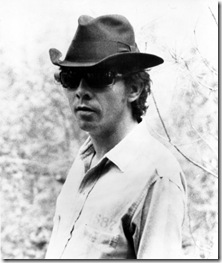
Dan Penn youngPenn’s speaking style is slow, reeeeal slow, with a melody in his voice and the endings clipped off the words. His first taste of what scrawling a few lyrics on chords on used “paper sacks” could do came at 16, when Conway Twitty covered his ‘Is a Bluebird Blue?’. (The song was also covered by New Zealand singer Toni Williams, very early in the 1960s.) Penn was playing in a band with Billy Sherrill when a song plugger came through and heard it. Next thing, it’s Top 20 in the pop charts and Penn’s still in high school.

“Conway was still pop then, rock’n’roll. I got him right before he went Nashville country. I made my first 700 bucks and bought me a car.”

Now Penn warms up. Legend has it he’s hard to get out from beneath a car to get songs written; both albums of his 45-year career (1973’s Nobody’s Fool and 1994’s Do Right Man) feature a shiny, curvy, classic Detroit beast.

“It was a ’54 Chevy, a four-door sedan with a ’56 V8 in it. It was a slick little devil, black. It looked like a school teacher, but in the back it had twin pipes. Of course I began to take all the chrome off of it and you could tell pretty soon it was a funky guy’s car.

It was in a ‘56 Caddy hearse that Penn’s singing career began. His band was called the Pallbearers and they played the drunken student frat-rock scene. “In Alabama all they wanted to hear was “Are you all right? Oh yeah! and ‘Bo Diddley’.”

Penn’s gritty voice reflected his idols: Ray Charles, James Brown and Bobby Bland. But when his songwriting took over, and with voices such as Arthur Alexander, Aretha, Otis Redding and Charlie Rich performing his songs, Penn’s own singing took a back seat.

“I got to singin’ on the demos, that was good enough for me. I got my licks in. I used them to sell the songs. I’m pretty sure that if it wasn’t for my singin’, I wouldn’t have got too many cuts.

“But you wasn’t going to get any white guys on black radio at that time. Even now, never. At that time it was kinda hard to get on the pop stations with sumpin’ real funky. We knew what the chances were of getting our blue-eyed soul on the radio. So that helped me stay in the studio and keep pitchin’.”

Penn says that his success with Conway Twitty was “a fluke”. It was when his friend Arthur Alexander had a hit with ‘You Better Move On’, recorded above a drugstore near Muscle Shoals, that Penn realised what could be achieved, despite their amateurism and their isolation. “My special memory of Arthur is that he got a hit. That was the beginning of believing for me. To actually see someone get a hit, someone I was hanging out with … I thought, mmm, I need to work harder.”

Shortly after, Alexander was having songs covered by the Beatles and Rolling Stones, though few royalties came back. “Arthur was an inspiration. I still have more respect for him than any other person I can think of in Alabama.”

But the person Penn regards as the “unsung hero” of Southern soul is Tom Stafford, who ran Fame Studios with Rick Hall: the tiny room above the drugstore in nearby Florence where musicians connected, took speed, and developed the Muscle Shoals sound. No one could have guessed that in a few years Jerry Wexler, the sophisticated New York producer for Atlantic Records, would bring Aretha Franklin down to Fame and change music history. Her career had been languishing at Columbia, but Penn knew her capabilities. He watched from the control room to see if some magic took place.

The song was ‘I Never Loved a Man’, nothing much from its demo. And it took a while for Aretha to click with the musicians. All white, they “walked and talked like sheriffs, and dressed like dollar-store managers off on a fishing trip”. That’s Robert Palmer ’s description; these Muscle Shoals cats grew up on country but lived and breathed R&B.

“I guess they’d been foolin’ round for about 20 minutes on that tune,” says Penn. “They played the demo, and everybody got the chords, and everybody was like, ‘But how we gonna start it?’ It was a little bit frustratin’. Ten, 20 minutes went by and it was coming to the place that everybody was looking at everybody.”

SpoonerJPEG“Then, all of a sudden, here comes Spoon.” It was Penn’s great friend and collaborator, Spooner Oldham (right), on his Wurlitzer electric piano. “Through the stares, Spooner goes Dah. Da daddle dah dum. And everybody says, yeah. They jump on their instruments and away they went. It was Spooner. So many times it was Spooner who just found that nucleus. From then on the session never looked back.”

Until, that is, time came to record a
B-side. ‘Do Right Woman’ was written by Penn and Oldham, and Penn had just had time to lay down his guide vocal over a backing track when a fight broke out between Hall and Aretha’s husband. Next day, they fled back up north, the song recording incomplete.

“I was pretty well shattered. There just wasn’t anything there. I’m just squeakin’ a little on her key,and trying to carry the song through, and nobody’s made a committed effort to actually play the song. Just a little bass lick, a little drum lick … a little squeak on the organ and maybe a little guitar chink. There wasn’t really anything there, least, not to my ears at the time. But of course when I got to New York, she’d finished it off. And it was amazing.”

Penn moved up to Memphis to work with his friend Chips Moman and his great American Studios band. This was where they recorded the Box Tops, Dusty and, in his last great burst, Elvis Presley. “Chips’s style was just gettin’ in so tight with the musicians mentally. He was close to being one of ’em through the glass. The only flaw to his cuttin’ style was he took too many takes. He just cut ’em till their knuckles bled.”
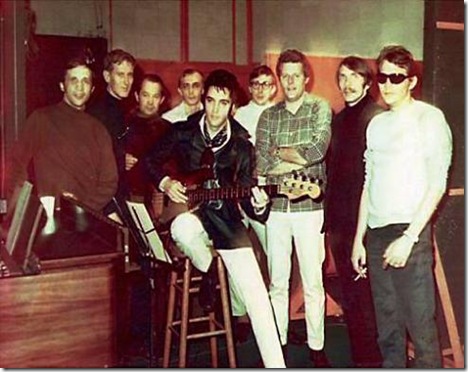
Elvis-AmericanStudioBandThe American Studios band, Memphis, takes a break from cutting hits, January 1969. From left: Bobby Wood, piano; Mike Leech, bass; Tommy Cogbill, bass; Gene Chrisman, drums; Elvis Presley, guest vocalist; Bobby Emmons, organ; Reggie Young, guitar; Ed Kollis, harmonica; and Dan Penn (“I just called over to take pitchers …”).

When Elvis entered the studio for what became the ‘In the Ghetto’ and ‘Suspicious Minds’ sessions, Penn had left American. “I just called over to take pitchers …”

You look even cooler than the man himself in one of them … “Ha ha ha. I had better glasses … I walked in, and they was playin’, and I thought it was great. But I was always hopin’ he’d return to ‘Don’t Be Cruel’. And further down the line, even funkier. Don’t get me wrong, I thought those records were great, but they were a little on the flowery side – and I still do. But I sure liked it better than ‘Blue Hawaii’.”

Penn just missed out on his Presley cut a few years later (“He was getting a little woozy then”) and to this day, the moment he cherishes most is James Carr’s version of ‘Dark End of the Street’. “Nobody has done it justice the way James did it. Aretha did it pretty good, and so did a lot of people. But James Carr was deeper than any of ’em. He had the voice. Put his on, and lean back, ’cause he’ll take you there. And that high-voiced girl singer in there? That’s yours truly. Ha ha ha.”

But who does Penn, the songwriter’s songwriter, regard as his mentors? “Oh, Lieber and Stoller, Burt Bacharach and Hal David. So many songs I don’t know the writers of but I know the songs. The great Motown writers. But now I have different mentors. Now I can definitely say that the Beatles were right up there with the best of ‘em, but at the time I rejected that, ‘cause it was so teeny weeny. As time’s gone along I’ve changed. I used to be, if it wasn’t black, I didn’t want to hear it. Now it doesn’t matter, I’m a lover of music.”

First published in Real Groove (New Zealand), March 1999.

04 September 2008

Gone up North for a while

1. Juno to Juneau
Sometimes the obvious headline is the best one, until it gets over used. That’s already happened with J2J: the director of Juno, Jason Reitman, doesn’t even want to talk about it.
But he did admit this much: “You’ve got a 17-year-old pregnant teenager, and Juneau is the capital of Alaska. The coincidence is cute.”

2. Northern exposure
The Juneau connection made me think of the first time I’d heard of the place: Jonathan Raban’s 1999 book Passage to Juneau, in which he takes a solo sea voyage through the Northwest Passage from Seattle, Washington, to Juneau, Alaska. As with his first sea voyage, Coasting, it was the personal journey that resonated most. But it reminded me that in the 1992 election Raban wrote a brilliant piece in the Los Angeles Times Magazine analysing the change in Bill Clinton’s use of language as that year
s campaign progressed. He started out with complex, intellectual, vocab-challenging verbosities. He finished using Good Ol’ Boy aphorisms. Earlier this year Raban considered how the language Rev Jeremiah Wright – the bogey man of black evangelism – had influenced that of his most famous parishoner, Barack Obama. Raban’s occasional journalism is available on-line. He has lived in Seattle since 1990, and this Englishman abroad is always good on US politics. I’d love to hear his take on what’s going on in Juneau.

3. When You’re Hot, You’re Hot
Jerry Reed, who died this week in Nashville,
had a breakthrough when Chet Atkins told him to put more of his own personality in his songwriting. ‘US Male’ and ‘Guitar Man’ quickly followed and they were instant hits for Elvis in his allegedly moribund post-army period. The songs were autobiographical of both men: ‘Guitar Man’ is a redneck road-song to match Chuck Berry’s ‘Promised Land’. Reed’s picker quits his job at the carwash, writes his mama a goodbye note and leaves town by sundown, his guitar hidden under his coat. He drifts South, bums a ride to Macon, Georgia, and finds a job as a swingin’ guitar man in Mobile. It was perfect for the big finale of Elvis’s comeback special, but here’s a leather-clad version from elsewhere in the 1968 show. Reed was no fool; he courageously told the Colonel he was keeping the publishing on his two songs. But he didn’t rest on his laurels collecting royalties. Like Roger Miller, he just had fun following his instincts. He starred in the Smokey and the Bandit series, had other hits like ‘When You’re Hot, You’re Hot’ and the great swamp-rocker, ‘Amos Moses’. One of his last hits was ‘She’s Got the Goldmine (I Got the Shaft)’. Which brings me to …

4. When You’re Not, You’re Not

A high-profile broadcasting personality. A stoush with the missus. Warrants for an arrest. A career in tatters. Andy Kershaw, this is your life.


5. Yellow Man

Okay, last connection to Elvis. What will Rodney Hide’s next unwise fashion statement be: wearing his Y-fronts outside his trousers? With his obsessive blitzing of Winston recently, trying every which way to tie the man they call Luigi in knots, Rockin’ Rod may feel he is now dancing with the stars. But I don’t think he’s quite pulled this one off yet: here is how a man in a yellow jacket dances with a star.

13 August 2008

Going to Graceland

Staying with Memphis in the meantime, where it's Death Week in more ways than one. On August 17, 1977 I was on a bus going through Wellington when I noticed the Evening Post's billboard:

THE KING IS DEAD - Elvis Presley 1935-1977

The circumstances of his death meant that Elvis became a punchline for those with limited imagination, or fodder for semioticians who can't dance. Growing up in Wellington, the closest I got to an Elvis film were the trailers at the local fleapit. Just old enough to remember 'In the Ghetto' as a hit, in the early 1970s when NZBC-TV had a run of daytime movies -
Loving You, King Creole and Jailhouse Rock - I suddenly got it. Later, even the post-army years.

In 1988, I made a 24-hour visit to Memphis, my first, driving up from New Orleans with Mike Howie at the wheel of a car that died in Elvis's carpark. After the article below was published, a woman from Taranaki wrote to say that she thought I was mocking Elvis, which wasn't the intention. To the visitor, Graceland is presented as an irony-free zone, and is a fascinating insight into the man. Surreal and sad at the same time.

A House On Lonely Street

In the early 1970s the city of Memphis finally found something adequate to name after their most famous son: a highway. So the six‑lane Highway 51 South became Elvis Presley Boulevard, and at 3764 stands Graceland, the palace/mausoleum that ranks with the White House and Taj Mahal as an icon. The enigma that is Elvis comes clear when one visits his home.

The first surprise is how close Graceland is to the highway – only about 50 metres. The famous wrought-iron gates, showing Elvis as a young rocker surrounded by musical notes, still stand at the roadside. They’ve been open since daughter Lisa Marie made Graceland a tourist attraction in 1982, to cover the costs of maintenance, she said: the Presley estate remains in trust till she turns 25 in 1993.

The gates were one of the first things Elvis installed after he bought the mansion in 1957. Aspirant Elvises struggled to pass through. Early in his career, Bruce Springsteen could only rattle them, crying to the guards in his frustration, “But I was on the cover of Time!” Mott the Hoople’s Ian Hunter snuck through, like a glam rocker in Colditz, making it as far as the kitchen. Jerry Lee Lewis didn’t wait for an invitation: he just turned up in a limo late one night, drunkenly waving a derringer. Raised from his slumber, the King told his guards to ignore him.

It’s easier these days. Leave your car in Elvis’s parking lot across the road (US$1.00) and buy a ticket for the mansion tour ($7.50). Stroll around his two private planes, the Lisa Marie 707, and small jet Hound Dog II (these “airborne luxury apartments” can be inspected for $3.95), and within two‑and‑a­-half minutes a shuttle bus arrives to take a group of 16 pilgrims across the road and through the hallowed gates.

The driveway winds past mature trees – cypresses and elms – to deposit the party beneath the portico of the Southern mansion. But despite the imposing columns, the antebellum architecture, the trimmed hedges, the Romanesque statues and vases, the effect is not so much Gone With the Wind as built­-without‑a‑permit.

While hardly humble, Graceland would be overshadowed by many homes in the more exclusive areas of Remuera or Fendleton, though the plans would never get past the residents’ protection group.

The front door is carved oak, its size as unremarkable as the attached metal fly screen. Before anyone enters, however, the “Graceland Guest Rules” are explained: no touching, no smoking, no exploring, no noisy children, no pets. Most important, no cameras with flashes: “Your respect of this rule will help preserve Graceland mansion and artefacts from the deteriorating effects of flash photography.’’

Is the decor as delicate as treasures from King Tut’s tomb? No. Even Presley’s interior decorator was aghast at his taste: “I would see it, and swallow hard,” he said. “There was really no way I could say, ‘Oh Elvis, you have made an abortion!’“ Or as one of Presley’s hangers-on said, “That house is filled with everything you’d walk into a furniture stare and not buy.’’

The crass splendour that is Graceland explains all about its owner. Elvis simply had no idea – of how to handle his fame or his money, let alone his talent. The feeling evoked is one of loneliness. It’s a house but not a home; the image is not one of roaring parties, or Lisa Marie toddling about in naps, but of Elvis, padding about alone, looking for his next banana split.

There are no books, no pictures other than motel room art – and nothing old. Elvis hated antiques. They reminded him of being poor. No, everything inside Graceland is new. I was prepared for tackiness – indeed that word quickly becomes inadequate – but what is surprising about the interior is that it’s all cheap tack.

The internal tour is limited to the ground floor. To visit the bedroom would be bad manners, to visit the upstairs bathroom where Elvis died (reading a book on the Shroud of Turin), bad taste. The visitors, mainly couples in their late 30s, are subdued and serious, as are the guides. With the vacant enthusiasm of doorstep evangelists, the guides shunt the visitors through the rooms with a rapid-fire patter. Their clean-cut demeanour barely hides their boredom, though they’re still buzzing that the heavy metal band Poison has just been through. “They all come here to pay homage,” said one guide.

The guides keep the myth intact. Presley’s divorce from Priscilla is conveniently forgotten; the TV cameras in every room were installed because “Elvis liked to look after his guests, to see what they were up to and what they needed.”

To the left of the foyer, carpeted in white shag-pile, is the dining room. A large smoked mirror glass table is surrounded by gold leaf baroque chairs, with velour upholstery. The drapes are turquoise, the walls white with gold scalloped trim. Glass cabinets are crammed with cheap knick‑knacks, statuettes, porcelain, vases.

On the right are two living rooms, smaller than one would expect, with low ceilings. Dividing them is an archway, flanked by peacocks in stained glass windows. One room is for a grand piano, dipped in gold.

Down a steep, narrow staircase, with walls and ceiling covered in mirrors. To one side is the TV room, with mirrored ceiling and bright-yellow vinyl furniture. Opposite is the pool room, so over-upholstered it’s like a womb. Heavy brown drapes cover all the walls and the ceiling, the fabric fanning out from the chandelier in widening pleats. The pool table is electric blue.

But the piece de resistance is at the back of the house: the Jungle Room. Elvis furnished his favourite room himself after seeing an ad on television for a local furniture store. He went straight down there, and in 30 minutes had what he wanted: a den with a Hawaiian theme. The intention may be Hollywood voodoo out of Blue Hawaii, but the result is more like a Dr­ Caligari nightmare. Bright green shagpile carpet, chairs with leopard-skin covers and dark wooden arms, roughly carved into gargoyles. A coffee table hewn from a tree trunk, voluminous curtains in M*A*S*H camouflage fabric, porcelain figurines of tigers, tikis and watermelons. Elvis liked it so much he recorded his last two albums right here, say the guides.

Out the back door, and viewed from behind, Graceland’s grandeur seems as superficial as a Hollywood film set, propping up the plantation-mansion facade. Across a lawn is a squash court, rapidly jerry-built in 1975 when Elvis wanted a game. He only used it twice, though the lounge room’s brown vinyl couches and upright piano are worn, one imagines from singalongs.


Into the trophy room, a concrete‑block museum that holds countless gold records and much more besides. Costumes from the Vegas period, with monumental belt buckles and high collars and smothered in rhinestones. On a mannequin, they seem small: Elvis, a quarter-inch over six feet, wore lifted heels. In frames are dozens of certificates proclaiming Elvis a sheriff in countless small towns, plus a blue police badge with accompanying letter from Richard Nixon appointing the King an undercover detective for the Bureau of Narcotics. Glass cases display Elvis’s guns: magnums, .38s, rifles, revolvers, derringers. “Elvis liked guns,” says the guide.

Outside is a kidney-shaped swimming pool (“Please Do Not Throw Coins in the Pool”) and beside it is the “Meditation Garden”. Less than 20 paces from the house, Elvis lies buried beneath a full-length bronze plaque alongside his mother, father and aunt. A small plaque remembers Jesse Garon Presley, Elvis’s twin brother who died at birth. An eternal flame has an inscription listing Elvis’s friends, including Dr Nichopolous, who prescribed the pills that Presley consumed in his final years.

Overlooking the scene is a full-sized statue of Jesus, arms outstretched, and two kneeling angels. Dotted about are wreaths and mementos from fans (“Always On Our Minds – Elvis followers of Malta”). Elvis’s epitaph is written by his father: “He had a God‑given talent that he shared with the world ... God saw that he needed some rest and called him home to be with Him.”

One is given a few moments of contemplation before the shuttle bus arrives to whisk the tour party back across the road. Another museum houses Elvis’s cars and motorbikes, including a Harley Davidson Electra Glide and a pink jeep, battered from Elvis playing dodgems. Pride of place is given to the fabled 1955 pink Cadillac that Elvis bought with his first flush of success, the ostentatious symbol that said he’d arrived.

Behind glass cases is more Elvis memorabilia: his first pay cheque ($54), some books (Kahil Gibran, Esoteric Psychology, The Legend of Bruce Lee, The Omen), LPs (Tom Jones Live in Las Vegas, Ray Charles The Man and His Soul) and videos (The Pink Panther, Monty Python episodes). In a mock drive‑in cinema plays a compilation of clips from Elvis films, called Follow That Dream. Six gift shops offer take-home memories of Elvis. The souvenirs – teddy bears, miniature juke boxes, ashtrays, snowies – follow the Graceland theme, tawdry workmanship at premium prices. In the heart of the South’s cotton growing district, the T‑shirts – Elvis in pink glitter – are made of polyester.

© Chris Bourke 1988