Showing posts with label music history. Show all posts

11 November 2015

Bach played the blues

Toussaint MotionAllen Toussaint was a gentleman: the way he carried himself, and every note he played. The much-loved New Orleans pianist, composer, producer and arranger, who unexpectedly died of a heart attack this week aged 77, also carried the history of his city’s music inside him. It had not just a rich past but an exciting future.

He was gracious and humble, always preferring to bring out the best in other performers rather than take the limelight. A stalwart of the city’s R&B since the late 1950s, he made only a few solo albums (1972’s Life, Love and Faith and 1975’s  Southern Nights are especially recommended) and rarely gave performances. But each year he had a showcase spot at the Jazz & Heritage Festival, and with good humour and a great groove he performed the hits he wrote for others. He was a tentative singer, but that was more his personality than a limitation, and to hear the familiar songs performed by their composer gave them extra depth and heart. On stage, he would often wear lurid, sequinned outfits, showing another side of his character, but he would bring forward the musicians he had hired for the one-off, highly rehearsed gigs, preferring to share the spotlight.

He seemed to be ubiquitous in New Orleans, wandering around the Jazzfest grounds immaculately dressed in a bespoke suit and leather sandals, his trimmed moustache and formal graces giving him the air of a black Clark Gable. He was the prince of the Crescent City. I was taken to see the New Orleans Symphony – a son of Shostakovich was conducting – and Toussaint was in a box in the circle, like he was holding court; he was the orchestra’s patron. It seemed appropriate – he was courtly – but he was just at home in a dirt-floor juke joint like the Dew Drop Inn where he started out.

I only met him once, and sadly it wasn’t for an interview. I was walking through New Orleans in April 1989 – Royal Street in the French Quarter – when I spotted a Rolls-Royce with the number plate PIANO. The Rolls was stuck in traffic in the narrow street, and as I got closer I saw it was Allen Toussaint at the wheel. I had my camera in my hand – for the number plate – and the electric window slid down.

Toussaint car“Did you want to take a photo?” he said with a grin. “Yes please, Mr Toussaint,” I said. “I saw your concert last night – it was wonderful.”
“Thank you,” he replied. “Did you want me in the car or out of the car?”

I was stunned, and before I answered he had a quick word into the brick of a phone wired into the dashboard, and stepped out. He put on a jacket, to complete his silver suit – with a tie, of course – and posed with a straight back standing beside the Rolls-Royce grill and number plate. I got down on one knee and took a vertical photo; the moment I clicked the shutter I realised the late afternoon shadows on his face would make it underexposed. There wasn’t enough time to get a flash to warm up; I thanked him, said I worked for a New Zealand music magazine called Rip It Up and gave him a card. He responded with another big grin, said “Wonderful”, got back in his car and glided off when the light turned green. A brief encounter, but it told so much about his character. (He also had a car with the plate SONGS, pictured above; the photo I took is below.)

It was only when Hurricane Katrina struck in 2005, and he had to abandon his flooded New Orleans home – which contained his archives, destroyed – that he won more of a national profile in the US. This, despite writing hits such as ‘Mother-in-Law’ and ‘Fortune Teller’ in the 1960s, ‘On Your Way Down’ and ‘Sneaking Sally in the Alley’ and – a special favourite – ‘What Do You Want the Girl to Do’ in the 1970s. In that decade, countless mainstream artists came to him to be produced – Robert Palmer, Paul McCartney, Paul Simon, Joe Cocker – with the Meters often the backing band. And the Band came calling when they wanted the horns arranged for the Rock of Ages and Last Waltz concerts. His greatest albums for others are probably Yes We Can – which he wrote and produced for Lee Dorsey, his favoured singer – and Dr John’s two mid-70s classics, In the Right Place and Desitively Bonnaroo.

Toussaint sandalsHomeless after Katrina, he settled in New York for a while and started playing a lot more gigs, made an album with Elvis Costello (with whom he had worked in the 80s), plus an excellent album of local jazz standards, and devoted a lot of time and energy to rebuilding his beloved home town.

Toussaint stands alongside Louis Armstrong as one of the giants of New Orleans music. His influences were omnivorous: Bach, Gottschalk, Professor Longhair, Fats Domino, also Haitian and Cuban music. He was a scholar of the piano, and an exquisite performer. You can hear the history of New Orleans in his music; somehow in a tune like ‘Country John’ off his 1975 Southern Nights album he mixes the interweaving lines of Dixieland jazz with 50s R&B and 70s funk. Witnessing him play ‘Southern Nights’ as twilight fell on a sticky New Orleans day it all came together.

Toussaint’s first break was playing on a Fats Domino session, pretending to be Fats when he was away on tour. Then he wrote ‘Java’, an instrumental that sold millions for Al Hirt. Toussaint was addicted to the rhythms of his home town: the syncopation that evolved from funeral parades, in which two bands would answer each other. He could turn the blues into pop, in the same way that his blind schoolfriend Snooks Eaglin could on an acoustic guitar. ‘Sneaking Sally Through the Alley’ is an example: a pop song with drumming from a funeral march, and harmonies like clarinets weaving through a brass band.

His first No 1 songwriting and production credit was ‘Mother-in-Law’, which singer Ernie K-Doe rescued from a rubbish tin. Backing vocalist Benny Spellman always claimed it was his deep-voiced response with the title that made it a hit; certainly that line was crucial but not nearly as much as Toussaint’s rippling, irresistible piano.

Songs such as ‘Lipstick Traces’ and ‘Fortune Teller’ and ‘I Like it Like That’ followed: simple songs with infectious rhythms. Herman’s Hermits attempted ‘Mother in Law’ and the Dave Clark Five had a go at ‘I Like It Like That’. The Rolling Stones tried ‘Fortune Teller’ and also – gamely – ‘Pain in My Heart’, originally a hit for Otis Redding (it was a re-write of ‘Ruler of My Heart’, which Toussaint wrote for Irma Thomas). (For these last two, and many others, he used his mother’s maiden name as credit: Naomi Neville.)

Toussaint’s biggest hit was ‘Southern Nights’, as covered by Glenn Campbell. Or maybe ‘Lady Marmalade’, which he produced for Labelle. He was a like one-man Motown coming out of New Orleans: the leading writer of pop R&B in the South. A group that idolised him was the Hawks, a white rock’n’roll band scuffling round the juke joints of the South. When they made it years later as the Band, they invited him to arrange ‘Life is a Carnival’ and those concerts mentioned above. And they paid tribute to him on the covers album Moondog Matinee with a version of Lee Dorsey’s weary-but-happy ‘Holy Cow’.

Out of the thousands of interpretations of Toussaint’s hundreds of songs is one that’s been forgotten here: Auckland R&B group the La De Das’ version of ‘Ride Your Pony’. And another that hasn’t been forgotten, Larry’s Rebels with ‘I Feel Good’ (original here, thanks Murray). Plus, I’ve just been sent a link to John Rowles doing a wonderful live version of ‘Yes We Can’ in New Zealand c1973, with the great Billy Nuku on drums. Who’s the bass player?

But usually it’s the original versions that stayed the distance, such as all those hits he wrote for Dorsey – everything he did gohn be funky – and local teenager Irma Thomas. ‘It’s Raining’ was his showcase for her: the feathery piano and drip-drop backing singers show how Toussaint could add his flair to the simplest rock’n’roll tunes. Understatement was his signature, plus polyrhythms that turned funerals into carnivals.

Toussaint’s funeral in New Orleans will be one of the last great carnivals. His take on the city’s rhythms put a smile on every face and a dance in every step. #

Allen Toussaint by CB april89025John Rowles covers ‘Yes We Can’ live in New Zealand c1973, with Billy Nuku on drums.

Paul Kelly on Allen Toussaint.
Richard Williams pays tribute.
New Orleans writer Dominic Massa’s obituary.
Toussaint plays ‘What Do You Want the Girl to Do’, 2011.
Allen Toussaint’s official website.
‘Soul Sister’ off Toussaint’s Life Love & Faith.
Lee Dorsey with ‘Everything I Do Gohn Be Funky’.
Hour-long BBC doco on Allen Toussaint.
The complete Southern Nights, 1975.
The complete Desitively Bonnaroo by Dr John with the Meters.
Sheet music for Toussaint’s post-Katrina instrumental ‘Tipitina and Me’ in which he turns Professor Longhair’s exuberant song into a minor-key lament.
And finally, the terrific documentary Piano Players Rarely Ever Play Together in which Toussaint (and Tuts Washington) tries to corral his mentor Professor Longhair.

02 December 2014

Bumper Christmas Retro Music Edition

1. Song Mining
Dylan by Elliott LandyI recently interviewed Greil Marcus about his book The History of Rock’n’Roll in Ten Songs (it can be heard at Radio New Zealand's website here). With the imminent release of The Complete Basement Tapes – six CDs, well over 100 songs that Dylan wrote while woodshedding with the Band in 1967 – I had to ask about them. I wondered whether – now that the sessions were finally seeing daylight – this would change the public’s fascination with them. Marcus’s response shows that his fascination with the Basement Tapes hasn’t dimmed since he wrote a whole book on the sessions, Invisible Republic, in 1997:
You know there’s a lot of material – there’s 30 something songs – that have never been heard before, that haven’t been bootlegged or leaked out, song by song, on Dylan’s own Bootleg Series. Certainly there’s stuff I never heard before. And what’s fascinating about it, in the context of the whole set – which I think is going to start this conversation all over again – is you know how down-to-earth and ordinary and ah, work-like a lot of the stuff is.
The [phrase] that leapt to mind when I was listening to the stuff that I hadn’t heard before was “song mining”. These people are digging into what look like songs but they aren’t really. And you just keep digging to see if you find something in there that will explain itself, that will say, ‘No! No! Go in this direction, not that direction’ Really digging in the ground, and finding a root, and grabbing onto that root and thinking, ‘Well this root must lead somewhere, and maybe you find where it leads and maybe you don’t. These are people mining for songs.
And I think that when people listen to all of this material – and its 140 tracks – they’re going to be fascinated by the way that fragments and cover versions of songs that weren’t that interesting to begin with, and experiments that really don’t go anywhere, surround these songs that seem like gifts from the Gods. It’s going to make the whole question of creation, of creativity and writing, and playing and improvising, even more mysterious than it already is.
In some ways the mystique of the Basement Tapes I think is going to be washed away – replaced by the spectre of a bunch of people getting together every day to fool around – in a clubhouse, in a kind of boy’s club.
On the other hand you can say, Well okay, but where did this stuff come from. My God: ‘Tears of Rage’, ‘I Shall Be Released’, ‘This Wheel’s on Fire’ … did some visitation come down and strike these people with lightning, and then go away and leave them to play with ordinary hands – as they weren’t doing for a few weeks?
I don’t know. But I love the way there is stuff here that is mediocre, that is second rate, and stuff that seems like junk – it sounds bad and it’s very hard to hear – and has flashes in it that are as strong and as disturbing as anything in the formal masterpieces that these sessions produced.
So I think you can tell by the way I’m answering that I don’t know. That I don’t know how to answer your question. That it’s as if you have to learn how to start listening to the stuff as if you’ve never heard it before. And see what story it tells.
2. His Back Pages
At last, a one-stop shop of Greil Marcus’s archives: articles, interviews and reviews, regularly updated. It was a very smart idea to compile a series of links to all the songs in his “Treasure Island” of essential discs Marcus added to Stranded, the 1979 anthology he edited in which music writers wrote about their “desert island disc”. (The essays by Lester Bangs on Astral Weeks, and M Marks on It’s Too Late to Stop Now are unsurpassed. Bangs’s masterpiece aside, one of the best reviews of Astral Weeks I ever heard was from an older woman who just said, “You breathe in, you breathe out, you breathe in, you breathe out.”)
3. Writer’s block
Of the six artists featured in Marcus’s 1975 classic Mystery Train (Harmonica Frank, Robert Johnson, the Band, Sly Stone, Randy Newman and Elvis Presley) only Newman’s career seems to have continue, rather than ended with pathos. Still, the exposure didn’t come without a cost to his productivity. In 1983 – I think in San Francisco’s BAM magazine – Newman said:
When I’m writing songs, the minutes are like hours – I sit there with nothing, just a big picture of Greil Marcus in my mind hanging over the piano as I think, ‘Ah, I don’t think this guy is gonna like this one, because I’m doing the same stuff he criticised me for before.
Marcus’s response? “You know, anybody who reads something I’ve written and comes back and tells me something about it that I didn’t know – that’s a valuable a reader as I can ever hope to have. And that’s happened with musicians and people who aren’t musicians. I really can't talk about other people’s reactions to my work, at least not positive reactions, it just comes off as self-congratulation. I’m lucky that I’ve been able to write, to find people to publish me, and to find people who read me. So that’s all I can say.”
4. Country gentlemen mystique
Speaking of the Band, I stumbled upon these 1969 reviews from the Village Voice of the Band live at the Fillmore, and of their second album. The writer, Johanna Schier, has a charming straightforward style, with a wry wit, a talent for an apt metaphor – and musical insights. (Though she describes Robbie Robertson on stage as “sweetly bashful”, she also hears Smokey Robinson in the chorus of ‘I Shall Be Released’). Schier soon befriended Janis Joplin, and with her future husband John Hall wrote ‘Holy Moon’, the b-side of ‘Me and Bobby McGee’. The pair then founded the group Orleans.
5. Ballad of a Teenage Queen
JLL1We have heard a lot from Jerry Lee Lewis over the years, especially about rock’n’roll and the Devil, but little from his child bride, Myra. At last, she breaks her silence. “They were looking for a place to stick the knife into rock & roll. And Jerry gave it to them—well, I did, I opened my mouth.”
6. Click track
From David Hepworth, a link to a batch of classic Motown hits with the vocals removed. I know, that seems criminal, but it is so illuminating to be able to concentrate on the Funk Brothers.
7. Down the avenue again
Van Morrison’s paranoia about YouTube seems to have dissipated. Three extraordinary, lengthy clips have recently been added to the site, without legal intervention thus far. The legendary It’s Too Late to Stop Now 1973 shows at London’s Rainbow were broadcast by TVNZ later in the 1970s on The Grunt Machine and talked about for years; a high-def version has been up for a while. Now, two other full-length concerts from the same period are online. At Winterland in February 1974, in B&W, the band is his usual combo from “Street Choir” period – also featured at the Rainbow, but lacking the string quartet. With a completely different – and integrated – band, but several of the same songs, he can be seen in full colour at the Orphanage, San Francisco in July 1974 (note the presence of Tom Donahue, the deep-throated influence on all FM rock jocks). Both feature Morrison’s ‘Caravan’ can-can schtick. Perhaps best of all is this 10-minute clip from the Fillmore East in September 1970, introduced by Bill Graham: maybe the earliest filmed version of his ‘Cyprus Avenue’ tease. As a taster to the Winterland gig, here he is covering Dylan’s ‘Just Like a Woman’.

8. Funky, funny and fun
More back pages: here is how the Victoria University of Wellington’s student newspaper Salient reviewed Abbey Road in 1969. Mike Bergin described the medley of songs on side two as “a mess”, whereas that was the only passage Nik Cohn liked in his New York Times review. But Bergin showed a lot of promise in this and other reviews; sadly, he died not long afterwards in a car accident.
9. Back to the Island
In July, Glenn Jowitt – one of New Zealand’s greatest photographers – died suddenly. He was mourned in Auckland by about 400 of his closest friends in a moving, multi-cultural ceremony. The NZ Herald asked me to write an obituary.
10. Take the Coltrane
A crucial influence on Glenn was the expatriate New York photographer Larence Shustak, who taught him at Ilam School of Fine Arts in Christchurch in the mid-1970s. Glenn was a dedicated music fan and an enthusiastic guitarist (in the 70s he even looked like his hero, Gram Parsons). A connection he had with Shustak that I never knew until researching for the obituary: in the 1950s Shustak took many compelling shots of New York jazz musicians.
11. A little bit frightening
Musical racism 101: ‘Kung Fu Fighting’, or how to express the whole of Asia in just nine notes. No, not the lyrics – which are bad enough – the influence of the arrangement has been even more pervasive, reports NPR.

11 November 2014

Close Encounters

Originally published in the NZ Listener in November 2010.

ROCK MUSICIANS AND photographers are natural-born partners: show-offs need an audience, and a Nikon lens loves a show-off. For some photographers, like Auckland’s Bruce Jarvis, the scent of the hunt has been a life-long quest. Shooting first as fans, many become professionals, and Jarvis’s tenacity at capturing live shows secured him access that today’s photographers can only envy.

Jarvis’s work is the backbone of a large-format book Live: Gigs that Rocked New Zealand, that portrays the flamboyant visitors in our midst. From the first international rock’n’roll tour – Johnny Cash and Gene Vincent, in 1959 – to Lady Gaga’s aerobic fashion-show earlier this year, the performers are freeze-framed at the peak of their careers. Some of the images – such as ZappaJarvis_thumb1Jarvis’s portraits of a satanic Frank Zappa, an exultant Bob Marley – belong in the rock photo hall of fame. But even more than the performers, it is the settings that resonate. In the background, a vanished New Zealand hovers like a vaguely remembered backdrop.

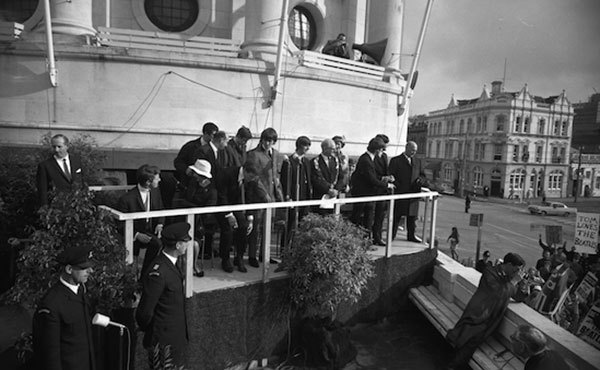
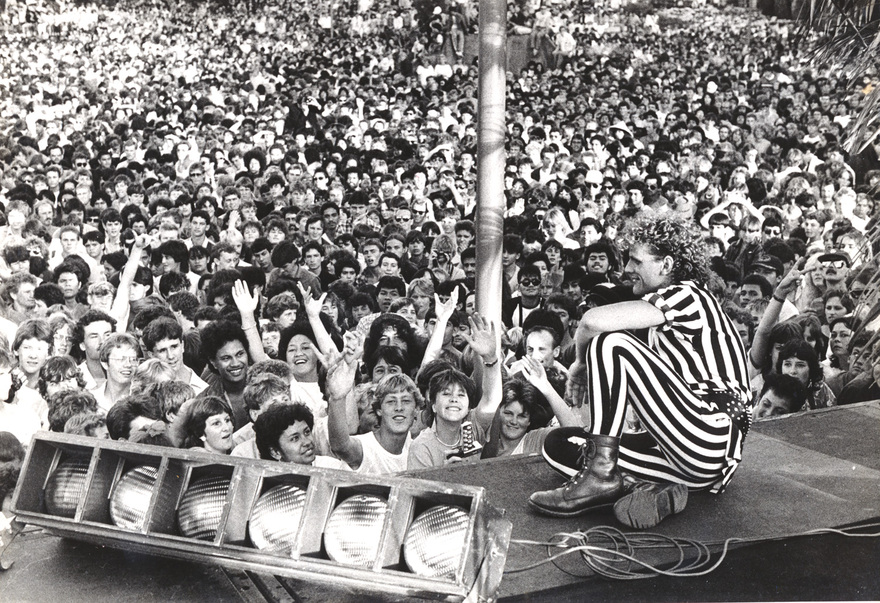
At the Beatles’ civic reception outside Auckland’s Town Hall in 1964 – how the councillors criticised Mayor Robbie for his generosity – one can glimpse the area now lost to Aotea Square. Out of sight are the 7000 fans who wagged school that morning. Instead, we spot the Market Hotel, one of many Edwardian corner pubs that are long since gone like the Vauxhall Velox seen cruising an almost empty street. Twenty years later, in the same area, a panoramic shot by Bryan Staff shows DD Smash’s drummer Peter Warren surveying a calm, peaceful crowd of thousands. The “Thank God It’s Friday” celebration to welcome the summer of 1984 will soon be renamed the Aotea Square riot.

The surprises often come from the unsung heroes who turn emotion into emulsion: the jobbing photographers rostered on for the day by a newspaper’s picture editor. At the Turnbull Library, saved from destruction, are gems from the files of deceased papers such as the Evening Post. These go beyond the requisite Maori welcome parties, the gimmick poses and the bland equivalents of rock stars kissing babies. Among the treasure are action shots of the Who, smashing their equipment on the Wellington’s Town Hall stage in 1968. Viv-Prince-from-natlib.govt.nz_thumbSomehow, the Pretty Things’ out-of-control drummer Viv Prince found time to sit for a formal portrait during the band’s notorious tour in 1965. He wears a woman’s leopard-skin hat, the coolest of rimless shades, chain bracelets of the style favoured by bodgies – and across his knuckles, a sticking plaster that testifies to his many scrapes while here.

As glamorous as some of the stars appear – the Temptations, stepping out in the 1970s’ finest flared suits; Roxy Music’s Bryan Ferry, elegant in herringbone tweed – it is the species Kiwi Rock Fan that makes these photos special. Invading the Rolling Stones’ stage in 1966 is an ecstatic fan, resplendent in homemade polka-dot mini skirt. Almost as gleeful are the navy-blue helmeted constables coming to Mick Jagger’s rescue.

Parked ostentatiously before the muslin-clad crowd waiting for Rod Stewart at Western Springs stadium in 1977 is a Ford Falcon emblazoned with Radio Hauraki’s logo. Beside it mooches a deejay in denim flares and manky long hair, while staff members or girlfriends attempt cool in satin jackets and bad posture. Their attitude: we are closer to the action than you.

StonesbyLloydGodman_thumb1The images also evoke the months of excitement that once came with the news that an overseas act was about to play “the Springs”. Long before the mammoth 1980s shows by David Bowie and ZZ Top, the Auckland speedway amphitheatre had hosted Little Richard, Elton John and Neil Diamond. For the first time we can see the Rolling Stones’ 1973 show in colour, thanks to a roll of film shot by Lloyd Godman. He didn’t need a flash – they played on a sunny afternoon – and it turns out that Jagger’s diamond-studded, low-cut, satin jumpsuit was turquoise.

Presented en masse, many of these shots have a “They walked this Earth” quality. They also answer the perennial question asked of visitors as they step off the plane: how do you find New Zealand? (It was apparently a wide-eyed Australian reporter who enquired “How many of you are there in your quartet, Mr Brubeck?”).

The Beatles look jubilant, although reports later came back that they described New Zealand as being like Britain, before the war. The Rolling Stones – specifically, Keith Richards – said of Invercargill it was “the arsehole of the World”. We remember these jibes, and almost more than the concerts we remember the interaction that these troubadours – grizzly or courteous – have with the locals.

Contrary to their surly reputation, in 1966 the Rolling Stones look cheerful, with their shirts off, enjoying the sun beside their Wellington motel swimming pool. The Guess Who play an après-gig jam at Tommy Adderley’s speakeasy Grandpa’s (sadly, no one was there to record the night in 1973 that Keith Richards turned up with a guitar and sundry other Rolling Stones).

Afterwards, when the litter has been cleared from the town halls and the paddocks that once hosted festivals, the anecdotes turn into urban legends. The Great Ngaruawahia Music Festival of 1973 is now remembered more for Corban Simpson’s nude performance than for headliners Black Sabbath headlining or the early appearance by Split Ends. Two years later, live on stage at the Te Rapa Racecourse, is Slade’s gormless Dave Hill; he is resplendent in an early mullet, a glitter-pasted forehead, a silver frock coat and platform boots. The promoter of this 1975 one-day festival – the cape-wearing Byron de Lacey – sounds almost mythological.

An Auckland school teacher friend says that every year – for nearly four decades – some 15-year-old aspiring guitar heroes in his class ask him the same question. “Sir, have you heard the Led Zeppelin song Stairway to Heaven?” Yes, he replies. “In fact, I heard them play it live at Western Springs in 1972 – before many of us had heard it on record.”

“Really?” they gasp. “Led Zeppelin played ... here?”

*

The Viv Prince shot is from the Alexander Turnbull Library’s collection of Evening Post negatives. The reference number is EP/1965/3179.

07 April 2014

Firebird Suite

stravinsky nz1
When Stravinsky visited New Zealand in 1961, Tom Shanahan had something better than a front row seat. As a member of the NZ Symphony Orchestra, and a photographer, he wasn’t looking at Stravinsky’s back when he conducted the orchestra, but his face. Shanahan was sitting with the musicians, ready to play his trombone. Luckily he took his camera along as well, and took some much used photographs of the Russian composer at work in the Wellington Town Hall.

Music in NZ 1Shanahan was a very keen photographer, who captured many images of New Zealand’s cultural history over several decades. One photograph – of musicians taken from above – was used on the cover of the first issue of William Dart’s Music in New Zealand (left). But he also took thousands of others that weren’t about music, including a set covering the Springbok tour in 1981.

Now, many of those images and negatives have been lost due to the fire – suspected as arson – at the Kilbirnie self-storage unit on Saturday. They were about to be given to the Turnbull Library for safe-keeping and use by future historians; now they are just one of many sad stories left behind by the fire, which ripped through one floor of storage units, and damaged those on another with smoke and water.

stravinsky nz2There have been many pros and cons with the National Library and Turnbull’s shift to the digital age. The increased availability of its photograph collection at an affordable price is one of the best elements; the loss of the accessible books on the ground floor – most now need to be ordered from storage – is one of the most difficult to comprehend.

Last year the New Zealand branch of Fairfax sent millions of images to Arizona to be digitised by a private company. They will hold the originals, and digital copies will be able to be used worldwide. These images have been assembled from the newspapers that Fairfax has bought over the years, and are often the only tangible assets when the papers have later been closed down. The National Library was unable to reach Fairfax’s price. Luckily, before the desperation of media owners in the digital age, the newspaper company INL gave many of its images from the Evening Post and Dominion to the Turnbull before INL was bought by Fairfax. These photos can now be used at an affordable price, usually $20.

I worry about what’s happening to New Zealand’s other big archive of photos, that of the NZ Herald, Listener and many other publications, since they were bought by Bauer. Already these images had become difficult to access by historians, and at unaffordable prices. For example, in 2010 it cost $80 an hour to research a photo, and then $100 for the use of that photo in a book.

This has major implications for New Zealand historians: images of our culture are priced off the market. Authors pay for the images they use in a book, not publishers. So when an author is getting, say, $5 royalty on a $50 book, it will take 20 sales just to cover the cost of that single photo. What happens? The photo archives stay idle, unloved and badly treated by their proprietors.
It remains to be seen what the cost of accessing and reprinting a photo from Arizona will be.

Luckily a vast resource of historic images is being released on the net through social media. Their owners are only too happy to share the images, and some replicate those the publishing conglomerates are sitting on. (It’s understandable the companies protecting their copyrights, where legitimate, but often photos are given to them to use, but not returned; in some cases they were originally paid for by the taxpayer). But there is  nothing as safe as a public archive with its own programme of digitising to a high standard. And where the cost of usage isn’t prohibitive.

Both photos are by Tom Shanahan. The top image is from the NZ International Arts Festival website, the third image is from the NZSO’s website. It shows Stravinsky meeting members of the NZSO, among them the violinist and Holocaust survivor Clare Galambos Winter, on the right – the subject of an excellent biography by Sarah Gaitanos.
The NZSO website shares this anecdote by former principal clarinettist Alan Gold:
“When Stravinsky was here, conducting the end of part of Firebird, where the big chords are, he changed it, which was fine, we did it, and about 18 months later, we had another conductor doing the whole of Firebird, and when we got to the end of it, we played these chords short. The conductor, almost in despair, threw his baton down on his podium. “My God,” he said, “What are you doing that for? What jerk ever told you to play the thing like that?” And old Vince [Aspey – NZSO Concertmaster at the time] he just sat there and said, “Oh, it was some old Russian bugger called Igor, I think!”

09 December 2013

Dreams to Remember

RY coverAt Stax Records the walls came tumbling down, twice. The first collapse of the legendary Memphis label began in December 1967, when Otis Redding’s sudden death was quickly followed by Stax’s separation from its distributor, Atlantic Records of New York. The death of Redding took out the label’s biggest solo star, while still in his ascendancy. The split with Atlantic didn’t just remove Sam & Dave from its books – the dynamic duo had only been “loaned” to Stax by Atlantic – it removed Stax’s entire back catalogue from its books. A hidden clause in Atlantic’s distribution contract said that ownership of the masters was vested in them, although Stax had made and paid for the recordings.

Another event in 1968 damaged the culture of Stax irrevocably. The murder of Martin Luther King in Memphis at the Lorraine Motel – a location that was one of the few to welcome visiting black musicians – altered the racial harmony that had existed at the label from the beginning. In a city where racism and segregation – both official and entrenched – survived long after the civil rights breakthroughs elsewhere, Stax was an integrated oasis. RY BT MGIt is crucially important to the Stax story that its house band Booker T and the MGs (right) was a “mixed crowd”. Booker T was the quartet’s black, teenage keyboard prodigy; drummer Al Jackson its black, metronomic groove master; Steve Cropper a white, quiffed C&W-influenced guitarist; and providing the fluid bottom-end came from Donald “Duck” Dunn, an amiable white bass player.

The death of MLK and the racial mores and tension in Memphis are crucial to the Stax story. In Robert Gordon’s rich, absorbing new history of the label, Respect Yourself: Stax Records and the Soul Explosion (Boomsbury USA), the issue of race is like a bad-ass backing vocal against the two-part harmony in the forefront: the music and business angles. Stax has been well covered over the years; dominating the work of Stax scholars and obsessives worldwide are Peter Guralnick’s moving, wide-ranging Sweet Soul Music, and Canadian musicologist Rob Bowman’s exhaustive Soulsville. But in Respect Yourself, you can taste the grits.

Gordon is a Memphian, who has been writing and directing documentaries about local music for nearly 30 years. He connects with the way musicians work and live, and he is also a superb story teller. Respect Yourself is the book he has been writing in the back of his mind since he first picked up a pen, producing two other classics in the meantime. It Came From Memphis (1994) was mostly about the city’s alternative rock scenes of the 1960s and 1970s, with Elvis and Stax barely mentioned, and Can’t Be Satisfied (2002) was an atmospheric, sensitive biography of Muddy Waters. Like Guralnick at a similar stage, Gordon has now produced a trilogy that evocatively recreates the culture in which American popular music was re-invented and heard worldwide.

Reeling from the blows it took in 1968 after Redding died, Stax quickly rebuilt itself under the new management of the visionary, risk-taking black entrepreneur Al Bell. His first task was to create an instant catalogue by recording and releasing 28 new albums simultaneously in an extravagant marketing gesture called the Soul Explosion. Extravagance soon became a byword at Stax, which had been founded by Jim Stewart and his sister Estelle Axton, two sensible, generous-hearted, white, small town music lovers. The frugality of Stewart’s approach is captured in the waste-free backings that Booker T and the MGs provided to the label’s first wave of recordings.

That extravagance was exemplified by the solo career of Isaac Hayes, Stax’s biggest star in the flamboyant Bell years. For Hayes (below), who first made his name as a Stax songwriter and producer, mostly for Sam & Dave, it meant recording albums with tracks that lasted nearly 20 minutes, wearing gold chain mail and little else as stage costumes, and driving a gold Cadillac, gifted to him in gratitude by Stax.

RY isaacPimp my wheels doesn’t begin to capture the swagger of the Shaft era, but does hint at another element of the story: the gangster-like behaviour of Johnny Baylor, a black hustler Bell hired to make sure distributors paid their bills and radio DJs played their records. Baylor, who likely put on a gun before his underwear, and his henchman Dino Woodard seem to be characters out of a Blaxploitation movie: they worked in entertainment, they had a great soundtrack, but their actions were deeply sinister.

It was Baylor who brought the walls of Stax tumbling down for the second time, when his bags were searched at Memphis airport, because of an unrelated bomb threat. Inside his bag were stacks of greenbacks, totalling more than $129,000. This alerted the FBI and IRD on to Stax: they were suspicious of the legitimacy of the money, and of other shadowy practices at the Southern, black-owned, independent company. Over the next couple of years Stax inexorably came apart, when debts to its local bank – itself a shaky, dodgy institution – were called in, and many were found to be fraudulent thanks to a bank employee taking backhanders. By 1976 the doors of Stax’s famous studio on McLemore Avenue were padlocked by armed guards, its publishing assets and master tapes taken by receivers. The label has since been sold several times, but is now in good hands at Concord Records, and thanks to revivals spurred by tributes such as The Blues Brothers and The Commitments movies, countless cover versions, and mostly the sheer strength of the back catalogue, the music Stax made has never been forgotten.

What makes Gordon’s book the best yet on this story – which is familiar to aficionados, but unknown to the millions who love the hits – is his identification with the musicians, their characters, and the community from which they sprung. So too is his use of the Memphis Sanitation workers’ strike of 1968 as a parallel story to relate just how pervasive and enduring racism and segregation was in the city.

Guralnick laid the groundwork in 1985 with Sweet Soul Music, which also covered other aspects of soul which didn’t emanate from Memphis (ie James Brown, Muscle Shoals). Bowman’s verbose, earthbound epic made one’s eyes water from the detail, and lacked the flair to move a reader from the armchair to the turntable. (Soulsville has a new purpose now as a book-length series of footnotes adding information about incidents to Gordon’s fast-paced, yet thorough, story-telling.)

RY estelleThanks to Gordon’s skill, the humanity of the characters comes through: Jim Stewart as the sober founder, out of his depth; his sister Estelle Axton – the hero of the book – whose open-mindedness welcomed talented black youths inside the studio; the dignified prodigy Booker T; the reliable Steve Cropper; the brilliant if flawed Al Bell. There is a sense of foreboding as the story unfolds: Stax is like a rollercoaster that sails through social and business barriers, taking risks at every corner, then builds up speed so that inevitably gravity comes knocking, in the guise of a hooded taxman and bank auditor. Gordon gets the sense of community and family that were essential to Stax’s success, and describes music making with just the right amount of colour and knowledge that while reading one is transported to the dance floor. Above: Jim Stewart and Estelle Axton.

Gordon has been interviewing the participants for almost 30 years, some of them for the 2007 Stax documentary Respect Yourself, which he co-directed. While the acknowledgements and suggestions of further reading and listening are helpful, I could have done with more precise information in the appendix about exactly who he interviewed, rather than general attributions to, say, Guralnick, who was one of several people who provided Gordon transcripts of their own interviews with key players. (Dead or alive, the interviewees are all quoted in the present tense.)* Also, the occasional subjective quip – which increase as the story continues – can sometimes intrude.

RY WexL-R: Jerry Wexler, Sam & Dave, Al Bell.

Gordon is understandably sceptical about Atlantic executive Jerry Wexler’s protestations of innocence in the saga of the company’s ruthless contract with Stax, but this could have been examined further. Wexler brought the incident up moments after Gordon began his interview with an innocent question, which is interpreted as “he protesteth too much”. Wexler could also have been racked with guilt, and haunted by the clause decades later. He was known as hard-nosed but always respected as a music man, not a suit: he could well have been oblivious to it. In his own biography, Wexler uses almost exactly the same words as he said to Gordon, and names Paul Marshall as the Atlantic lawyer responsible for the master-grabbing clause in fine print neither party had read. Also, there is a mention of Wexler asking Jim Stewart if he was interested in Aretha Franklin, whose contract at Columbia was about to finish. $25,000 was too much for Stax, so Atlantic signed her directly. I am unconvinced that Wexler would be so coldblooded towards the small Memphis label, whose musical and personal style he so admired, that he would suggest this while knowing of the hidden clause.

That small niggle aside, even when the business story of Stax begins to dominate the racial, political, and most importantly the musical angles, Respect Yourself is an exhilarating, often heart-breaking history. It will satisfy Stax aficionados and the newly converted, and does justice to the story by providing a context to the miracle of Memphis – and by opening up the music itself, like a re-mix editor looking for a hidden hook in the original multi-track tapes.

When I first visited Memphis, on an overnight stopover in 1988, I asked a white taxi driver where we were in relation to Stax. “Sex?” he said. “You want sex?” It was mainly my accent (in Georgia, asking for a Beck’s beer, after much confusion I was offered a Bax) but the confusion typified the disinterest that mainstream Memphis had in its local success story. One of the most gratifying elements of Gordon’s book is the conclusion, which suggests this disdain – much of it a product of institutional and inbuilt racism – has now evaporated. In the wake of Elvis’s death and the tourism dollars generated by Graceland, a new respect has been granted Stax. But the positive ending isn’t about filling motel rooms, it’s in keeping with the spirit of the label. The Stax Museum of American Soul Music – its premises a replica of the studio, on the original site – now contributes enormously to the community with its music and education programmes. This street-level activity proves to the neighbourhood children, whose grandparents once danced outside the doors of the studio, that music will not just help take you there, but to respect yourself.

* Update – apparently more expanded footnotes are to appear on Robert Gordon’s website, alongside some pure musical gold he rescued when visiting the Stax building as it was demolished: a stash of reel-to-reel tapes, featuring jam sessions by Booker T and the MGs, radio stings, etc.

Visit the Memphis Music Hall of Fame website for many rare pictures and links to audio interviews and video clips. The Stax Museum also has many video clips. Here is a Spotify playlist of 252 songs mentioned in the book, compiled by Jim Higgins of Milwaukee.

Finally, a word from our sponsor, Rufus Thomas.

19 October 2013

Celtic Swing

The cancelled Neon Picnic festival of January 1988 had one good spinoff – the amount of copy it generated for Rip It Up (even if I am still $200 out of pocket for hiring a caravan for the magazine’s campsite). I interviewed Roy Orbison, Murray Cammick interviewed Nona Hendryx, and Kerry Buchanan tried to talk to James Brown. Although Orbison died shortly after I talked with him, especially memorable was an interview I did with Philip Chevron of the Pogues. While the rest of the band was on tour, he was at home with an ulcer, and handling the interviews. He turned out to be exceptionally articulate and knowledgeable about the history of Irish pop music. Besides the courteous closing line – the idea had simply never occurred to me – for years I have been quoting his line about the boorish Irish expatriates and wannabes who appear around the world on St Patrick’s Day: “We’re a bit more subtle about our Irishness over here.” 

Sadly, Phil Chevon has recently died, of oesophageal cancer, aged 56. Contrary to the Pogues image, he was a well-read, historically minded, highly astute musician, and quite philosophical. Shortly before his death he said, “I am a gay, Irish, Catholic, alcoholic, Pogue who is about to die from cancer – and don’t think I don’t know it.” 

Along with Bob Geldof, the Pogues were one of the few acts that made it to New Zealand for the Neon Picnic. With so many people in Auckland to attend the festival that never happened, the Pogues’ gig at the Galaxy was packed to the ceiling with an audience that had already been partying all weekend. MacGowan won few friends among the audience for his slurred, out-of-it performance, and even fewer backstage where he insisted on limitless supplies of white wine and go-fast.

THE IRISH are plagued by ignorant stereotypes, but they know how to have a good time— I can personally recommend their funerals.

Sunday night is certain to be hoedown night at Neon Picnic, with the Pogues and Los Lobos on the same bill. Both bands have brought a contemporary edge and spirit to sounds that reach back over generations, and both bands know how to move the soul and the feet.

The Pogues are currently in New York, filming a video for their new single ‘Fairy Tale of New York.’ Then they tour the East Coast and Canada, finishing up at the Hollywood Palladium as guests of their friends Los Lobos.

chevron sepiaBut one Pogue who has stayed home in London is guitarist Philip Chevron. “I’ve had to stay behind because I’ve had a recurring duodenal ulcer which I need treat­ment for. But I’m feeling a bit better now,” he says.

Filling in for Chevron in North America is Joe Strummer. Last year the Clash singer and the Pogues starred, together with Elvis Costello, Grace Jones and Dennis Hopper, in Straight to Hell, a spoof spaghetti western by Sid and Nancy director Alex Cox. It re­ceived mixed reviews...

“Well I liked it!” laughs Chevron. “It was great fun to make, basically our annual summer holiday which we filmed and then forced on people in cinemas... no, it was a lot of hard work actually.”

Chevron joined the Pogues temporarily in 1985 before Rum Sodomy and the Lash – when their banjo player Jem Finer nee­ded a rest. “I liked it so much I stayed, well they invited me to.” Prior to that, he was in the seminal punk combo Radiators from Space. “We were the only punk band in Ireland, so we were quite well known for a while.” The Rad­iators, who had “terrible trouble” battling with an Australian outfit of the same name, made two albums, and Chevron has made two solo LPs, one produced by Elvis Costello.

A LOT IS MADE of the Pogues’ punk origins, with Finer and mil­lion-dollar smile Shane MacGowan being part of the Nipple Erectors. But through the Pogues’ concertina player Terry Woods, who helped form Steeleye Span, there are links back to an earlier era when traditional music was popular:

“There’s a long gap between that folk rock and us,” says Chevron. “Very early Steeleye Span were very good and adven­turous, as were early Horslips and early Fairport Convention. But somewhere along the line something went wrong and it got more rock than folk, and the two el­ements didn’t blend very well.

“I think it took another few years before the vital ingredient came along to make it work, and that was punk rock. That had the same sort of energy that Irish folk music has. It said, stop taking it seriously ’cause it’s supposed to be fun. Stop sticking your finger in your ear.”

And the respected Irish singer Christy Moore approves: he cove­red a song of the Radiators in the late 1970s, and the Pogues’ ‘A Pair of Brown Eyes’ on his latest album. “Christy always had a good ear for what’s going on, it doesn’t matter which strand of music of music it comes from. It was quite a radical thing to do then for a performer like Christy Moore to record what on the surface looked like a punk rock song. And to have him record ‘A Pair of Brown Eyes’ was like a progression of that.

“Because the Radiators, although they never ended up sounding like the Pogues, their attitude was similar in that they were using the long standing tradition of Irish ballad writing, and playing it a different way, with an upfront energy and force, but re­specting the tradition.”

Chevron says that when he grew up in Dublin, traditional Irish music was “shoved down my throat, and I hated it. It was part of the same misguided government policy which shoved the Irish lan­guage and sport down people’s throats, to the point that all you could do was vomit it back up again. That’s the wrong way to in­terest people.

“It took till that attitude cooled off a bit – for me it was a band called the Horslips, an Irish band in the 70s, who said, well fuck that, we’re gonna make this music sound like fun again. That had a big influence on me, it made it sound exciting again, and for my generation, kindled for the first time a love for Irish music.

“Now things are more relaxed, and they don’t force music or the language on you, so it’s easier to appreciate. Though there still pur­ists who despise what we do. But there will always be those people, always.”

pogues

ALONG WITH U2, the Pogues are known throughout Ireland. But Chevron stresses that only three members of the eight Pogues are actually Irish. “We’re a London band, all based there except for Terry who still lives in Ireland. But in London, there’s a very strong Irish music thing there in the Irish pubs. So that’s where a lot of the Pogues’ Irish music comes from, for the people who weren’t actu­ally born in Ireland.

“But we’ve been adopted as an Irish band in Ireland. Irish people are very proud of people who be­come internationally successful, particularly if they wear their Irish-ness on their sleeves.”

Irish pub bands play in the back­ground, “they wouldn’t have their jobs very long if they did what we do,” says Chevron. “But a lot of what those bands play, country and Irish, has some bearing on the Pogues. ‘A Pair of Brown Eyes’ is in that sort of mode, an Irish waltz. The pub bands play in that spirit – only we play it with a great deal more feeling than they would!”

The Irish immigrants to America had a large influence on early country music. “And therefore rock ‘n’ roll, so it’s very integral to the way rock music turned out,” says Chevron. “It’s amazing it’s taken so long for Irish music to be this popular internationally.”

Now the Pogues (particularly in their version of ‘Jesse James’ on RSL) reflect the way country has flowed back across the Atlantic. But the links go further: ‘London Girl’ thumps along with the zydeco rhythms of Louisiana. With Los Lobos, the Pogues have brought the accordion back into favour:

“Yeah – it’s been a very under­rated instrument until recently. Someone like William Schimmel who plays accordian with Tom Waits is brilliant. There are people who are using the accordian in an intelligent way these days. For a long time it had a justifiably terrible reputation.”

THE “Irish ravers” image of the Pogues has tended to obscure the fact that the band is full of ex­cellent musicians. Shane MacGowan has done the bulk of the writing, though on the new LP If I Should Fall From Grace With God various members of the band con­tribute. “Shane’s songs are pretty hard to beat – they have to be pretty shit hot to better him.

“Songs are everything. That’s one thing that unites us. With eight people in the band, there are lots of different influences and pre­ferences. But we all have got great respect for the songs. The art is the songs, which I think has become grossly devalued and debased over the past few years. We’ve got production and market­ing and so on, and the songs seem to have got lost. I’ve always regret­ted that.”

It’s been two years since Rum, Sodomy and the Lash. “We’ve had a lot of problems with our record company, and it’s taken this long to iron them out. We’ve had the album recorded for quite a while, but we weren’t prepared to let them release it except on our terms. That’s been a source of great frustration for us. We’ve been playing the stuff off the album for quite a while, but it helps if people know what you’re play­ing. And the band is very prolific, we write a helluva lot of material, so it’s frustrating not being able to record it and get on with the next one. However it’s been worth the wait.”

Fall From Grace has been prod­uced by Steve Lillywhite, and Chevron is enthusiastic about his approach:

“Without knocking anyone else who has produced the band, they haven’t really been producers but musicians. Steve Lillywhite’s a real producer, and it’s a different discipline from being a musician, you think differently. This time the album was pretty much recorded live in the studio. We added some colouring to it afterwards, but the essence of each track is live.

“Steve Lillywhite captured that, he didn’t impose anything on us at all, he was brilliant. He’s probably the best producer in the world — apart from his technical brilliance, he knows how to get the perform­ance out of people. That’s what a producer should do. He hasn’t done anything to the sound that isn’t us, he’s listened very care­fully to what we do and translated it onto vinyl. So it won’t sound like a Steve Lillywhite record, but like a Pogues record. I was so full of admiration for the man, on every level. He was easy going, intelli­gent, imaginative.”

NEVERTHELESS, the production work Elvis Costello did on RSL and the sublime EP Poguetry in Motion seemed sympathetic to the band.

“Yeah, to some extent, but actu­ally it was on that EP that things came to a head. ’Cause we had to argue for a lot of things that we felt were right, and he didn’t. So our working relationship with him sou­red a little bit during that. In the end we more or less got what we wanted, but we felt, it’s really stupid to have to argue with your producer about what you should sound like. There are one or two things on that EP that, quite frankly, he had a lot less to do with than his credit would suggest. Because we went away and re-did certain things after he’d finished.

“But Elvis is a nice man, he’s a nice man to work with, but our working relationship with him came to an end there ’cause we were thinking differently about our sound. We had ambitions about our sound that Elvis felt weren’t really in keeping with what the Pogues should be doing. Our feel­ing was, well fuck that, ’cause we’re the Pogues, and we know what we should be doing! I think he was a bit nervous about ex­perimentation. But around the time we made Rum, Sodomy, he was in tune with our ideas.

“You see, people don’t always give the Pogues credit for inven­tion or imagination or musical know-how really, and Elvis was slightly guilty of that in the end, I think. But we’ve never been as we’re popularly imagined. We’ve always been as ambitious music­ally as the circumstances would allow, and now they allow us to be as adventurous as we want. At the time of Poguetry in Motion it was in a state of transition. So it wasn’t en­tirely Elvis’s fault. I don’t want to blame him for it. It was a natural period of transition.”

The Pogues’ music has the ability to cross over to any audi­ence, from fans of a garage sound, country or folk, to Gaelic grandmothers.

“Maybe it’s a lot to do with the eclecticism of the band,” says Chevron. “Irish music is very strong, but that’s only a part. There’s country, but on the new album it’ll be obvious there’re bits of jazz, Spanish music, Eastern folk music, ’60s rock — there’s a lot going on there.

“So it’s gratifying that people who just love music love what we do. Because we obviously love music, and I think that comes ac­ross in what we play. There’s so much music that you hear now on the radio that seems so loveless, it sounds as if the people who made it don’t really care about it, maybe they care more about their haircut or their bank balance.”

The Pogues supported U2 on many of the Joshua Tree dates, including Madison Square Gar­den. “There are people who would have us playing small pubs in London forever,” says Chevron. “But the nice thing about what we do is it seems to translate to huge audiences. We still manage to make it seem intimate. We really enjoy stadiums, but also enjoy playing small places, like recently we did a short tour of Ireland, play­ing in dance halls and large clubs. It was great fun.”

chevron1THE BAND HAS made a tradi­tion, though, of returning to London each year to play St Patrick’s Day in a small venue. But now it’s a problem: “As we get bigger, St Patrick’s Day has ten­ded to become extended be­cause not everyone can see us. We could go and do Wembley Arena and cover most people, but what we’re doing, which is nicer, is we’re gonna have St Patrick’s Week – playing six shows at the Town and Country, holding 2000 people. St Patrick’s Week with the Pogues.”

Perhaps you could stain the river green, like they do in Chicago.

“I think we’ll leave that to the Americans, actually – we’re a bit more subtle about our Irishness over here.

“The further you get away from a country, the more you celebrate your nationality, if you’re an immi­grant. Sometimes it’s emb­arrassing, but I can understand it, ‘cause if you take this country where the Irish, alongside the Scottish, are still ... curiosities as citizens. Irish people over here are regarded by English people as one step above Asians and blacks and so on, which is all of course inherent racism. But in those circumstances where a nat­ional identity is sublimated, well then I think a slightly ... kitsch el­ement comes out. You have to show your national identity a bit louder than you would in your own country. So I don’t really knock that sort of thing.

“You have a lot of us over there, and a lot of us in America. There’s a song about it on the new album: ‘Thousands are Sailing.’ The economy isn’t there to sustain the population, unfortunately. The song links the new immigration with the mass immigration of the 19th Century potato famine. People are leaving at the rate of 30,000 a year, I believe, which is a lot in a population of three million.”

But despite the dispersion for­ced by economics, music from the likes of the Pogues and Los Lobos means cultural identities are not forgotten, but celebrated. A last word from Philip Chevron:
“... Thanks very much for not asking us about drinking.”

There is also an excellent obituary of Chevron in the London Independent. Before his death, the Irish Daily Mail published a long interview with him. Page 1.. Page 2. Page 3. Page 4.

10 October 2013

Southern Moonlight 3

A Mississippi Journey, 1989

Part three of a six-part series. Part one. Part Two.

Ol’ Man River

Seeing the Mississippi River for the first time is not the religious experience you might expect. In a bestselling guidebook for river traders published in 1814, Zadok Cramer wrote: “To a stranger, the first view of the Mississippi conveys not that idea of grandeur which he may have pictured to himself: his first judgment will rest upon the appearance of its breadth, in which respect it is inferior to many rivers of much less note.”

Cramer wrote those words three years after the first steamboat had been built; I was contemplating them from my cabin in the last. “Someday,” predicted Mark Twain, “they’ll build the biggest steamboat the world has ever known, and she’ll be long, white and gleaming in the sunshine, with her twin black stacks. And that one shall be the Queen of the Mississippi.”

Mississippi Queen 1

The Mississippi Queen became a reality in 1976. It is the largest steamboat ever built and, with the Delta Queen (built 1926), is one of the last two overnight paddle steamers to ply the Mississippi. Built at a cost of US $27 million, and designed by the same person as the QE2, the Mississippi Queen is certainly luxurious: a floating hotel for 400 guests. I couldn’t believe my luck to be one of them.

It happened like this. Shortly after canoeing down the Wanganui River – New Zealand’s Mississippi equivalent, in legend and commerce – I had read Old Glory, Jonathan Raban’s eloquent account of his trip down the Mississippi in a small boat. A month later I was in New Orleans, at the start of a backpacking trip around the States, and asked Ben Sandmel, a local writer, musician and folklorist, if he knew anyone – an old pilot, maybe – I could interview for a story about the Mississippi.

“Give this company a ring,” he had said. “They run cruises down the Mississippi on paddle steamers.” When I rang the Delta Queen Steamboat Company, a voice said, “Sure. What part of the river do you want to go on?”

The same day, an itinerary arrived by courier. The accompanying letter read: “Your coming from one of the great maritime nations of the world gives me no surprise that you would be interested in writing a story about America’s only two overnight paddlewheel passenger steamboats.”

Finally, after four months of sleeping on people’s floors and in crowded, often squalid hostels, I was on the Mississippi Queen about to cruise from Memphis to New Orleans. Although only 400 miles as the crow flies, with all the twists in the river, plus stopovers in historic towns like Vicksburg, Natchez and Baton Rouge, the journey would take a week.

However, it would include none of the hardships encountered by Hernando de Soto, the Spanish conquistador who in 1541 became the first European to see the Mississippi. On the Mississippi Queen’s top deck, beside the twin smoke stacks and calliope steam organ, was a jacuzzi; on the bottom was a movie theatre. In between were bars, a ballroom, dining room, library, gymnasium and sauna. The seven decks were trimmed with New Orleans-style wrought-iron railings, and linked by a grand staircase with brass bannisters. At the stern was the bright red steam-powered paddlewheel, 12 metres wide.

Mississippi Queen 2My cabin had twin beds, wide windows, its own bathroom and a private veranda. I unpacked the library I’d bought for the journey in Burke’s, the great Memphis second-hand bookshop. Inevitably, Mark Twain’s The Adventures of Huckleberry Finn and Life on the Mississippi; Raban’s Old Glory; the Penguin collections Stories of the Modern South, with work by Faulkner, Agee, Welty, O’Connor, McCullers, Capote; Bruce Catton’s Short History of the Civil War, and the just-published Encyclopedia of Southern Culture, a magnificent, all-encompassing work the size of a family Bible.

I flicked on the radio, and heard Dwight Yoakam singing ‘South of Cincinnati’: “If you ever get south of the Mason and Dixon ...” Opening Life on the Mississippi, I read Twain’s introduction: “The Mississippi is well worth reading about. It is not a commonplace river, but on the contrary is in all ways remarkable. “

The place for river-buffs was at the bow of the boat, in the passenger wheelhouse. Situated just beneath the pilot house, it was a haven for Walter Mitty boatmen, with a ship’s wheel, navigating instruments and detailed charts from which to follow the boat’s journey down the river, mile by mile.

In the pilot house above sat Captain Lawrence Keeton, a Mississippi boatman with 55 years’ experience. “I was a Huckleberry Finn guy, myself,” he said in a relaxed Southern drawl. “I grew up in Memphis, above the river, and it was my big playground. My mother would say ‘Don’t go down to the river,’ but I always did. Where we put in at Memphis was where I learnt to swim. We dug up an old rowboat there, went fishing, fooled around, like kids do.”

Piloting is just like it’s always been, though there are more navigational aids now: channel lights, buoys (boo-oys), radar. When Keeton first started, there was no radar and only “dot-dash” radio. “You used natural things to help you. You’d look out for big rocks, or a special tree at the head of a bend. During World War Two there was so much traffic, they started boo-oying the river. Now it’s like a picket fence.”

A lot of engineering work has been done this century to keep the Mississippi navigable. Dykes and wire-mesh coverings protect the banks from erosion. “There’s always something washing away. The dykes keep the river from being wide and shallow.” On the banks of the river there are markings to show the water level. “If you get aground on a low river, you’re in trouble. A towboat with barges can get caught for two months. And you’re paid by the mile. But if you get a running start, your barges can drag your boat over. So a lot of it’s like it used to be.

“Sometimes people say they’ve taken all the fun out of it. But no, there’s still plenty of fun, even with all the books and notes. But time is money. If you’re doing five miles-per-hour rather than three-and-a-half, you’re using less fuel and doing more miles – so the companies encourage speed.

“Mark Twain had a reason to race – to make time and deliver cargo. They raced to get their cargo. The cotton and the passengers were all lined up, waiting. That caused a lot of boats to burn up. Sparks would blow out of the stacks onto the cotton, and there’d be a fire.”

Even today, with steel construction, fires occur. “Some of the towboats burn up. Their windows all pop out, and bulkheads warp. Just because they’re steel doesn’t mean they can’t burn. We’re very conscious of fire.”

The pilot house is now high tech. Radar scans the river for foreign objects, a depth sounder sets off an alarm if the river gets shallower than eight feet; a radio is tuned to the Coast Guard for weather warnings and three-day forecasts from “river sages”. When Keeton first became a pilot, “We didn’t want to fool with the radios. Now you can’t get the guys off them. People help each other out here. The pilot who last went around the bend is in the best position to warn you.”

Keeton preferred the Mississippi to the Cinncinati or Ohio rivers. “Too many locks up there. Here, it’s all open – the way I like it.”

Rolling down the river is a mixture of freedom and familiarity. “It gets to be like walking through your house in the dark. You know where everything is.”

*

Sadly, after several owners, the Delta Queen Steamboat Company is no more, and neither is the Mississippi Queen. It was taken out of service in 2008, after 32 years on the river, and broken down for scrap in 2011. Thanks to Ben Sandmel, who is collecting awards for his recent biography of Ernie K-Doe. 

09 October 2013

Southern Moonlight 2

A Mississippi Journey, 1989

Part two of a six-part series. Part one here.

Memphis in the Meantime

Memphis has so much history, they don’t know what to do with it. Once the city was notorious as a rough-and-tumble frontier-town, a haven for Mississippi flatboatmen wanting to party on their way down to New Orleans. Now, immortalised for nurturing the blues and rock’n’roll, it is a musical Mecca legendary for Beale Street, the Sun Studios and Stax Records.

Musicians around the world have sung about going to Memphis, falling in love there, leaving it, or not being able to get a f1ight.

Chuck Berry wanted long distance information to give him Memphis, Tennessee. The Rolling Stones met a gin-soaked barroom queen there, and Little Feat a Southern belle under a street lamp. Paul Simon was drawn to Graceland. Meanwhile Bob Dylan couldn’t make it, being stuck in Mobile (Alabama) with the Memphis blues again.

These are just the most obvious examples. But when you see the position of the city, it’s easy to understand why it’s been so romanticised. Situated just 400 miles north of New Orleans, it’s a gateway to the South, or out of it. You can get there by boat on the Mississippi, or by driving along Highway 61. Or go by rail, using the same route thousands of Southern blacks took when migrating north to St Louis and Chicago, taking their blues and jazz with them. That train is called the Midnight Special, and I feel another song coming on.

The locals are at once bemused but respectful of their heritage. When they talk of the Elvis phenomenon, they separate the music from “the deity.” The former revolutionised the world, the latter draws 1.5 million visitors to Graceland each year. Underground musicians who revere more contemporary local heroes such as Alex Chilton relate with affection anecdotes about living legends. “I bumped into Al Green last week at Ardent Studios, talking to Willie Mitchell. Manic as ever.” “Did you hear Jerry Lee’s neighbours complained again? He keeps shooting off guns in his fancy apartment.”

During the heyday of Beale Street, Memphis was known as the “murder capital of the US.” A police station on the street contains a museum that recalls the lawlessness that went with the saloons, casinos, brothels, and pawn shops. One gets the feeling that the only problems the police deal with now are lost tourists. For Beale Street, like much of America that has a past, has been “historified.” Anything still standing from its sordid past has received a lick of paint and a bronze plaque. There are statues of Elvis and W C Handy, and the barrooms have been renovated into chintzy but still funky juke joints.

“It was the greatest place on earth,” said an old blues musician, “until they rurnt it.” But some symbols still remain untouched. Schwab’s department store is like a five-and-dime from the age when things did cost five or ten cents, and you can still find on its chaotic shelves voodoo powders, magic potions, clerical collars and handcuffs. And across the street stands Lansky’s Menswear, the place Sam Phillips of Sun Records sent Elvis Presley to learn how to dress cool (ie, like a black man). In the window are some striped winklepickers and a yellow suit with leopard skin lapels.

Memphis SunOn Union Avenue, a stone’s throw from the end of Beale, is Sun Studios, where the visionary Phillips made the first recordings of Elvis, Howlin’ Wolf, Jerry Lee Lewis, Johnny Cash and Charlie Rich. The small building is once again a studio – and tourist attraction – but thankfully the people who used it for 30 years as a refrigerator repair store didn’t alter the decor. The worn lino and grimy acoustic tiles are the same ones that first heard ‘That’s Alright Mama’ and ‘Great Balls of Fire’. The curators are just as awe-struck as their visitors, for this is the sacred spot of “the rockabilly moment”, when Elvis, doodling with pick-up band, was stopped by Sam Phillips, who heard something special: “Fine, fine, man, hell that’s different! That’s a pop song now. That’s good!”

Graceland is a 10-minute drive south, down Elvis Presley Boulevard, and also a moving experience. The patter of the guides is sterile and bored; 4000 teary-eyed fans will pass before them today. But shuffling through the rooms stuffed with lurid furnishings and grotesque fittings, all in the best veneer money can buy, you realise Elvis simply had no idea – of how to handle his wealth, his fame, or his talent.

An alternative view of Memphis is provided by the black history tour, whose militant guides give the details usually left out by the publicists. They point out a statue of Nathan Bedford Forrest, the Confederate general who is revered by whites but hated by blacks. A brilliant cavalry leader who developed guerilla warfare, he later founded the original Ku Klux Klan. He also ran a slave farm, keeping his strongest slaves in cages for breeding.

They explain why Memphis, unlike most of the other major US cities, has never had a black mayor. There is no one area of black housing, but many scattered pockets, all producing their own candidates and splitting the vote. It’s a town planning legacy of Edward H “Boss” Crump, the man who dominated Memphis politics for nearly 50 years earlier this century. Blacks were allowed to vote; Crump’s machine told them who to vote for.

Despite the billion dollars that has been spent on redeveloping the city in the past decade, downtown Memphis has a ghostliness about it. Grand old buildings stand empty as businesses and their customers have moved out to the suburban malls. The city has turned its back on the Mississippi, once the lifeblood of its economy. Half of the US cotton crop still goes through Memphis, but it leaves by train, and the cotton warehouses facing the river are being turned into yuppie apartments.

Memphis StaxMemphis morale suffered a severe blow when Martin Luther King was assassinated there in April, 1963. Up till then, the 1960s had been years of prosperity and pride, thanks to the music from Sun and Stax, and local success stories like the Holiday Inn chain and the Piggly Wiggly stores (the first supermarket was opened in Memphis, and now there’s a museum to go with it).

“Start something great in Memphis” is the slogan of the city’s publicists, an appropriate line considering the city’s impact on Western culture. We have all, as local writer Stanley Booth points out, shopped at supermarkets, eaten at drive-in restaurants, slept in Holiday Inns, and heard blues, rock’n’roll and soul because people in Memphis found ways to convert these things into groceries. Now the city has decided tourism will be its saviour. The complex on Mud Island, with its Mississippi museum and magnificent working scale model of the river, is a step in the right direction.

Memphis LorraineI’m not so sure about the civil rights museum planned for the site of the Lorraine Motel, where King was shot. Included among its exhibits will be a laser beam display tracing the path of the bullet from James Earl Ray’s rifle to King. Protesting against the development is Jacqueline Smith, who has been camping outside for two years. She says the US$5.5 million would be better spent turning the motel into housing for the poor, or a training centre for the unemployed. “This museum is not the way Memphis should remember Dr King,” she says. “It’s nothing but a circus freak show.”

The problem Memphis faces is living up to all its history, and making it work for the city, tastefully.

*

Twenty-four years later, this article has of course dated. Saying it had so much history, but didn’t know what to do with it, was a reflection of locals I spoke to who did know what the place had to offer, but despaired at the lack of initiative taken to celebrate that; or that what had been done was in a corporate way missing the soul. Since then, there has been a lot of regentrification and redevelopment of the downtown area. There are also museums devoted to Stax (reconstructing the original building, seen above just before it was demolished in 1989) and, on Beale Street, Memphis rock’n’roll. Perhaps the city’s establishment and its attitude towards music and other elements of its history has changed, but race and class are barriers that don’t evaporate easily, and buildings of architectural or cultural value are always under threat. Last I heard, Jacqueline Smith was still going strong, 24 years on. Historic Memphis is an excellent non-sanitised site to explore. A pioneering alternative view of the city’s pop culture is former Shangri La Records’ proprietor Sherman Willmott’s Low-Life Guide to Memphis tours. Local music writer Robert Gordon is about to follow up his classic 1994 book on the city’s underground music It Came From Memphis with what is likely to be the best book on Stax, Respect Yourself, and early 1980s psychobilly star Tav Falco has written a fascinating history of lowlife Memphis, Ghosts Behind the Sun. Thanks to David Nicholson of the Memphis Convention and Visitor’s Bureau, who after I cold-called him was tireless in his efforts to help, though he probably wondered if I was legitimate. Once he heard where I was staying – a hostel that was dis-affiliated from the YHA, the owners seemed to resent the guests, and there was one toilet for 17 people – he shuddered and sorted out a room at the Sheraton, and drove me around town sharing the insights of a Brit who had lived there for eight years. The visitor’s bureau has a great website with much more recent articles on things like Memphis and civil rights, black history, its music legacy and current status (eg Justin Timberlake, Amy LaVere), its entrepreneurial history, film-making, food, bars, etc.

It would be wrong not to include this very 80s clip of John Hiatt at Fisk University, Tennessee, with many guests including Carl Perkins, Rodney Crowell and what looks like the Jordanaires.