11 November 2015

Bach played the blues

Toussaint MotionAllen Toussaint was a gentleman: the way he carried himself, and every note he played. The much-loved New Orleans pianist, composer, producer and arranger, who unexpectedly died of a heart attack this week aged 77, also carried the history of his city’s music inside him. It had not just a rich past but an exciting future.

He was gracious and humble, always preferring to bring out the best in other performers rather than take the limelight. A stalwart of the city’s R&B since the late 1950s, he made only a few solo albums (1972’s Life, Love and Faith and 1975’s  Southern Nights are especially recommended) and rarely gave performances. But each year he had a showcase spot at the Jazz & Heritage Festival, and with good humour and a great groove he performed the hits he wrote for others. He was a tentative singer, but that was more his personality than a limitation, and to hear the familiar songs performed by their composer gave them extra depth and heart. On stage, he would often wear lurid, sequinned outfits, showing another side of his character, but he would bring forward the musicians he had hired for the one-off, highly rehearsed gigs, preferring to share the spotlight.

He seemed to be ubiquitous in New Orleans, wandering around the Jazzfest grounds immaculately dressed in a bespoke suit and leather sandals, his trimmed moustache and formal graces giving him the air of a black Clark Gable. He was the prince of the Crescent City. I was taken to see the New Orleans Symphony – a son of Shostakovich was conducting – and Toussaint was in a box in the circle, like he was holding court; he was the orchestra’s patron. It seemed appropriate – he was courtly – but he was just at home in a dirt-floor juke joint like the Dew Drop Inn where he started out.

I only met him once, and sadly it wasn’t for an interview. I was walking through New Orleans in April 1989 – Royal Street in the French Quarter – when I spotted a Rolls-Royce with the number plate PIANO. The Rolls was stuck in traffic in the narrow street, and as I got closer I saw it was Allen Toussaint at the wheel. I had my camera in my hand – for the number plate – and the electric window slid down.

Toussaint car“Did you want to take a photo?” he said with a grin. “Yes please, Mr Toussaint,” I said. “I saw your concert last night – it was wonderful.”
“Thank you,” he replied. “Did you want me in the car or out of the car?”

I was stunned, and before I answered he had a quick word into the brick of a phone wired into the dashboard, and stepped out. He put on a jacket, to complete his silver suit – with a tie, of course – and posed with a straight back standing beside the Rolls-Royce grill and number plate. I got down on one knee and took a vertical photo; the moment I clicked the shutter I realised the late afternoon shadows on his face would make it underexposed. There wasn’t enough time to get a flash to warm up; I thanked him, said I worked for a New Zealand music magazine called Rip It Up and gave him a card. He responded with another big grin, said “Wonderful”, got back in his car and glided off when the light turned green. A brief encounter, but it told so much about his character. (He also had a car with the plate SONGS, pictured above; the photo I took is below.)

It was only when Hurricane Katrina struck in 2005, and he had to abandon his flooded New Orleans home – which contained his archives, destroyed – that he won more of a national profile in the US. This, despite writing hits such as ‘Mother-in-Law’ and ‘Fortune Teller’ in the 1960s, ‘On Your Way Down’ and ‘Sneaking Sally in the Alley’ and – a special favourite – ‘What Do You Want the Girl to Do’ in the 1970s. In that decade, countless mainstream artists came to him to be produced – Robert Palmer, Paul McCartney, Paul Simon, Joe Cocker – with the Meters often the backing band. And the Band came calling when they wanted the horns arranged for the Rock of Ages and Last Waltz concerts. His greatest albums for others are probably Yes We Can – which he wrote and produced for Lee Dorsey, his favoured singer – and Dr John’s two mid-70s classics, In the Right Place and Desitively Bonnaroo.

Toussaint sandalsHomeless after Katrina, he settled in New York for a while and started playing a lot more gigs, made an album with Elvis Costello (with whom he had worked in the 80s), plus an excellent album of local jazz standards, and devoted a lot of time and energy to rebuilding his beloved home town.

Toussaint stands alongside Louis Armstrong as one of the giants of New Orleans music. His influences were omnivorous: Bach, Gottschalk, Professor Longhair, Fats Domino, also Haitian and Cuban music. He was a scholar of the piano, and an exquisite performer. You can hear the history of New Orleans in his music; somehow in a tune like ‘Country John’ off his 1975 Southern Nights album he mixes the interweaving lines of Dixieland jazz with 50s R&B and 70s funk. Witnessing him play ‘Southern Nights’ as twilight fell on a sticky New Orleans day it all came together.

Toussaint’s first break was playing on a Fats Domino session, pretending to be Fats when he was away on tour. Then he wrote ‘Java’, an instrumental that sold millions for Al Hirt. Toussaint was addicted to the rhythms of his home town: the syncopation that evolved from funeral parades, in which two bands would answer each other. He could turn the blues into pop, in the same way that his blind schoolfriend Snooks Eaglin could on an acoustic guitar. ‘Sneaking Sally Through the Alley’ is an example: a pop song with drumming from a funeral march, and harmonies like clarinets weaving through a brass band.

His first No 1 songwriting and production credit was ‘Mother-in-Law’, which singer Ernie K-Doe rescued from a rubbish tin. Backing vocalist Benny Spellman always claimed it was his deep-voiced response with the title that made it a hit; certainly that line was crucial but not nearly as much as Toussaint’s rippling, irresistible piano.

Songs such as ‘Lipstick Traces’ and ‘Fortune Teller’ and ‘I Like it Like That’ followed: simple songs with infectious rhythms. Herman’s Hermits attempted ‘Mother in Law’ and the Dave Clark Five had a go at ‘I Like It Like That’. The Rolling Stones tried ‘Fortune Teller’ and also – gamely – ‘Pain in My Heart’, originally a hit for Otis Redding (it was a re-write of ‘Ruler of My Heart’, which Toussaint wrote for Irma Thomas). (For these last two, and many others, he used his mother’s maiden name as credit: Naomi Neville.)

Toussaint’s biggest hit was ‘Southern Nights’, as covered by Glenn Campbell. Or maybe ‘Lady Marmalade’, which he produced for Labelle. He was a like one-man Motown coming out of New Orleans: the leading writer of pop R&B in the South. A group that idolised him was the Hawks, a white rock’n’roll band scuffling round the juke joints of the South. When they made it years later as the Band, they invited him to arrange ‘Life is a Carnival’ and those concerts mentioned above. And they paid tribute to him on the covers album Moondog Matinee with a version of Lee Dorsey’s weary-but-happy ‘Holy Cow’.

Out of the thousands of interpretations of Toussaint’s hundreds of songs is one that’s been forgotten here: Auckland R&B group the La De Das’ version of ‘Ride Your Pony’. And another that hasn’t been forgotten, Larry’s Rebels with ‘I Feel Good’ (original here, thanks Murray). Plus, I’ve just been sent a link to John Rowles doing a wonderful live version of ‘Yes We Can’ in New Zealand c1973, with the great Billy Nuku on drums. Who’s the bass player?

But usually it’s the original versions that stayed the distance, such as all those hits he wrote for Dorsey – everything he did gohn be funky – and local teenager Irma Thomas. ‘It’s Raining’ was his showcase for her: the feathery piano and drip-drop backing singers show how Toussaint could add his flair to the simplest rock’n’roll tunes. Understatement was his signature, plus polyrhythms that turned funerals into carnivals.

Toussaint’s funeral in New Orleans will be one of the last great carnivals. His take on the city’s rhythms put a smile on every face and a dance in every step. #

Allen Toussaint by CB april89025John Rowles covers ‘Yes We Can’ live in New Zealand c1973, with Billy Nuku on drums.

Paul Kelly on Allen Toussaint.
Richard Williams pays tribute.
New Orleans writer Dominic Massa’s obituary.
Toussaint plays ‘What Do You Want the Girl to Do’, 2011.
Allen Toussaint’s official website.
‘Soul Sister’ off Toussaint’s Life Love & Faith.
Lee Dorsey with ‘Everything I Do Gohn Be Funky’.
Hour-long BBC doco on Allen Toussaint.
The complete Southern Nights, 1975.
The complete Desitively Bonnaroo by Dr John with the Meters.
Sheet music for Toussaint’s post-Katrina instrumental ‘Tipitina and Me’ in which he turns Professor Longhair’s exuberant song into a minor-key lament.
And finally, the terrific documentary Piano Players Rarely Ever Play Together in which Toussaint (and Tuts Washington) tries to corral his mentor Professor Longhair.

08 January 2015

Caught in a trap

If you’re looking for the real Elvis, you’ve come to the right place.

LAST TRAIN TO MEMPHIS: The Rise of Elvis Presley, by Peter Guralnick (Little, Brown).

elvis mourns momA photograph captures the teen idol on the steps of his newly bought mansion, hugging his father: both men are utterly bereft. Gladys Presley is dead. Vernon Presley has just lost his wife; Elvis, his mother.

What follows makes a heartbreaking con­clusion to Last Train to Memphis, the first volume of Peter Guralnick’s two-part bio­graphy of Elvis Presley. While fans keep a vigil at the gates of Graceland, in the kitchen, Elvis’s cousins and cronies get drunk. In the music room, Elvis sobs and keeps hugging and kissing his mother’s body in its silver casket. A doctor adminis­ters a sedative so Elvis can sleep before the funeral, for which Hollywood stars fly in from the coast. Elvis has to be helped into the church; he sobs as his mother’s favourite gospel group sings hymns. At the cemetery he leans over the coffin and cries out, “Goodbye, darling, goodbye.” Four friends drag him to his limo, where he declares, “Oh God, everything I have is gone.”

That night, he tells his childhood sweet­heart that his life is getting out of control. He is surrounded by new friends, they depend on him now, he can’t walk away. “I’m in too far to get out.” A few weeks later, Private Elvis Presley, serial number 53 310 761, is on a troopship to Germany. The rollercoaster ride of the past three years is over. Elvis is 23.

Guralnick is the leading historian of American roots music: blues, country, R&B and soul. Unlike many pop writers, who rely on hyperbole or ego, he writes with the sober eye of a musicologist and the ear of a true fan. As a consequence, his prose sings with authenticity. And his books – among them Lost Highway, Feel Like Going Home and Sweet Soul Music – have always been in print, unlike most pop books.

Elvis dances 1950sSince the late 1960s, Guralnick has been leading the battle to have Presley discussed as a serious artist. If a campaign was neces­sary then – when Presley was lost in his own genre of B-movies – now, it’s long overdue. Albert Goldman’s 1981 book Elvis was a ground-breaking necrography that dripped with malice; heavily marketed, it changed the world’s image of Presley to a sad joke with a cheeseburger in both hands.

Since then, the running joke that “Elvis is Alive” has only shifted the myth away from the music. And no one could have predicted last year’s marriage between Michael Jackson and Lisa-Marie Presley. That’s what happens when you start reading the tabloids. When it comes to Elvis, it’s best to keep a sense of humour and perspective -and return to the primary sources.

Guralnick has compiled his biography like a detective, interviewing first-hand observers and comparing their stories to sort out the accurate from the apocryphal. Contemporary news reports and previously published accounts are quoted when the par­ticipants are no longer available (ie, dead). Guralnick also consults archive tapes of Presley interviews and recording sessions, TV shows and concert film footage.

The closing scenes described above may sound melodramatic, but Guralnick’s fastidious research makes them utterly credible. The difference is in his attitude -he knows that what drives musicians is often not a quest for stardom, but a sense of vocation. The biography is not hagiography. He delivers the evidence, not a verdict, and avoids speculation, sensationalism and pop psychology.

Elvis and Col Tom ParkerGuralnick’s Presley is a complex character. At school he’s desperately shy, but wears flamboyant clothes. He speaks to no one, but explodes with energy when encouraged to sing. He loves gospel music, but also schmaltzy ballads and raunchy R&B. He lives by the Bible in public, but in private doesn’t turn away any women. He’s an odd mix of awk­ward humility and supreme self-confidence. Above: Elvis and the Colonel.

The story is familiar, but never before has it been told in such evocative detail (Guralnick fills in the facts behind Greil Marcus’s intellectual flights of fancy in Mystery Train). It takes off with Presley’s metamorphosis from misanthrope to musician. The moment in which Elvis, Scotty and Bill discover the sound – by countrifying “That’s All Right [Mama]” – is pure magic. Guralnick’s style is almost novelistic, but scrupulously sourced.

Certain themes recur: Presley’s awareness of his image (every outfit is lovingly described) and of every nuance of his perfor­mance – hiccup, hip shake or “affable sneer”. Meanwhile, dark clouds loom overhead: the growing Memphis mafia of hangers-on, the increasing crassness of Colonel Parker’s management hustle, the increasing mail from Presley’s draft board – while his mother sits at home drinking beer, missing her baby.

Elvis armyLast Train to Memphis finally tells the story properly, with sensitivity and insight. It answers the simple questions, the ones that have been hardest to answer: why Elvis sang the way he did, and why his music affected the world so profoundly. And, crucially, what affect fame had on him. Guralnick has re-established the credibility of the early career. Now we can trust him with the vital question of the second volume: did Elvis die when he went into the army?

First published in the NZ Listener, 28 January 1995. If he is alive, Elvis is 80 today. I was going to link to his version of Dylan’s ‘Tomorrow’s a Long Time’ but this is a lot more fun …

02 December 2014

Bumper Christmas Retro Music Edition

1. Song Mining
Dylan by Elliott LandyI recently interviewed Greil Marcus about his book The History of Rock’n’Roll in Ten Songs (it can be heard at Radio New Zealand's website here). With the imminent release of The Complete Basement Tapes – six CDs, well over 100 songs that Dylan wrote while woodshedding with the Band in 1967 – I had to ask about them. I wondered whether – now that the sessions were finally seeing daylight – this would change the public’s fascination with them. Marcus’s response shows that his fascination with the Basement Tapes hasn’t dimmed since he wrote a whole book on the sessions, Invisible Republic, in 1997:
You know there’s a lot of material – there’s 30 something songs – that have never been heard before, that haven’t been bootlegged or leaked out, song by song, on Dylan’s own Bootleg Series. Certainly there’s stuff I never heard before. And what’s fascinating about it, in the context of the whole set – which I think is going to start this conversation all over again – is you know how down-to-earth and ordinary and ah, work-like a lot of the stuff is.
The [phrase] that leapt to mind when I was listening to the stuff that I hadn’t heard before was “song mining”. These people are digging into what look like songs but they aren’t really. And you just keep digging to see if you find something in there that will explain itself, that will say, ‘No! No! Go in this direction, not that direction’ Really digging in the ground, and finding a root, and grabbing onto that root and thinking, ‘Well this root must lead somewhere, and maybe you find where it leads and maybe you don’t. These are people mining for songs.
And I think that when people listen to all of this material – and its 140 tracks – they’re going to be fascinated by the way that fragments and cover versions of songs that weren’t that interesting to begin with, and experiments that really don’t go anywhere, surround these songs that seem like gifts from the Gods. It’s going to make the whole question of creation, of creativity and writing, and playing and improvising, even more mysterious than it already is.
In some ways the mystique of the Basement Tapes I think is going to be washed away – replaced by the spectre of a bunch of people getting together every day to fool around – in a clubhouse, in a kind of boy’s club.
On the other hand you can say, Well okay, but where did this stuff come from. My God: ‘Tears of Rage’, ‘I Shall Be Released’, ‘This Wheel’s on Fire’ … did some visitation come down and strike these people with lightning, and then go away and leave them to play with ordinary hands – as they weren’t doing for a few weeks?
I don’t know. But I love the way there is stuff here that is mediocre, that is second rate, and stuff that seems like junk – it sounds bad and it’s very hard to hear – and has flashes in it that are as strong and as disturbing as anything in the formal masterpieces that these sessions produced.
So I think you can tell by the way I’m answering that I don’t know. That I don’t know how to answer your question. That it’s as if you have to learn how to start listening to the stuff as if you’ve never heard it before. And see what story it tells.
2. His Back Pages
At last, a one-stop shop of Greil Marcus’s archives: articles, interviews and reviews, regularly updated. It was a very smart idea to compile a series of links to all the songs in his “Treasure Island” of essential discs Marcus added to Stranded, the 1979 anthology he edited in which music writers wrote about their “desert island disc”. (The essays by Lester Bangs on Astral Weeks, and M Marks on It’s Too Late to Stop Now are unsurpassed. Bangs’s masterpiece aside, one of the best reviews of Astral Weeks I ever heard was from an older woman who just said, “You breathe in, you breathe out, you breathe in, you breathe out.”)
3. Writer’s block
Of the six artists featured in Marcus’s 1975 classic Mystery Train (Harmonica Frank, Robert Johnson, the Band, Sly Stone, Randy Newman and Elvis Presley) only Newman’s career seems to have continue, rather than ended with pathos. Still, the exposure didn’t come without a cost to his productivity. In 1983 – I think in San Francisco’s BAM magazine – Newman said:
When I’m writing songs, the minutes are like hours – I sit there with nothing, just a big picture of Greil Marcus in my mind hanging over the piano as I think, ‘Ah, I don’t think this guy is gonna like this one, because I’m doing the same stuff he criticised me for before.
Marcus’s response? “You know, anybody who reads something I’ve written and comes back and tells me something about it that I didn’t know – that’s a valuable a reader as I can ever hope to have. And that’s happened with musicians and people who aren’t musicians. I really can't talk about other people’s reactions to my work, at least not positive reactions, it just comes off as self-congratulation. I’m lucky that I’ve been able to write, to find people to publish me, and to find people who read me. So that’s all I can say.”
4. Country gentlemen mystique
Speaking of the Band, I stumbled upon these 1969 reviews from the Village Voice of the Band live at the Fillmore, and of their second album. The writer, Johanna Schier, has a charming straightforward style, with a wry wit, a talent for an apt metaphor – and musical insights. (Though she describes Robbie Robertson on stage as “sweetly bashful”, she also hears Smokey Robinson in the chorus of ‘I Shall Be Released’). Schier soon befriended Janis Joplin, and with her future husband John Hall wrote ‘Holy Moon’, the b-side of ‘Me and Bobby McGee’. The pair then founded the group Orleans.
5. Ballad of a Teenage Queen
JLL1We have heard a lot from Jerry Lee Lewis over the years, especially about rock’n’roll and the Devil, but little from his child bride, Myra. At last, she breaks her silence. “They were looking for a place to stick the knife into rock & roll. And Jerry gave it to them—well, I did, I opened my mouth.”
6. Click track
From David Hepworth, a link to a batch of classic Motown hits with the vocals removed. I know, that seems criminal, but it is so illuminating to be able to concentrate on the Funk Brothers.
7. Down the avenue again
Van Morrison’s paranoia about YouTube seems to have dissipated. Three extraordinary, lengthy clips have recently been added to the site, without legal intervention thus far. The legendary It’s Too Late to Stop Now 1973 shows at London’s Rainbow were broadcast by TVNZ later in the 1970s on The Grunt Machine and talked about for years; a high-def version has been up for a while. Now, two other full-length concerts from the same period are online. At Winterland in February 1974, in B&W, the band is his usual combo from “Street Choir” period – also featured at the Rainbow, but lacking the string quartet. With a completely different – and integrated – band, but several of the same songs, he can be seen in full colour at the Orphanage, San Francisco in July 1974 (note the presence of Tom Donahue, the deep-throated influence on all FM rock jocks). Both feature Morrison’s ‘Caravan’ can-can schtick. Perhaps best of all is this 10-minute clip from the Fillmore East in September 1970, introduced by Bill Graham: maybe the earliest filmed version of his ‘Cyprus Avenue’ tease. As a taster to the Winterland gig, here he is covering Dylan’s ‘Just Like a Woman’.

8. Funky, funny and fun
More back pages: here is how the Victoria University of Wellington’s student newspaper Salient reviewed Abbey Road in 1969. Mike Bergin described the medley of songs on side two as “a mess”, whereas that was the only passage Nik Cohn liked in his New York Times review. But Bergin showed a lot of promise in this and other reviews; sadly, he died not long afterwards in a car accident.
9. Back to the Island
In July, Glenn Jowitt – one of New Zealand’s greatest photographers – died suddenly. He was mourned in Auckland by about 400 of his closest friends in a moving, multi-cultural ceremony. The NZ Herald asked me to write an obituary.
10. Take the Coltrane
A crucial influence on Glenn was the expatriate New York photographer Larence Shustak, who taught him at Ilam School of Fine Arts in Christchurch in the mid-1970s. Glenn was a dedicated music fan and an enthusiastic guitarist (in the 70s he even looked like his hero, Gram Parsons). A connection he had with Shustak that I never knew until researching for the obituary: in the 1950s Shustak took many compelling shots of New York jazz musicians.
11. A little bit frightening
Musical racism 101: ‘Kung Fu Fighting’, or how to express the whole of Asia in just nine notes. No, not the lyrics – which are bad enough – the influence of the arrangement has been even more pervasive, reports NPR.

11 November 2014

Close Encounters

Originally published in the NZ Listener in November 2010.

ROCK MUSICIANS AND photographers are natural-born partners: show-offs need an audience, and a Nikon lens loves a show-off. For some photographers, like Auckland’s Bruce Jarvis, the scent of the hunt has been a life-long quest. Shooting first as fans, many become professionals, and Jarvis’s tenacity at capturing live shows secured him access that today’s photographers can only envy.

Jarvis’s work is the backbone of a large-format book Live: Gigs that Rocked New Zealand, that portrays the flamboyant visitors in our midst. From the first international rock’n’roll tour – Johnny Cash and Gene Vincent, in 1959 – to Lady Gaga’s aerobic fashion-show earlier this year, the performers are freeze-framed at the peak of their careers. Some of the images – such as ZappaJarvis_thumb1Jarvis’s portraits of a satanic Frank Zappa, an exultant Bob Marley – belong in the rock photo hall of fame. But even more than the performers, it is the settings that resonate. In the background, a vanished New Zealand hovers like a vaguely remembered backdrop.

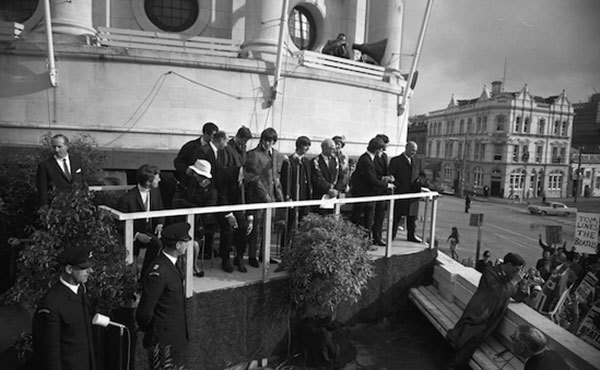
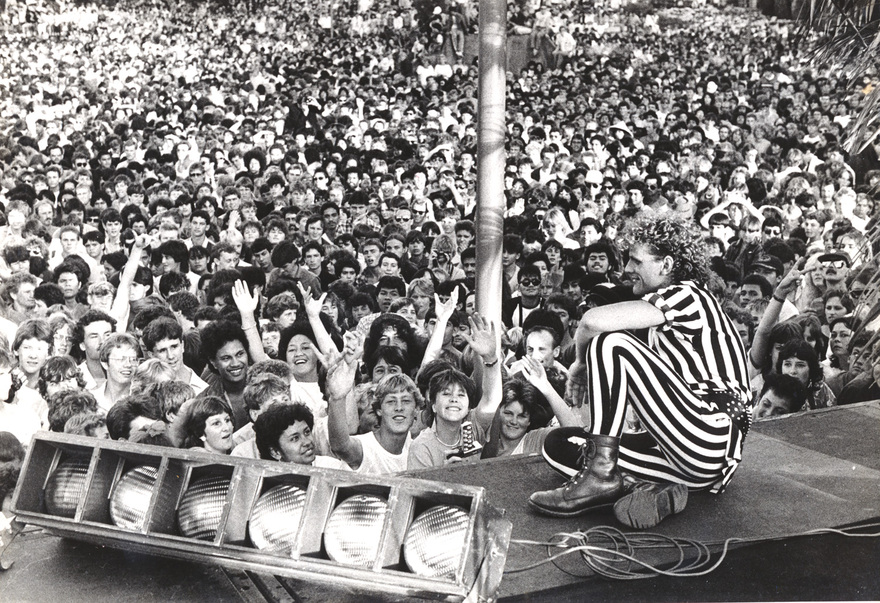
At the Beatles’ civic reception outside Auckland’s Town Hall in 1964 – how the councillors criticised Mayor Robbie for his generosity – one can glimpse the area now lost to Aotea Square. Out of sight are the 7000 fans who wagged school that morning. Instead, we spot the Market Hotel, one of many Edwardian corner pubs that are long since gone like the Vauxhall Velox seen cruising an almost empty street. Twenty years later, in the same area, a panoramic shot by Bryan Staff shows DD Smash’s drummer Peter Warren surveying a calm, peaceful crowd of thousands. The “Thank God It’s Friday” celebration to welcome the summer of 1984 will soon be renamed the Aotea Square riot.

The surprises often come from the unsung heroes who turn emotion into emulsion: the jobbing photographers rostered on for the day by a newspaper’s picture editor. At the Turnbull Library, saved from destruction, are gems from the files of deceased papers such as the Evening Post. These go beyond the requisite Maori welcome parties, the gimmick poses and the bland equivalents of rock stars kissing babies. Among the treasure are action shots of the Who, smashing their equipment on the Wellington’s Town Hall stage in 1968. Viv-Prince-from-natlib.govt.nz_thumbSomehow, the Pretty Things’ out-of-control drummer Viv Prince found time to sit for a formal portrait during the band’s notorious tour in 1965. He wears a woman’s leopard-skin hat, the coolest of rimless shades, chain bracelets of the style favoured by bodgies – and across his knuckles, a sticking plaster that testifies to his many scrapes while here.

As glamorous as some of the stars appear – the Temptations, stepping out in the 1970s’ finest flared suits; Roxy Music’s Bryan Ferry, elegant in herringbone tweed – it is the species Kiwi Rock Fan that makes these photos special. Invading the Rolling Stones’ stage in 1966 is an ecstatic fan, resplendent in homemade polka-dot mini skirt. Almost as gleeful are the navy-blue helmeted constables coming to Mick Jagger’s rescue.

Parked ostentatiously before the muslin-clad crowd waiting for Rod Stewart at Western Springs stadium in 1977 is a Ford Falcon emblazoned with Radio Hauraki’s logo. Beside it mooches a deejay in denim flares and manky long hair, while staff members or girlfriends attempt cool in satin jackets and bad posture. Their attitude: we are closer to the action than you.

StonesbyLloydGodman_thumb1The images also evoke the months of excitement that once came with the news that an overseas act was about to play “the Springs”. Long before the mammoth 1980s shows by David Bowie and ZZ Top, the Auckland speedway amphitheatre had hosted Little Richard, Elton John and Neil Diamond. For the first time we can see the Rolling Stones’ 1973 show in colour, thanks to a roll of film shot by Lloyd Godman. He didn’t need a flash – they played on a sunny afternoon – and it turns out that Jagger’s diamond-studded, low-cut, satin jumpsuit was turquoise.

Presented en masse, many of these shots have a “They walked this Earth” quality. They also answer the perennial question asked of visitors as they step off the plane: how do you find New Zealand? (It was apparently a wide-eyed Australian reporter who enquired “How many of you are there in your quartet, Mr Brubeck?”).

The Beatles look jubilant, although reports later came back that they described New Zealand as being like Britain, before the war. The Rolling Stones – specifically, Keith Richards – said of Invercargill it was “the arsehole of the World”. We remember these jibes, and almost more than the concerts we remember the interaction that these troubadours – grizzly or courteous – have with the locals.

Contrary to their surly reputation, in 1966 the Rolling Stones look cheerful, with their shirts off, enjoying the sun beside their Wellington motel swimming pool. The Guess Who play an après-gig jam at Tommy Adderley’s speakeasy Grandpa’s (sadly, no one was there to record the night in 1973 that Keith Richards turned up with a guitar and sundry other Rolling Stones).

Afterwards, when the litter has been cleared from the town halls and the paddocks that once hosted festivals, the anecdotes turn into urban legends. The Great Ngaruawahia Music Festival of 1973 is now remembered more for Corban Simpson’s nude performance than for headliners Black Sabbath headlining or the early appearance by Split Ends. Two years later, live on stage at the Te Rapa Racecourse, is Slade’s gormless Dave Hill; he is resplendent in an early mullet, a glitter-pasted forehead, a silver frock coat and platform boots. The promoter of this 1975 one-day festival – the cape-wearing Byron de Lacey – sounds almost mythological.

An Auckland school teacher friend says that every year – for nearly four decades – some 15-year-old aspiring guitar heroes in his class ask him the same question. “Sir, have you heard the Led Zeppelin song Stairway to Heaven?” Yes, he replies. “In fact, I heard them play it live at Western Springs in 1972 – before many of us had heard it on record.”

Really?” they gasp. “Led Zeppelin played ... here?”

*

The Viv Prince shot is from the Alexander Turnbull Library’s collection of Evening Post negatives. The reference number is EP/1965/3179.

07 April 2014

Firebird Suite

stravinsky nz1
When Stravinsky visited New Zealand in 1961, Tom Shanahan had something better than a front row seat. As a member of the NZ Symphony Orchestra, and a photographer, he wasn’t looking at Stravinsky’s back when he conducted the orchestra, but his face. Shanahan was sitting with the musicians, ready to play his trombone. Luckily he took his camera along as well, and took some much used photographs of the Russian composer at work in the Wellington Town Hall.

Music in NZ 1Shanahan was a very keen photographer, who captured many images of New Zealand’s cultural history over several decades. One photograph – of musicians taken from above – was used on the cover of the first issue of William Dart’s Music in New Zealand (left). But he also took thousands of others that weren’t about music, including a set covering the Springbok tour in 1981.

Now, many of those images and negatives have been lost due to the fire – suspected as arson – at the Kilbirnie self-storage unit on Saturday. They were about to be given to the Turnbull Library for safe-keeping and use by future historians; now they are just one of many sad stories left behind by the fire, which ripped through one floor of storage units, and damaged those on another with smoke and water.

stravinsky nz2There have been many pros and cons with the National Library and Turnbull’s shift to the digital age. The increased availability of its photograph collection at an affordable price is one of the best elements; the loss of the accessible books on the ground floor – most now need to be ordered from storage – is one of the most difficult to comprehend.

Last year the New Zealand branch of Fairfax sent millions of images to Arizona to be digitised by a private company. They will hold the originals, and digital copies will be able to be used worldwide. These images have been assembled from the newspapers that Fairfax has bought over the years, and are often the only tangible assets when the papers have later been closed down. The National Library was unable to reach Fairfax’s price. Luckily, before the desperation of media owners in the digital age, the newspaper company INL gave many of its images from the Evening Post and Dominion to the Turnbull before INL was bought by Fairfax. These photos can now be used at an affordable price, usually $20.

I worry about what’s happening to New Zealand’s other big archive of photos, that of the NZ Herald, Listener and many other publications, since they were bought by Bauer. Already these images had become difficult to access by historians, and at unaffordable prices. For example, in 2010 it cost $80 an hour to research a photo, and then $100 for the use of that photo in a book.

This has major implications for New Zealand historians: images of our culture are priced off the market. Authors pay for the images they use in a book, not publishers. So when an author is getting, say, $5 royalty on a $50 book, it will take 20 sales just to cover the cost of that single photo. What happens? The photo archives stay idle, unloved and badly treated by their proprietors.
It remains to be seen what the cost of accessing and reprinting a photo from Arizona will be.

Luckily a vast resource of historic images is being released on the net through social media. Their owners are only too happy to share the images, and some replicate those the publishing conglomerates are sitting on. (It’s understandable the companies protecting their copyrights, where legitimate, but often photos are given to them to use, but not returned; in some cases they were originally paid for by the taxpayer). But there is  nothing as safe as a public archive with its own programme of digitising to a high standard. And where the cost of usage isn’t prohibitive.

Both photos are by Tom Shanahan. The top image is from the NZ International Arts Festival website, the third image is from the NZSO’s website. It shows Stravinsky meeting members of the NZSO, among them the violinist and Holocaust survivor Clare Galambos Winter, on the right – the subject of an excellent biography by Sarah Gaitanos.
The NZSO website shares this anecdote by former principal clarinettist Alan Gold:
“When Stravinsky was here, conducting the end of part of Firebird, where the big chords are, he changed it, which was fine, we did it, and about 18 months later, we had another conductor doing the whole of Firebird, and when we got to the end of it, we played these chords short. The conductor, almost in despair, threw his baton down on his podium. “My God,” he said, “What are you doing that for? What jerk ever told you to play the thing like that?” And old Vince [Aspey – NZSO Concertmaster at the time] he just sat there and said, “Oh, it was some old Russian bugger called Igor, I think!”

31 January 2014

The envelope, please

In February 1984, Michael Jackson was primed to win big at the Grammys for Thriller, but had recently had an unfortunate accident – the first of a few, probably – during a video shoot for one of the album's many singles. His hair was set on fire, and it was uncertain that he would be able to attend. The Grammys were so unhip for so long that whenever they do get it right, it's a relief. They got it right with Lorde. Thirty years on from this story, I can understand why it took so long to shake off the feeling that it was for the old guard of the industry. anita kerrIn the Grammys for 1967 (for recordings of 1966), Sinatra won the best pop vocal, and the Anita Kerr Singers (left) best pop group vocal – the Beatles did get an award, but not for Revolver. Paul McCartney took the Best Contemporary (R&R) Vocal for 'Eleanor Rigby', which was something the old guard could understand. (Pet Sounds also missed out, though it could be said that its innovations were only innovations in rock’n’roll: great melodies aside, it was a pastiche of techniques that had been used in mainstream pop since the early 1950s.  Older Grammy voters could see that.)

For years the likes of the urbane CBS president Goddard Lieberson held court; they were still hoping that rock'n'roll would go away, and musicals would once again reign supreme, or real vocalists like Barbra Streisand. In 1966, rock’n’roll – and the Grammys – were only about 10 years old. (Were they set up as a counter-attack, and last stand of old values?) They even cut out the rock'n'roll category for 15 years after 1966. This year, I noticed the rock category was completely dominated by has-beens or "heritage acts" such as Led Zeppelin or Neil Young. Now, I don’t care that rock was being sidelined; it has no lien on quality, originality or sincerity. So three cheers for Lorde who, unlike Beyonce, didn't need to f*** in public to get attention, or over-act like the pod-person Taylor Swift, who looked like she was faking an orgasm in a bad movie.

How to Win a Grammy

MICHAEL JACKSON will be there. That’s the latest news from Hollywood. Jackson may have to borrow Frank Sinatra’s toupee, but it’s essential he appears at the 1984 Grammy Awards. There can be no show without Punch.

The music industry last year was dominated so effectively by Jackson that without him the show would be rather empty. As it is, this year’s Grammys will be similar to our own record awards last November, when Dave Dobbyn seemed to stroll away with every relevant award. Jackson is eligible for 12 Grammys, having received a record number of nominations.

The last time an act dominated the year’s music so overwhelmingly was in 1964, when the Beatles invaded America. Who won the Best New Artist Award? The Bach-scatting Swingle Singers. The Record of the Year was ‘The Girl from Ipanema’, but wait – it gets more perverse. The Best Rock and Roll Recording was not ‘She Loves You’ or ‘The House of the Rising Sun’ – but Petula Clark’s ‘Downtown’.

The Beatles did win a Grammy that year,for the Best Performance by a Vocal Group. Ironically, the song which won them the award was ‘A Hard Day’s Night’, in a year when the winner for Best Motion Picture Score was Mary Poppins.

In 1966, just as rock music began to have some bite again, Rock and Roll was dropped as a Grammy category. But as the American rock writer Dave Marsh points out, “the travesties picked from 1962 to 1966, when ‘Winchester Cathedral’ was one of the victors, made it obvious that the Best Rock and Roll slot was a fraud from the start.”

There was no Rock and Roll category again until 1979, when a tuxedoed Bob Dylan collected his first Grammy for ‘You Gotta Serve Somebody’ – a gospel song. But then, the only Grammys Elvis Presley ever won were for his gospel recordings. ‘How Great Thou Art’ won twice.

Marsh is one of those who believe the Grammy Awards have an anti-rock bias. The confusing thing is that though the cynical may think that sales would be the only criterion that counted – and whatever one may think of rock as music, it does sell – rock music has invariably been snubbed.

But there is another irony. Popular music tastes and these days the mass market in America demands a heavier sound. Some critics suggest that it was Michael Jackson’s use of heavy-metal guitarist Eddie Van Halen which helped him break through the virtual ban on black music on the FM stations and the all-rock cable TV channel MTV. With the greater exposure, Jackson’s album Thriller went on to sell an estimated 20 million copies.

The Grammys are voted for by the members of the National Academy of Recording Arts and Sciences (Naras). The voting system is questionable – only active members of Naras can vote, but they only have to be active in the industry at the time they join. From then on, as long as they pay their fees, they can vote. Block voting and the trading of votes is not uncommon. “Many record companies,” says Marsh, “vote in wholesale lots, without regard for quality. This problem is endemic to industry awards.”

Of course, conflicts of interest also arise. In 1975, Janis Ian led the nominations, being eligible for five awards – and the producer of her comeback album was a past president of Naras. Albums ignored that year included Bob Dylan’s Blood on the Tracks and Bruce Springsteen’s Born to Run.

But there is a lack of interest in the awards among the US music industry, because the Grammys don’t really mean very much. Being nominated for, or winning, an Oscar ensures that a rerun of the movie will make money, but a Grammy does not mean a retailer will push on of last year’s albums.

Sales figures are central to winning the Grammy, but equally important is the need to be recognisable to out-of-touch Naras members. As with any political election, in the end, voters may choose not on the issues, but for the name they recognise.

This is how Christopher Cross won five Grammys with his debut album in 1981. The album had already gone platinum (two million units sold) before the Grammys, but more importantly, Cross had covered the TV talk-show circuit – collecting “exposure” as any good candidate should.

Classical music gets similar treatment from the Grammys. Itzhak Perlman’s talents as a violinist are equalled by his skills as a candidate. Perlman, who has won several Grammys in the past, and has four nominations this year, is a veteran TV talk-show guest who even appears on Sesame Street. Classical critic William Anderson comments: “Naras members vote not for the things they have heard but for things they have heard of, and all too often in a field where they are less than knowledgeable.”

THIS YEAR, Michael Jackson has had more exposure and sales than anyone. But he leads a strong field: his main opponents are David Bowie, the Police, Billy Joel, Lionel Richie and the Flashdance soundtrack. At the American Music Awards, in January, Jackson collected seven awards, winning every category he entered but one. In an upset, Lionel Richie’s ‘All Night Long’  won the favourite soul single award.

Of the candidates for the Best New Artist, Culture Club is the most “recognisable” amongst Big Country, Eurythmics, Men Without Hats and Musical Youth.

But why have the Grammys? Says Dave Marsh: “The Grammys ought to bring some artistic recognition to a form and an industry all too often seen as shallow and corrupt. For much of the public, the Grammys establish popular music’s artistic reputation. Yet the Grammys continue to snub art whenever it rears its head.”

THE 1984 GRAMMY AWARDS, Friday on TWO, 6.30pm.

First published in the Listener, 10 March 1984. The Grammys get it right more often than they used to – sometimes because a broken clock is correct twice a day – though there are still anomalies such as this year’s rap award going to the Pat Boone duo of rap. It’s easy to mock: there are thousands of new releases each year, and – despite the number of categories, which was only recently cut from over 100 to about 75 – every year, some future classics will miss out. But there is a lot of fun to be had going back and forth through the years starting with these results from 1966. But one wonders really what the rock-blinkered Marsh was frothing at the mouth about: weren’t the acts he was championing supposed to be alternatives to the establishment? As David Hepworth pointed out this week, in reference to this year’s Hollywood Reporter school photo of high-profile Grammy acts, “I look at this Grammy Awards line-up picture & think of all the past greats who would have refused to do it.”

grammy2014.2

13 December 2013

Liverpool Kiss

Inevitably, interviewing George Melly was an unforgettable encounter. That’s why I suggested it to the Listener. We met at 10.00am, he ordered a gin and tonic, and he was away. His 1965 memoir Owning Up about his days in a 1950s UK jazz band is one of the great music memoirs, about the days of touring before the M1 was built, staying in dodgy B&Bs with Carry On landladies, pints and pints of beer, and apres-gig knees-ups beneath the canal bridge. The article below was written in 1990, when Melly was one of many unfashionable musical guests of the “International” Wellington festival of the arts. I mean, were they serious about inviting Max Bygraves? But Melly’s talents went beyond the trad jazz they hired hiim for.

Fifteen years later, in 2005, I saw Melly wandering through a leafy street in St John’s Wood, London, very near Abbey Road. Two years before his death, he was still in his pyjama suit, but seemed decrepit with his stick and eye patch. All his memoirs are great reading, evening the final one about his physical decline, Slowing Down. He was trisexual – try anything – and he certainly tried. Was the Daily Mail pic serious when it captioned this picture, “Despite his bed-hopping, George Melly was loved by jazz fans across the world.”?

Melly verticalBEING BORN in Liverpool, claimed one celebrated citizen, carries with it certain responsibilities. It also makes one a member of the Liverpool mafia, says George Melly. “You give a few signs, says ‘ ’ello thur wack!’ and you’re away at once. It’s a sort of Freemasonry by birth.”

Melly, jazz singer and scholar, art critic and popular culture essayist, raconteur and bon vivant, still feels the pull of his birthplace. Immediately after his appearance at the 1990 International Festival of the Arts in Wellington he was going back to judge an art competition in a brewery. And the Liverpool Polytechnic have just awarded him an honorary degree.

Are they trying to make the man in the pyjama-striped suit and fruit-salad tie respectable? He hopes not. “It’s a great difficulty not to slip into being embraced by the establishment as one gets older. However the recent scandal about one’s seduction of Peregrine Worsthorne helps keep respectability from the door!”

Melly chuckles with saucy delight. The revelations in the defamation case between London Newspaper editors were in fact old news. Both Melly and the Sunday Telegraph editor had already written about their teenage liaison in their autobiographies. “But it was useful evidence in [Sunday Times editor Andrew] Neil’s trial of Worsthorne. Because Neil could say, ‘How dare this man say I shouldn’t go out with a perfectly respectable call-girl, and give her a Magimix, when he himself has admitted in print that he was seduced by a jazz singer!?’”

Surely Melly’s confessional memoir Owning Up makes it harder to be a victim of the tabloids? “I daresay they could find things that would embarrass me,” he says. “But it’s much harder. It’s not like I always pretended to be a pillar of the church and the establishment. You can’t accuse somebody of something they’ve already admitted to themselves.”

Melly arrived in London in the early 1950s, after a stint in the navy (detailed in Rum, Bum and Concertina). Although this was before it became a “positive bonus” to come from the provinces, he didn’t have any trouble infiltrating the London art world and music scene. “Liverpudlians take it for granted that they’re going to amuse and charm everyone, even if they’re not.”

An ideological battle was going on between jazz fans at the time. One was either a revivalist or a trad jazzer, and one didn’t fraternise with the opposition. They argued over the cut-off point when jazz lost its “purity” – after it left New Orleans, or when big-band-swing came along? Meanwhile the UK beboppers, led by Ronnie Scott and Johnny Dankworth, and better musicians, according to Melly, interpreted the jazz of their own era.

“i was a revivalist, totally,” he says. “I thought bebop was the work of the devil. Ridiculous nonsense. Nowadays one hears it as just a development, it came out of what came before it.” In the mid-1950s with the arrival of Elvis, it looked as though jazz was doomed. “But somehow it staggered to its feet and produced its most banal and boring period, the trad boom of the late ’50s, which in turn was swept out of the way by the Beatles: beat music, as we called rock’n’roll.”

Melly is adept at giving a potted history of post-war British jazz, having witness its “death”, and revival, several times over. For the moment, he says, jazz is “extraordinarily chick” in London, even if it sounds like an accessory to fashion photography. Young black musicians like Courtenay Pine are stars, jazz has replaced rock on film soundtracks, and is used to advertise clothes and scent. “You see people in pseudo-Armani black clothes and pale expressionless faces listening to that form of jazz. I don’t know them very well, these types of people. I’m more likely to see them at art galleries than at a jazz concert.”

In the 1960s, Melly retired from singing and started to write. Revolt Into Style, his 1970 collection of essays on British popular culture, still reads well, relying on sober, informed analysis rather than dated hipness. The book almost predicts punk rock with its conclusion that pop was “temporarily done for”, having turned “pretentious and sour”.

For a recent new edition. all Melly added was an afterword saying that punk was the only exciting thing to have happened since. “But I said I was letting the book stand. As a consequence there are now what appear archaic references, and the word negro throughout, which now gives one a shock to read. But the word was respectable then – if I’d used black I would have been very unpopular. And now I believe ‘black’ is dying out and one has to say something cumbersome like Afro-American.

Melly returned to performing in the mid-1970s, with John Chilton’s Feetwarmers. “I still did it when people asked me, but they very infrequently did during the Beatles.” Ronnie Scott’s club gave them a residency because, he suspects, they attracted a crowd of young heavy drinkers, and the act became a cult. It was time to give up the day job. “We decided to go back on the road, we’d had a taste of it again. And it promised to be in rather more luxurious circumstances than hitherto. in the ’50s one led a very squalid life, which appeals to you when you’re young, but less so when you're middle-aged.”

Is performing still, as he once suggested, like seduction? “Yes, but I’m rather better at performing than seduction, I have to add. But it’s a similar process. I have an audience there who is a virgin every night, willing or unwilling. You come on stage and have to get them into a state where they’re saying ‘yes’ by the end. The similar may appal some people but I think it’s an accurate one – and for every performer, in whatever sphere. Playing the cello with an orchestra, acting Richard III, the audience has to be seduced.”

Melly 50sThough Melly’s blackface vocals can make Al Jolson seem like Ray Charles, his sincerity is unimpeachable. he is more an educator than interpreter, leading people to on to the originals. “I hope so,” he says. “Yesterday in this town somebody said, ‘I saw a concert you gave in England years ago and I went out and bought a Bessie Smith record, and I’ve still got it.’ If I’ve done that one in a thousand times …

“Of course, right from the start one questioned one’s right in black music. I did it at first because I so believed in it, and I’ve done it for so long I can’t give it up. And I must say what criticism I’ve had has always been from white critics. And I’ve sung with many black artists, none of whom have been anything but … kind.”

Melly’s love of 1920s jazz began at school, when he heard Muggsy Spanier’s ‘I Wish I Could Shimmy Like My Sister Kate’. “In between seducing Peregrine Worsthorne I was listening to this music,” he says. Then, the musicians were still in the entertainment business and consequently “produced a great deal of marvellous music because they weren’t self-consciously in pursuit of great art. There is high art, there is low art, and there is an awful lot of art which is pretentious, takes itself terribly seriously and produces nothing of lasting value.”

Bessie Smith is till his number-one singer. Next, he’d put “a whole lot of people in a row”: Ma Rainey, Jimmy Rushing, Joe Turner, Fats Waller, the “underrated” Ethel Waters, Bill Holiday. “There’s a big spectrum there, but Bessie – not even Billie has the same effect on me.”

However Melly no longer sings ‘Frankie and Johnny’ – the seduction requires too much energy. “One has to pretend to be shot – if possible fall off the stage, which is sometimes several feet high – leap to one’s feet and continue to sing, and so on. I don’t think I’d be able to do it more than once, and then with luck. So I dropped that many years ago.”

Another singer who made ‘Frankie and Johnny’ his own was Sam Cooke, who was shot in circumstances uncannily similar to those in the song Melly the scholar hasn’t considered this example of life following art. But if that’s the case, he say’s, “I’d prefer ‘Do You Want a Hot Dog in Your Roll’, which is a song I sing now, to come true than ‘Frankie and Johnny’.”

09 December 2013

Dreams to Remember

RY coverAt Stax Records the walls came tumbling down, twice. The first collapse of the legendary Memphis label began in December 1967, when Otis Redding’s sudden death was quickly followed by Stax’s separation from its distributor, Atlantic Records of New York. The death of Redding took out the label’s biggest solo star, while still in his ascendancy. The split with Atlantic didn’t just remove Sam & Dave from its books – the dynamic duo had only been “loaned” to Stax by Atlantic – it removed Stax’s entire back catalogue from its books. A hidden clause in Atlantic’s distribution contract said that ownership of the masters was vested in them, although Stax had made and paid for the recordings.

Another event in 1968 damaged the culture of Stax irrevocably. The murder of Martin Luther King in Memphis at the Lorraine Motel – a location that was one of the few to welcome visiting black musicians – altered the racial harmony that had existed at the label from the beginning. In a city where racism and segregation – both official and entrenched – survived long after the civil rights breakthroughs elsewhere, Stax was an integrated oasis. RY BT MGIt is crucially important to the Stax story that its house band Booker T and the MGs (right) was a “mixed crowd”. Booker T was the quartet’s black, teenage keyboard prodigy; drummer Al Jackson its black, metronomic groove master; Steve Cropper a white, quiffed C&W-influenced guitarist; and providing the fluid bottom-end came from Donald “Duck” Dunn, an amiable white bass player.

The death of MLK and the racial mores and tension in Memphis are crucial to the Stax story. In Robert Gordon’s rich, absorbing new history of the label, Respect Yourself: Stax Records and the Soul Explosion (Boomsbury USA), the issue of race is like a bad-ass backing vocal against the two-part harmony in the forefront: the music and business angles. Stax has been well covered over the years; dominating the work of Stax scholars and obsessives worldwide are Peter Guralnick’s moving, wide-ranging Sweet Soul Music, and Canadian musicologist Rob Bowman’s exhaustive Soulsville. But in Respect Yourself, you can taste the grits.

Gordon is a Memphian, who has been writing and directing documentaries about local music for nearly 30 years. He connects with the way musicians work and live, and he is also a superb story teller. Respect Yourself is the book he has been writing in the back of his mind since he first picked up a pen, producing two other classics in the meantime. It Came From Memphis (1994) was mostly about the city’s alternative rock scenes of the 1960s and 1970s, with Elvis and Stax barely mentioned, and Can’t Be Satisfied (2002) was an atmospheric, sensitive biography of Muddy Waters. Like Guralnick at a similar stage, Gordon has now produced a trilogy that evocatively recreates the culture in which American popular music was re-invented and heard worldwide.

Reeling from the blows it took in 1968 after Redding died, Stax quickly rebuilt itself under the new management of the visionary, risk-taking black entrepreneur Al Bell. His first task was to create an instant catalogue by recording and releasing 28 new albums simultaneously in an extravagant marketing gesture called the Soul Explosion. Extravagance soon became a byword at Stax, which had been founded by Jim Stewart and his sister Estelle Axton, two sensible, generous-hearted, white, small town music lovers. The frugality of Stewart’s approach is captured in the waste-free backings that Booker T and the MGs provided to the label’s first wave of recordings.

That extravagance was exemplified by the solo career of Isaac Hayes, Stax’s biggest star in the flamboyant Bell years. For Hayes (below), who first made his name as a Stax songwriter and producer, mostly for Sam & Dave, it meant recording albums with tracks that lasted nearly 20 minutes, wearing gold chain mail and little else as stage costumes, and driving a gold Cadillac, gifted to him in gratitude by Stax.

RY isaacPimp my wheels doesn’t begin to capture the swagger of the Shaft era, but does hint at another element of the story: the gangster-like behaviour of Johnny Baylor, a black hustler Bell hired to make sure distributors paid their bills and radio DJs played their records. Baylor, who likely put on a gun before his underwear, and his henchman Dino Woodard seem to be characters out of a Blaxploitation movie: they worked in entertainment, they had a great soundtrack, but their actions were deeply sinister.

It was Baylor who brought the walls of Stax tumbling down for the second time, when his bags were searched at Memphis airport, because of an unrelated bomb threat. Inside his bag were stacks of greenbacks, totalling more than $129,000. This alerted the FBI and IRD on to Stax: they were suspicious of the legitimacy of the money, and of other shadowy practices at the Southern, black-owned, independent company. Over the next couple of years Stax inexorably came apart, when debts to its local bank – itself a shaky, dodgy institution – were called in, and many were found to be fraudulent thanks to a bank employee taking backhanders. By 1976 the doors of Stax’s famous studio on McLemore Avenue were padlocked by armed guards, its publishing assets and master tapes taken by receivers. The label has since been sold several times, but is now in good hands at Concord Records, and thanks to revivals spurred by tributes such as The Blues Brothers and The Commitments movies, countless cover versions, and mostly the sheer strength of the back catalogue, the music Stax made has never been forgotten.

What makes Gordon’s book the best yet on this story – which is familiar to aficionados, but unknown to the millions who love the hits – is his identification with the musicians, their characters, and the community from which they sprung. So too is his use of the Memphis Sanitation workers’ strike of 1968 as a parallel story to relate just how pervasive and enduring racism and segregation was in the city.

Guralnick laid the groundwork in 1985 with Sweet Soul Music, which also covered other aspects of soul which didn’t emanate from Memphis (ie James Brown, Muscle Shoals). Bowman’s verbose, earthbound epic made one’s eyes water from the detail, and lacked the flair to move a reader from the armchair to the turntable. (Soulsville has a new purpose now as a book-length series of footnotes adding information about incidents to Gordon’s fast-paced, yet thorough, story-telling.)

RY estelleThanks to Gordon’s skill, the humanity of the characters comes through: Jim Stewart as the sober founder, out of his depth; his sister Estelle Axton – the hero of the book – whose open-mindedness welcomed talented black youths inside the studio; the dignified prodigy Booker T; the reliable Steve Cropper; the brilliant if flawed Al Bell. There is a sense of foreboding as the story unfolds: Stax is like a rollercoaster that sails through social and business barriers, taking risks at every corner, then builds up speed so that inevitably gravity comes knocking, in the guise of a hooded taxman and bank auditor. Gordon gets the sense of community and family that were essential to Stax’s success, and describes music making with just the right amount of colour and knowledge that while reading one is transported to the dance floor. Above: Jim Stewart and Estelle Axton.

Gordon has been interviewing the participants for almost 30 years, some of them for the 2007 Stax documentary Respect Yourself, which he co-directed. While the acknowledgements and suggestions of further reading and listening are helpful, I could have done with more precise information in the appendix about exactly who he interviewed, rather than general attributions to, say, Guralnick, who was one of several people who provided Gordon transcripts of their own interviews with key players. (Dead or alive, the interviewees are all quoted in the present tense.)* Also, the occasional subjective quip – which increase as the story continues – can sometimes intrude.

RY WexL-R: Jerry Wexler, Sam & Dave, Al Bell.

Gordon is understandably sceptical about Atlantic executive Jerry Wexler’s protestations of innocence in the saga of the company’s ruthless contract with Stax, but this could have been examined further. Wexler brought the incident up moments after Gordon began his interview with an innocent question, which is interpreted as “he protesteth too much”. Wexler could also have been racked with guilt, and haunted by the clause decades later. He was known as hard-nosed but always respected as a music man, not a suit: he could well have been oblivious to it. In his own biography, Wexler uses almost exactly the same words as he said to Gordon, and names Paul Marshall as the Atlantic lawyer responsible for the master-grabbing clause in fine print neither party had read. Also, there is a mention of Wexler asking Jim Stewart if he was interested in Aretha Franklin, whose contract at Columbia was about to finish. $25,000 was too much for Stax, so Atlantic signed her directly. I am unconvinced that Wexler would be so coldblooded towards the small Memphis label, whose musical and personal style he so admired, that he would suggest this while knowing of the hidden clause.

That small niggle aside, even when the business story of Stax begins to dominate the racial, political, and most importantly the musical angles, Respect Yourself is an exhilarating, often heart-breaking history. It will satisfy Stax aficionados and the newly converted, and does justice to the story by providing a context to the miracle of Memphis – and by opening up the music itself, like a re-mix editor looking for a hidden hook in the original multi-track tapes.

When I first visited Memphis, on an overnight stopover in 1988, I asked a white taxi driver where we were in relation to Stax. “Sex?” he said. “You want sex?” It was mainly my accent (in Georgia, asking for a Beck’s beer, after much confusion I was offered a Bax) but the confusion typified the disinterest that mainstream Memphis had in its local success story. One of the most gratifying elements of Gordon’s book is the conclusion, which suggests this disdain – much of it a product of institutional and inbuilt racism – has now evaporated. In the wake of Elvis’s death and the tourism dollars generated by Graceland, a new respect has been granted Stax. But the positive ending isn’t about filling motel rooms, it’s in keeping with the spirit of the label. The Stax Museum of American Soul Music – its premises a replica of the studio, on the original site – now contributes enormously to the community with its music and education programmes. This street-level activity proves to the neighbourhood children, whose grandparents once danced outside the doors of the studio, that music will not just help take you there, but to respect yourself.

* Update – apparently more expanded footnotes are to appear on Robert Gordon’s website, alongside some pure musical gold he rescued when visiting the Stax building as it was demolished: a stash of reel-to-reel tapes, featuring jam sessions by Booker T and the MGs, radio stings, etc.

Visit the Memphis Music Hall of Fame website for many rare pictures and links to audio interviews and video clips. The Stax Museum also has many video clips. Here is a Spotify playlist of 252 songs mentioned in the book, compiled by Jim Higgins of Milwaukee.

Finally, a word from our sponsor, Rufus Thomas.

19 October 2013

Celtic Swing

The cancelled Neon Picnic festival of January 1988 had one good spinoff – the amount of copy it generated for Rip It Up (even if I am still $200 out of pocket for hiring a caravan for the magazine’s campsite). I interviewed Roy Orbison, Murray Cammick interviewed Nona Hendryx, and Kerry Buchanan tried to talk to James Brown. Although Orbison died shortly after I talked with him, especially memorable was an interview I did with Philip Chevron of the Pogues. While the rest of the band was on tour, he was at home with an ulcer, and handling the interviews. He turned out to be exceptionally articulate and knowledgeable about the history of Irish pop music. Besides the courteous closing line – the idea had simply never occurred to me – for years I have been quoting his line about the boorish Irish expatriates and wannabes who appear around the world on St Patrick’s Day: “We’re a bit more subtle about our Irishness over here.” 

Sadly, Phil Chevon has recently died, of oesophageal cancer, aged 56. Contrary to the Pogues image, he was a well-read, historically minded, highly astute musician, and quite philosophical. Shortly before his death he said, “I am a gay, Irish, Catholic, alcoholic, Pogue who is about to die from cancer – and don’t think I don’t know it.” 

Along with Bob Geldof, the Pogues were one of the few acts that made it to New Zealand for the Neon Picnic. With so many people in Auckland to attend the festival that never happened, the Pogues’ gig at the Galaxy was packed to the ceiling with an audience that had already been partying all weekend. MacGowan won few friends among the audience for his slurred, out-of-it performance, and even fewer backstage where he insisted on limitless supplies of white wine and go-fast.

THE IRISH are plagued by ignorant stereotypes, but they know how to have a good time— I can personally recommend their funerals.

Sunday night is certain to be hoedown night at Neon Picnic, with the Pogues and Los Lobos on the same bill. Both bands have brought a contemporary edge and spirit to sounds that reach back over generations, and both bands know how to move the soul and the feet.

The Pogues are currently in New York, filming a video for their new single ‘Fairy Tale of New York.’ Then they tour the East Coast and Canada, finishing up at the Hollywood Palladium as guests of their friends Los Lobos.

chevron sepiaBut one Pogue who has stayed home in London is guitarist Philip Chevron. “I’ve had to stay behind because I’ve had a recurring duodenal ulcer which I need treat­ment for. But I’m feeling a bit better now,” he says.

Filling in for Chevron in North America is Joe Strummer. Last year the Clash singer and the Pogues starred, together with Elvis Costello, Grace Jones and Dennis Hopper, in Straight to Hell, a spoof spaghetti western by Sid and Nancy director Alex Cox. It re­ceived mixed reviews...

“Well I liked it!” laughs Chevron. “It was great fun to make, basically our annual summer holiday which we filmed and then forced on people in cinemas... no, it was a lot of hard work actually.”

Chevron joined the Pogues temporarily in 1985 before Rum Sodomy and the Lash – when their banjo player Jem Finer nee­ded a rest. “I liked it so much I stayed, well they invited me to.” Prior to that, he was in the seminal punk combo Radiators from Space. “We were the only punk band in Ireland, so we were quite well known for a while.” The Rad­iators, who had “terrible trouble” battling with an Australian outfit of the same name, made two albums, and Chevron has made two solo LPs, one produced by Elvis Costello.

A LOT IS MADE of the Pogues’ punk origins, with Finer and mil­lion-dollar smile Shane MacGowan being part of the Nipple Erectors. But through the Pogues’ concertina player Terry Woods, who helped form Steeleye Span, there are links back to an earlier era when traditional music was popular:

“There’s a long gap between that folk rock and us,” says Chevron. “Very early Steeleye Span were very good and adven­turous, as were early Horslips and early Fairport Convention. But somewhere along the line something went wrong and it got more rock than folk, and the two el­ements didn’t blend very well.

“I think it took another few years before the vital ingredient came along to make it work, and that was punk rock. That had the same sort of energy that Irish folk music has. It said, stop taking it seriously ’cause it’s supposed to be fun. Stop sticking your finger in your ear.”

And the respected Irish singer Christy Moore approves: he cove­red a song of the Radiators in the late 1970s, and the Pogues’ ‘A Pair of Brown Eyes’ on his latest album. “Christy always had a good ear for what’s going on, it doesn’t matter which strand of music of music it comes from. It was quite a radical thing to do then for a performer like Christy Moore to record what on the surface looked like a punk rock song. And to have him record ‘A Pair of Brown Eyes’ was like a progression of that.

“Because the Radiators, although they never ended up sounding like the Pogues, their attitude was similar in that they were using the long standing tradition of Irish ballad writing, and playing it a different way, with an upfront energy and force, but re­specting the tradition.”

Chevron says that when he grew up in Dublin, traditional Irish music was “shoved down my throat, and I hated it. It was part of the same misguided government policy which shoved the Irish lan­guage and sport down people’s throats, to the point that all you could do was vomit it back up again. That’s the wrong way to in­terest people.

“It took till that attitude cooled off a bit – for me it was a band called the Horslips, an Irish band in the 70s, who said, well fuck that, we’re gonna make this music sound like fun again. That had a big influence on me, it made it sound exciting again, and for my generation, kindled for the first time a love for Irish music.

“Now things are more relaxed, and they don’t force music or the language on you, so it’s easier to appreciate. Though there still pur­ists who despise what we do. But there will always be those people, always.”

pogues

ALONG WITH U2, the Pogues are known throughout Ireland. But Chevron stresses that only three members of the eight Pogues are actually Irish. “We’re a London band, all based there except for Terry who still lives in Ireland. But in London, there’s a very strong Irish music thing there in the Irish pubs. So that’s where a lot of the Pogues’ Irish music comes from, for the people who weren’t actu­ally born in Ireland.

“But we’ve been adopted as an Irish band in Ireland. Irish people are very proud of people who be­come internationally successful, particularly if they wear their Irish-ness on their sleeves.”

Irish pub bands play in the back­ground, “they wouldn’t have their jobs very long if they did what we do,” says Chevron. “But a lot of what those bands play, country and Irish, has some bearing on the Pogues. ‘A Pair of Brown Eyes’ is in that sort of mode, an Irish waltz. The pub bands play in that spirit – only we play it with a great deal more feeling than they would!”

The Irish immigrants to America had a large influence on early country music. “And therefore rock ‘n’ roll, so it’s very integral to the way rock music turned out,” says Chevron. “It’s amazing it’s taken so long for Irish music to be this popular internationally.”

Now the Pogues (particularly in their version of ‘Jesse James’ on RSL) reflect the way country has flowed back across the Atlantic. But the links go further: ‘London Girl’ thumps along with the zydeco rhythms of Louisiana. With Los Lobos, the Pogues have brought the accordion back into favour:

“Yeah – it’s been a very under­rated instrument until recently. Someone like William Schimmel who plays accordian with Tom Waits is brilliant. There are people who are using the accordian in an intelligent way these days. For a long time it had a justifiably terrible reputation.”

THE “Irish ravers” image of the Pogues has tended to obscure the fact that the band is full of ex­cellent musicians. Shane MacGowan has done the bulk of the writing, though on the new LP If I Should Fall From Grace With God various members of the band con­tribute. “Shane’s songs are pretty hard to beat – they have to be pretty shit hot to better him.

“Songs are everything. That’s one thing that unites us. With eight people in the band, there are lots of different influences and pre­ferences. But we all have got great respect for the songs. The art is the songs, which I think has become grossly devalued and debased over the past few years. We’ve got production and market­ing and so on, and the songs seem to have got lost. I’ve always regret­ted that.”

It’s been two years since Rum, Sodomy and the Lash. “We’ve had a lot of problems with our record company, and it’s taken this long to iron them out. We’ve had the album recorded for quite a while, but we weren’t prepared to let them release it except on our terms. That’s been a source of great frustration for us. We’ve been playing the stuff off the album for quite a while, but it helps if people know what you’re play­ing. And the band is very prolific, we write a helluva lot of material, so it’s frustrating not being able to record it and get on with the next one. However it’s been worth the wait.”

Fall From Grace has been prod­uced by Steve Lillywhite, and Chevron is enthusiastic about his approach:

“Without knocking anyone else who has produced the band, they haven’t really been producers but musicians. Steve Lillywhite’s a real producer, and it’s a different discipline from being a musician, you think differently. This time the album was pretty much recorded live in the studio. We added some colouring to it afterwards, but the essence of each track is live.

“Steve Lillywhite captured that, he didn’t impose anything on us at all, he was brilliant. He’s probably the best producer in the world — apart from his technical brilliance, he knows how to get the perform­ance out of people. That’s what a producer should do. He hasn’t done anything to the sound that isn’t us, he’s listened very care­fully to what we do and translated it onto vinyl. So it won’t sound like a Steve Lillywhite record, but like a Pogues record. I was so full of admiration for the man, on every level. He was easy going, intelli­gent, imaginative.”

NEVERTHELESS, the production work Elvis Costello did on RSL and the sublime EP Poguetry in Motion seemed sympathetic to the band.

“Yeah, to some extent, but actu­ally it was on that EP that things came to a head. ’Cause we had to argue for a lot of things that we felt were right, and he didn’t. So our working relationship with him sou­red a little bit during that. In the end we more or less got what we wanted, but we felt, it’s really stupid to have to argue with your producer about what you should sound like. There are one or two things on that EP that, quite frankly, he had a lot less to do with than his credit would suggest. Because we went away and re-did certain things after he’d finished.

“But Elvis is a nice man, he’s a nice man to work with, but our working relationship with him came to an end there ’cause we were thinking differently about our sound. We had ambitions about our sound that Elvis felt weren’t really in keeping with what the Pogues should be doing. Our feel­ing was, well fuck that, ’cause we’re the Pogues, and we know what we should be doing! I think he was a bit nervous about ex­perimentation. But around the time we made Rum, Sodomy, he was in tune with our ideas.

“You see, people don’t always give the Pogues credit for inven­tion or imagination or musical know-how really, and Elvis was slightly guilty of that in the end, I think. But we’ve never been as we’re popularly imagined. We’ve always been as ambitious music­ally as the circumstances would allow, and now they allow us to be as adventurous as we want. At the time of Poguetry in Motion it was in a state of transition. So it wasn’t en­tirely Elvis’s fault. I don’t want to blame him for it. It was a natural period of transition.”

The Pogues’ music has the ability to cross over to any audi­ence, from fans of a garage sound, country or folk, to Gaelic grandmothers.

“Maybe it’s a lot to do with the eclecticism of the band,” says Chevron. “Irish music is very strong, but that’s only a part. There’s country, but on the new album it’ll be obvious there’re bits of jazz, Spanish music, Eastern folk music, ’60s rock — there’s a lot going on there.

“So it’s gratifying that people who just love music love what we do. Because we obviously love music, and I think that comes ac­ross in what we play. There’s so much music that you hear now on the radio that seems so loveless, it sounds as if the people who made it don’t really care about it, maybe they care more about their haircut or their bank balance.”

The Pogues supported U2 on many of the Joshua Tree dates, including Madison Square Gar­den. “There are people who would have us playing small pubs in London forever,” says Chevron. “But the nice thing about what we do is it seems to translate to huge audiences. We still manage to make it seem intimate. We really enjoy stadiums, but also enjoy playing small places, like recently we did a short tour of Ireland, play­ing in dance halls and large clubs. It was great fun.”

chevron1THE BAND HAS made a tradi­tion, though, of returning to London each year to play St Patrick’s Day in a small venue. But now it’s a problem: “As we get bigger, St Patrick’s Day has ten­ded to become extended be­cause not everyone can see us. We could go and do Wembley Arena and cover most people, but what we’re doing, which is nicer, is we’re gonna have St Patrick’s Week – playing six shows at the Town and Country, holding 2000 people. St Patrick’s Week with the Pogues.”

Perhaps you could stain the river green, like they do in Chicago.

“I think we’ll leave that to the Americans, actually – we’re a bit more subtle about our Irishness over here.

“The further you get away from a country, the more you celebrate your nationality, if you’re an immi­grant. Sometimes it’s emb­arrassing, but I can understand it, ‘cause if you take this country where the Irish, alongside the Scottish, are still ... curiosities as citizens. Irish people over here are regarded by English people as one step above Asians and blacks and so on, which is all of course inherent racism. But in those circumstances where a nat­ional identity is sublimated, well then I think a slightly ... kitsch el­ement comes out. You have to show your national identity a bit louder than you would in your own country. So I don’t really knock that sort of thing.

“You have a lot of us over there, and a lot of us in America. There’s a song about it on the new album: ‘Thousands are Sailing.’ The economy isn’t there to sustain the population, unfortunately. The song links the new immigration with the mass immigration of the 19th Century potato famine. People are leaving at the rate of 30,000 a year, I believe, which is a lot in a population of three million.”

But despite the dispersion for­ced by economics, music from the likes of the Pogues and Los Lobos means cultural identities are not forgotten, but celebrated. A last word from Philip Chevron:
“... Thanks very much for not asking us about drinking.”

There is also an excellent obituary of Chevron in the London Independent. Before his death, the Irish Daily Mail published a long interview with him. Page 1.. Page 2. Page 3. Page 4.