Showing posts with label photography. Show all posts

02 December 2014

Bumper Christmas Retro Music Edition

1. Song Mining
Dylan by Elliott LandyI recently interviewed Greil Marcus about his book The History of Rock’n’Roll in Ten Songs (it can be heard at Radio New Zealand's website here). With the imminent release of The Complete Basement Tapes – six CDs, well over 100 songs that Dylan wrote while woodshedding with the Band in 1967 – I had to ask about them. I wondered whether – now that the sessions were finally seeing daylight – this would change the public’s fascination with them. Marcus’s response shows that his fascination with the Basement Tapes hasn’t dimmed since he wrote a whole book on the sessions, Invisible Republic, in 1997:
You know there’s a lot of material – there’s 30 something songs – that have never been heard before, that haven’t been bootlegged or leaked out, song by song, on Dylan’s own Bootleg Series. Certainly there’s stuff I never heard before. And what’s fascinating about it, in the context of the whole set – which I think is going to start this conversation all over again – is you know how down-to-earth and ordinary and ah, work-like a lot of the stuff is.
The [phrase] that leapt to mind when I was listening to the stuff that I hadn’t heard before was “song mining”. These people are digging into what look like songs but they aren’t really. And you just keep digging to see if you find something in there that will explain itself, that will say, ‘No! No! Go in this direction, not that direction’ Really digging in the ground, and finding a root, and grabbing onto that root and thinking, ‘Well this root must lead somewhere, and maybe you find where it leads and maybe you don’t. These are people mining for songs.
And I think that when people listen to all of this material – and its 140 tracks – they’re going to be fascinated by the way that fragments and cover versions of songs that weren’t that interesting to begin with, and experiments that really don’t go anywhere, surround these songs that seem like gifts from the Gods. It’s going to make the whole question of creation, of creativity and writing, and playing and improvising, even more mysterious than it already is.
In some ways the mystique of the Basement Tapes I think is going to be washed away – replaced by the spectre of a bunch of people getting together every day to fool around – in a clubhouse, in a kind of boy’s club.
On the other hand you can say, Well okay, but where did this stuff come from. My God: ‘Tears of Rage’, ‘I Shall Be Released’, ‘This Wheel’s on Fire’ … did some visitation come down and strike these people with lightning, and then go away and leave them to play with ordinary hands – as they weren’t doing for a few weeks?
I don’t know. But I love the way there is stuff here that is mediocre, that is second rate, and stuff that seems like junk – it sounds bad and it’s very hard to hear – and has flashes in it that are as strong and as disturbing as anything in the formal masterpieces that these sessions produced.
So I think you can tell by the way I’m answering that I don’t know. That I don’t know how to answer your question. That it’s as if you have to learn how to start listening to the stuff as if you’ve never heard it before. And see what story it tells.
2. His Back Pages
At last, a one-stop shop of Greil Marcus’s archives: articles, interviews and reviews, regularly updated. It was a very smart idea to compile a series of links to all the songs in his “Treasure Island” of essential discs Marcus added to Stranded, the 1979 anthology he edited in which music writers wrote about their “desert island disc”. (The essays by Lester Bangs on Astral Weeks, and M Marks on It’s Too Late to Stop Now are unsurpassed. Bangs’s masterpiece aside, one of the best reviews of Astral Weeks I ever heard was from an older woman who just said, “You breathe in, you breathe out, you breathe in, you breathe out.”)
3. Writer’s block
Of the six artists featured in Marcus’s 1975 classic Mystery Train (Harmonica Frank, Robert Johnson, the Band, Sly Stone, Randy Newman and Elvis Presley) only Newman’s career seems to have continue, rather than ended with pathos. Still, the exposure didn’t come without a cost to his productivity. In 1983 – I think in San Francisco’s BAM magazine – Newman said:
When I’m writing songs, the minutes are like hours – I sit there with nothing, just a big picture of Greil Marcus in my mind hanging over the piano as I think, ‘Ah, I don’t think this guy is gonna like this one, because I’m doing the same stuff he criticised me for before.
Marcus’s response? “You know, anybody who reads something I’ve written and comes back and tells me something about it that I didn’t know – that’s a valuable a reader as I can ever hope to have. And that’s happened with musicians and people who aren’t musicians. I really can't talk about other people’s reactions to my work, at least not positive reactions, it just comes off as self-congratulation. I’m lucky that I’ve been able to write, to find people to publish me, and to find people who read me. So that’s all I can say.”
4. Country gentlemen mystique
Speaking of the Band, I stumbled upon these 1969 reviews from the Village Voice of the Band live at the Fillmore, and of their second album. The writer, Johanna Schier, has a charming straightforward style, with a wry wit, a talent for an apt metaphor – and musical insights. (Though she describes Robbie Robertson on stage as “sweetly bashful”, she also hears Smokey Robinson in the chorus of ‘I Shall Be Released’). Schier soon befriended Janis Joplin, and with her future husband John Hall wrote ‘Holy Moon’, the b-side of ‘Me and Bobby McGee’. The pair then founded the group Orleans.
5. Ballad of a Teenage Queen
JLL1We have heard a lot from Jerry Lee Lewis over the years, especially about rock’n’roll and the Devil, but little from his child bride, Myra. At last, she breaks her silence. “They were looking for a place to stick the knife into rock & roll. And Jerry gave it to them—well, I did, I opened my mouth.”
6. Click track
From David Hepworth, a link to a batch of classic Motown hits with the vocals removed. I know, that seems criminal, but it is so illuminating to be able to concentrate on the Funk Brothers.
7. Down the avenue again
Van Morrison’s paranoia about YouTube seems to have dissipated. Three extraordinary, lengthy clips have recently been added to the site, without legal intervention thus far. The legendary It’s Too Late to Stop Now 1973 shows at London’s Rainbow were broadcast by TVNZ later in the 1970s on The Grunt Machine and talked about for years; a high-def version has been up for a while. Now, two other full-length concerts from the same period are online. At Winterland in February 1974, in B&W, the band is his usual combo from “Street Choir” period – also featured at the Rainbow, but lacking the string quartet. With a completely different – and integrated – band, but several of the same songs, he can be seen in full colour at the Orphanage, San Francisco in July 1974 (note the presence of Tom Donahue, the deep-throated influence on all FM rock jocks). Both feature Morrison’s ‘Caravan’ can-can schtick. Perhaps best of all is this 10-minute clip from the Fillmore East in September 1970, introduced by Bill Graham: maybe the earliest filmed version of his ‘Cyprus Avenue’ tease. As a taster to the Winterland gig, here he is covering Dylan’s ‘Just Like a Woman’.

8. Funky, funny and fun
More back pages: here is how the Victoria University of Wellington’s student newspaper Salient reviewed Abbey Road in 1969. Mike Bergin described the medley of songs on side two as “a mess”, whereas that was the only passage Nik Cohn liked in his New York Times review. But Bergin showed a lot of promise in this and other reviews; sadly, he died not long afterwards in a car accident.
9. Back to the Island
In July, Glenn Jowitt – one of New Zealand’s greatest photographers – died suddenly. He was mourned in Auckland by about 400 of his closest friends in a moving, multi-cultural ceremony. The NZ Herald asked me to write an obituary.
10. Take the Coltrane
A crucial influence on Glenn was the expatriate New York photographer Larence Shustak, who taught him at Ilam School of Fine Arts in Christchurch in the mid-1970s. Glenn was a dedicated music fan and an enthusiastic guitarist (in the 70s he even looked like his hero, Gram Parsons). A connection he had with Shustak that I never knew until researching for the obituary: in the 1950s Shustak took many compelling shots of New York jazz musicians.
11. A little bit frightening
Musical racism 101: ‘Kung Fu Fighting’, or how to express the whole of Asia in just nine notes. No, not the lyrics – which are bad enough – the influence of the arrangement has been even more pervasive, reports NPR.

11 November 2014

Close Encounters

Originally published in the NZ Listener in November 2010.

ROCK MUSICIANS AND photographers are natural-born partners: show-offs need an audience, and a Nikon lens loves a show-off. For some photographers, like Auckland’s Bruce Jarvis, the scent of the hunt has been a life-long quest. Shooting first as fans, many become professionals, and Jarvis’s tenacity at capturing live shows secured him access that today’s photographers can only envy.

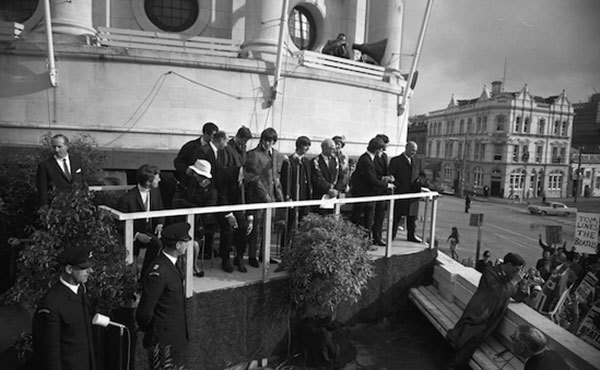
Jarvis’s work is the backbone of a large-format book Live: Gigs that Rocked New Zealand, that portrays the flamboyant visitors in our midst. From the first international rock’n’roll tour – Johnny Cash and Gene Vincent, in 1959 – to Lady Gaga’s aerobic fashion-show earlier this year, the performers are freeze-framed at the peak of their careers. Some of the images – such as ZappaJarvis_thumb1Jarvis’s portraits of a satanic Frank Zappa, an exultant Bob Marley – belong in the rock photo hall of fame. But even more than the performers, it is the settings that resonate. In the background, a vanished New Zealand hovers like a vaguely remembered backdrop.

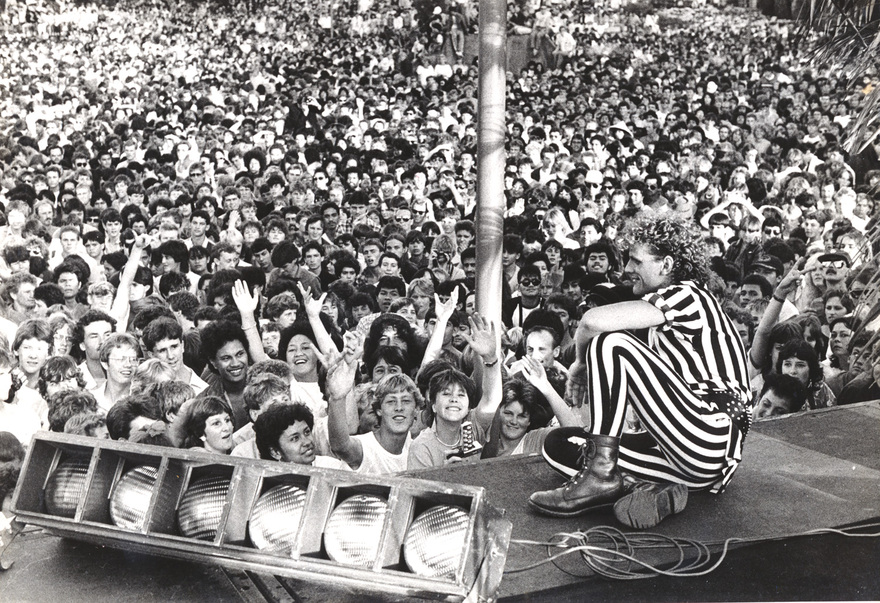
At the Beatles’ civic reception outside Auckland’s Town Hall in 1964 – how the councillors criticised Mayor Robbie for his generosity – one can glimpse the area now lost to Aotea Square. Out of sight are the 7000 fans who wagged school that morning. Instead, we spot the Market Hotel, one of many Edwardian corner pubs that are long since gone like the Vauxhall Velox seen cruising an almost empty street. Twenty years later, in the same area, a panoramic shot by Bryan Staff shows DD Smash’s drummer Peter Warren surveying a calm, peaceful crowd of thousands. The “Thank God It’s Friday” celebration to welcome the summer of 1984 will soon be renamed the Aotea Square riot.

The surprises often come from the unsung heroes who turn emotion into emulsion: the jobbing photographers rostered on for the day by a newspaper’s picture editor. At the Turnbull Library, saved from destruction, are gems from the files of deceased papers such as the Evening Post. These go beyond the requisite Maori welcome parties, the gimmick poses and the bland equivalents of rock stars kissing babies. Among the treasure are action shots of the Who, smashing their equipment on the Wellington’s Town Hall stage in 1968. Viv-Prince-from-natlib.govt.nz_thumbSomehow, the Pretty Things’ out-of-control drummer Viv Prince found time to sit for a formal portrait during the band’s notorious tour in 1965. He wears a woman’s leopard-skin hat, the coolest of rimless shades, chain bracelets of the style favoured by bodgies – and across his knuckles, a sticking plaster that testifies to his many scrapes while here.

As glamorous as some of the stars appear – the Temptations, stepping out in the 1970s’ finest flared suits; Roxy Music’s Bryan Ferry, elegant in herringbone tweed – it is the species Kiwi Rock Fan that makes these photos special. Invading the Rolling Stones’ stage in 1966 is an ecstatic fan, resplendent in homemade polka-dot mini skirt. Almost as gleeful are the navy-blue helmeted constables coming to Mick Jagger’s rescue.

Parked ostentatiously before the muslin-clad crowd waiting for Rod Stewart at Western Springs stadium in 1977 is a Ford Falcon emblazoned with Radio Hauraki’s logo. Beside it mooches a deejay in denim flares and manky long hair, while staff members or girlfriends attempt cool in satin jackets and bad posture. Their attitude: we are closer to the action than you.

StonesbyLloydGodman_thumb1The images also evoke the months of excitement that once came with the news that an overseas act was about to play “the Springs”. Long before the mammoth 1980s shows by David Bowie and ZZ Top, the Auckland speedway amphitheatre had hosted Little Richard, Elton John and Neil Diamond. For the first time we can see the Rolling Stones’ 1973 show in colour, thanks to a roll of film shot by Lloyd Godman. He didn’t need a flash – they played on a sunny afternoon – and it turns out that Jagger’s diamond-studded, low-cut, satin jumpsuit was turquoise.

Presented en masse, many of these shots have a “They walked this Earth” quality. They also answer the perennial question asked of visitors as they step off the plane: how do you find New Zealand? (It was apparently a wide-eyed Australian reporter who enquired “How many of you are there in your quartet, Mr Brubeck?”).

The Beatles look jubilant, although reports later came back that they described New Zealand as being like Britain, before the war. The Rolling Stones – specifically, Keith Richards – said of Invercargill it was “the arsehole of the World”. We remember these jibes, and almost more than the concerts we remember the interaction that these troubadours – grizzly or courteous – have with the locals.

Contrary to their surly reputation, in 1966 the Rolling Stones look cheerful, with their shirts off, enjoying the sun beside their Wellington motel swimming pool. The Guess Who play an après-gig jam at Tommy Adderley’s speakeasy Grandpa’s (sadly, no one was there to record the night in 1973 that Keith Richards turned up with a guitar and sundry other Rolling Stones).

Afterwards, when the litter has been cleared from the town halls and the paddocks that once hosted festivals, the anecdotes turn into urban legends. The Great Ngaruawahia Music Festival of 1973 is now remembered more for Corban Simpson’s nude performance than for headliners Black Sabbath headlining or the early appearance by Split Ends. Two years later, live on stage at the Te Rapa Racecourse, is Slade’s gormless Dave Hill; he is resplendent in an early mullet, a glitter-pasted forehead, a silver frock coat and platform boots. The promoter of this 1975 one-day festival – the cape-wearing Byron de Lacey – sounds almost mythological.

An Auckland school teacher friend says that every year – for nearly four decades – some 15-year-old aspiring guitar heroes in his class ask him the same question. “Sir, have you heard the Led Zeppelin song Stairway to Heaven?” Yes, he replies. “In fact, I heard them play it live at Western Springs in 1972 – before many of us had heard it on record.”

Really?” they gasp. “Led Zeppelin played ... here?”

*

The Viv Prince shot is from the Alexander Turnbull Library’s collection of Evening Post negatives. The reference number is EP/1965/3179.

07 April 2014

Firebird Suite

stravinsky nz1
When Stravinsky visited New Zealand in 1961, Tom Shanahan had something better than a front row seat. As a member of the NZ Symphony Orchestra, and a photographer, he wasn’t looking at Stravinsky’s back when he conducted the orchestra, but his face. Shanahan was sitting with the musicians, ready to play his trombone. Luckily he took his camera along as well, and took some much used photographs of the Russian composer at work in the Wellington Town Hall.

Music in NZ 1Shanahan was a very keen photographer, who captured many images of New Zealand’s cultural history over several decades. One photograph – of musicians taken from above – was used on the cover of the first issue of William Dart’s Music in New Zealand (left). But he also took thousands of others that weren’t about music, including a set covering the Springbok tour in 1981.

Now, many of those images and negatives have been lost due to the fire – suspected as arson – at the Kilbirnie self-storage unit on Saturday. They were about to be given to the Turnbull Library for safe-keeping and use by future historians; now they are just one of many sad stories left behind by the fire, which ripped through one floor of storage units, and damaged those on another with smoke and water.

stravinsky nz2There have been many pros and cons with the National Library and Turnbull’s shift to the digital age. The increased availability of its photograph collection at an affordable price is one of the best elements; the loss of the accessible books on the ground floor – most now need to be ordered from storage – is one of the most difficult to comprehend.

Last year the New Zealand branch of Fairfax sent millions of images to Arizona to be digitised by a private company. They will hold the originals, and digital copies will be able to be used worldwide. These images have been assembled from the newspapers that Fairfax has bought over the years, and are often the only tangible assets when the papers have later been closed down. The National Library was unable to reach Fairfax’s price. Luckily, before the desperation of media owners in the digital age, the newspaper company INL gave many of its images from the Evening Post and Dominion to the Turnbull before INL was bought by Fairfax. These photos can now be used at an affordable price, usually $20.

I worry about what’s happening to New Zealand’s other big archive of photos, that of the NZ Herald, Listener and many other publications, since they were bought by Bauer. Already these images had become difficult to access by historians, and at unaffordable prices. For example, in 2010 it cost $80 an hour to research a photo, and then $100 for the use of that photo in a book.

This has major implications for New Zealand historians: images of our culture are priced off the market. Authors pay for the images they use in a book, not publishers. So when an author is getting, say, $5 royalty on a $50 book, it will take 20 sales just to cover the cost of that single photo. What happens? The photo archives stay idle, unloved and badly treated by their proprietors.
It remains to be seen what the cost of accessing and reprinting a photo from Arizona will be.

Luckily a vast resource of historic images is being released on the net through social media. Their owners are only too happy to share the images, and some replicate those the publishing conglomerates are sitting on. (It’s understandable the companies protecting their copyrights, where legitimate, but often photos are given to them to use, but not returned; in some cases they were originally paid for by the taxpayer). But there is  nothing as safe as a public archive with its own programme of digitising to a high standard. And where the cost of usage isn’t prohibitive.

Both photos are by Tom Shanahan. The top image is from the NZ International Arts Festival website, the third image is from the NZSO’s website. It shows Stravinsky meeting members of the NZSO, among them the violinist and Holocaust survivor Clare Galambos Winter, on the right – the subject of an excellent biography by Sarah Gaitanos.
The NZSO website shares this anecdote by former principal clarinettist Alan Gold:
“When Stravinsky was here, conducting the end of part of Firebird, where the big chords are, he changed it, which was fine, we did it, and about 18 months later, we had another conductor doing the whole of Firebird, and when we got to the end of it, we played these chords short. The conductor, almost in despair, threw his baton down on his podium. “My God,” he said, “What are you doing that for? What jerk ever told you to play the thing like that?” And old Vince [Aspey – NZSO Concertmaster at the time] he just sat there and said, “Oh, it was some old Russian bugger called Igor, I think!”

04 February 2012

Indoor Outdoor Flow

One room shack, NOTalk about a one-room shack. A New Orleans dwelling, c1959, from Frederic Ramsey Jr’s Been Here and Gone, a lyrical photo journey through the American South (Cassell, 1960).

The book shows “the men and women who have created work songs, spirituals, blues and jazz”, with Ramsey’s lens creating a distancing goldfish bowl as he romanticises “the other” on Catfish Row.

15 July 2011

F-Stop Fitzgerald

Haley-ElvisIn the 1950s a Cleveland radio DJ called Tommy Edwards – not the singer of ‘It’s All In the Game’ – took colour photographs of stars and aspirant stars who came to his station or gigs he promoted. At a time when there was no colour TV and very little colour printing in pop mags, they were of such interest that he used to have slide shows of his snaps between sets. Arlene-Fontana

The photographs have been collected in a book, 1950s Radio in Color. Many of them can be viewed at the Collector’s Weekly site, in a piece headlined “When Rock Lost its Innocence”. Though I don’t think there’s too much innocent about this shot of Elvis, seen here before he started dying his hair black, with Bill Haley, or the teen temptress Arlene Fontana (right).

More lost photos can be found here, of the Rolling Stones’ portrait sessions for Sticky Fingers, and here, of the Beatles’ US tours in 1965-66.

Monitor: Word

21 March 2008

Magnum Opus

In the history of photo-journalism, John G Morris has been involved in almost as many classic images as Kodak. Although his contribution has been outside the viewfinder, many of the pictures that have spoken loudest have had Morris’s thumbprint on the contact sheet. Robert Capa’s blurred GI bobbing above the waves at Omaha Beach is the most famous image from the D-Day landings; Morris was Life magazine’s London photo editor when the undeveloped films arrived from Normandy.

The two most unforgettable images from Vietnam are Ernie Adams’s startling moment-of-execution in a Saigon street, and Huynh Cong Ut’s shocking photo of a naked Vietnamese girl running down a track, in agony after a napalm attack. Morris was the New York Times photo editor that convinced the paper to run the pictures on its front page. He modestly says the question with Adams’s execution image was not Should we run it? It was How big? And he recalls the editors’ relief that
the naked girl in the napalm picture was so young, otherwise the photo would never have been published. Both images won the Pulitzer Prize; more importantly, they helped turn public opinion against the Vietnam war.

Morris is keenly aware of the impact photo-journalism can have. He managed the legendary photo-agency Magnum in its early years, and was photo-editor at the New York Times and Washington Post during the tumultuous 1960s, when image after image entered the history books long after the newspapers lined bird cages. The 1968 assassination of Martin Luther King was followed only weeks later by that of Robert F Kennedy; the latter event gave Morris his only front-page byline of the New York Times. He happened to be in the Los Angeles hotel when Kennedy was shot, and filed his report. In the next two years, pictures would arrive of Neil Armstrong walking on the moon, of Teddy Kennedy’s car submerged at Chappaquiddick, and of the student killings at Kent State. Morris oversaw the images that were to go with the Times’ “Pentagon Papers” scoop, only to see the lengthy text run without illustration, and probably to lesser effect.

Now 90 and a retired American in Paris – a city which can still be regarded as the home base of photo-journalism – Morris pinpoints the difference between photographers in World War Two and the current conflict in Iraq. “Let’s face it, [in the Second World War] we were propagandists. The American and Allied press was not neutral, we were fighting the war and we were an instrument of propaganda.” Hence the job involved self-censorship, even before news copy and photos went through official channels for approval: injured or dead Allied combatants were rarely photographed, and neither were images that may contain useful information (unit badges on uniforms, technical equipment, weaponry). Even photographers such as Capa avoided taking these pictures because they knew they would not be published.

In Iraq, there is also an agenda taking place, says Morris: “There are so many on our side who believe the war in Iraq was unjustified that a lot of people are happy to see it photographed in all its horror.” He compares the lack of images of casualties in Iraq – of either side, but especially American soldiers – with the experience of Life’s Ralph Morse, who photographed a cover story of an injured soldier, following from his wounding in the battlefield, through treatment in field hospitals to his arrival back home.

“Photographers refrained from photographing the most gruesome aspects of war, and perhaps avoided that too much. In recent wars, photo coverage has become more realistic. David Duncan’s pictures of the Korean War showed American forces in retreat: his photos were very realistic and very tragic, too. In the Vietnam War the photos were even more realistic, from people like Larry Burrows but many others as well. The standards of what gets published have loosened up as wars have gone on.”

We met in 2005 at the Frontline Club in Paddington, a London retreat for war correspondents, photographers and film crew. The glass cases showing bloodied maps, destroyed flak jackets and cameras that weren’t bullet proof testify to the dangers endured by the club members and their need to mingle when not in the field. In a black cab ride across London to the Institute of Contemporary Arts for a seminar on war photography, Morris’s anecdotes continued. The ICA was founded by Roland Penrose, husband of Lee Miller – Man Ray’s muse and a war photographer herself, known for her early shots of the liberated concentration camps. Arriving at the ICA, we were greeted by another legendary photo-journalist, Philip Jones Griffiths, whose 1971 book Vietnam Inc. would be the most famous collection from that war.

In London during the Second World War, Morris befriended George Silk, New Zealand’s most celebrated war photographer. Silk was offered a job on Life for one image, in which a Papua New Guinean leads a blind Australian soldier to safety, and later concentrated on sports and stop-motion photography. (Morris was also on the interview panel when New Zealander Brian Brake applied for membership at Magnum.)

We began by talking about George Silk. They first met during the war when Silk was hired by Life magazine, where Morris was assistant editor to the picture editor, in New York. “George was hired on the basis of one remarkable photo he’d taken of a Papuan native walking with a blinded soldier across the mountains of New Guinea. It was a powerful picture and I think Life used it as the picture of the week.

“Then I got to know him better when he came to London several months after D-Day. He’d been in the Italian theatre after covering the action in North Africa. He photographed the Italian front in colour, which was very seldom used at Life, because at Life it took six weeks to close a colour page so we didn’t do it often.


“George more or less experimented with colour in battle in Italy. That was one of very few colour reportages that Life ever published during the war. Then he came to London I guess about October 1944, after the liberation of Paris.
“After the war he became a specialist in sports photography and developed techniques which were really quite special. He opened the camera and got sense of motion, and also did multiple exposures.”

It is easy to forget now the impact that the weekly Life magazine had around the world.
(Life magazine cover, from 12 June 1964, by Larry Burrows.)

“In the days before television Life magazine was the evidence that America existed, and it was the most prestigious place for a photographer to appear, any photo-journalist. We really had no competition among the magazines: Look was a picture magazine but it closed two or three weeks in advance, whereas we closed on a Saturday night and the magazine appeared the following week. Look would appear two or three weeks later, or normally six weeks. So when Pearl Harbour happened, which was on a Sunday, Look came out for at least one more issue without any reference to the war whatever.”

During wartime, photo editors must balance questions of news values, security and taste. But their role changed between the Second World War and Vietnam.

“The most serious questions of taste are those that arise over the coverage of war, because life and death is so serious. We had to submit everything to censors in the Second World War if it was taken in combat areas. There was no censorship domestically of the magazine. But anything taken in a war theatre had to be censored. Here the censorship was done at the Ministry of Information, mostly English and Canadian censors at work. Every photograph I wanted to send back to the states, every negative, had to be printed four times proof -print size, 5x7: one print for us, one for London censors, one for Washington censors and one print for Life and they would get the negative itself.

“The photographers normally avoided shooting pictures that they knew would be censored. For example the faces of the American dead would have been censored. The shoulder patches that designated military units were censored. Secret weapons were censored: there were fewer and fewer secret weapons as the war went on, but the Norden bombsight for example was something one could not photograph. It was used for precision bombing, a sensor placed in the nose of an aircraft. Norden was the trade name of the manufacturer. Once a picture of the Norden bombsight got through the censors somehow and caused some problems: that’s the kind of thing.

“Photographers also refrained from photographing the most gruesome aspects of war and perhaps avoided that too much. In recent wars, as war has gone on – I was going to say progressed, but I don’t regard it as progression – photo coverage became more realistic with the Korean pictures. David Duncan’s pictures of Korean War that really showed American forces in retreat. His photos of the marines in the Korean War were very realistic indeed, very tragic too. And then in the Vietnam War the photo coverage was very realistic also. Larry Burrows did great work but many others did great reporting in the Vietnam War – some of that got published.

“The standards of what gets published have loosened up as wars have gone on. And I have a slide for example, of the front of the Guardian that shows a photo taken by Jerome Delay of AP in Baghdad the day of the shelling of the Palestine Hotel in Baghdad when two journalists were killed. An event that is taken very seriously by the journalistic community. Jerome Delay is a French photographer, he was there and was one of those who carried the wounded – he carried the Reuters cameraman out of the hotel to the hospital. He was so upset by this he continued photographing in the hospital, and his colour photo of body parts, of Allied action – when I say Allied action, it’s really American action – appeared on the front of the Guardian. But that’s not very likely in the US.”

There was an element of self-censorship in the Second World War - not just what couldn't be shown, but what wouldn't - because of patriotism.

“Let’s face it, we were propagandists – the American and Allied press was not neutral, we were fighting the war and were an instrument of propaganda. There is such feeling on both sides, so many on our side who believe the war in Iraq was unjustified that a lot of people are happy to see it photographed in all its horror.”

The US government has imposed restrictions on showing the bodies of US soldiers killed in Iraq. Have you discussed this with any of your former colleagues?

“I’ve only talked with the New York Times and International Herald-Tribune. I was picture editor of the New York Times from 1967 to 1974, then I started New York Time Pictures, and I’ve been in touch ever since and have known every managing editor for last 40 years.

“So I’m known there as one who has broken the bounds in stages. I was picture editor of the Times when the famous Eddie Adams pic of an execution of a prisoner in Saigon came over the wire. And at the time I was determined that the picture be used because it was a shocking picture. I also remember the picture of the little naked girl running from the napalm. And I remember the discussion of that at the time. The news editor to whom I presented it was so relieved that she showed no pubic hair because that would have created a problem. Retouching used to be done consistently on genitals and breasts and things of that sort [for taste and also to get clearer reproduction]. Now retouching is easier to do electronically. My first newspaper job in June 1964 was at the Washington Post, they had never had an executive picture editor over the picture desk and photographers. The art department was three men devoted to retouching photos to make them look better. Mostly they made them worse.”

The New York Times published the "Pentagon Papers", but now must be frustrated by the restrictions in Iraq imposed by the military.

“The ‘Pentagon Papers’ was a journalistic triumph. I was asked by Abe Rosenthal, the managing editor of the New York Times, to take a man off my desk to work for a month on the ‘Pentagon Papers’. I wasn’t told why he was being detached. He systematically worked at illustrating the ‘Pentagon Papers’, then when time came to publish, the publisher got worried about the cost of so many extra pages and cut the space allotment so severely that very few pictures got used.

“And I think that’s one reason the ‘Pentagon Papers’ never got through to the general public. They did have an importance in terms of the government, especially: Nixon was furious. They may have had some affect in our strategic posture, but the ‘Pentagon Papers’ were a professional success and a public nothing. One of the reasons, I’m afraid, was that they weren’t properly illustrated.

The casualties aren't being shown in Iraq.

“We still tend to use photographs in ways that favour our side. One of the remarkable things about the Jerome Delay pic was that it showed Iraqi casualties. In the Second World War it was simple, we didn’t show enemy casualties – we simply didn’t show the terrible things we did to them. [There was] a shipment of pics that came from Stockholm to London that showed the horrible effects of the night air raids on Berlin – stacks of bodies – and the censors took them away from me and wouldn’t even let me keep them.”

Can you comment on the effects on photographers of working in these combat zones, of getting in close, having a job to do, while remaining detached.

“One never tells a photographer who’s going into danger how to do it. That’s a decision each person has to make for himself. Picture editors have three basic functions: assignment, collection and usage. Very few picture editors have the ultimate decision as to what runs. They have an advisory function. But at the New York Times and Washington Post I reported directly to the managing editor, so I had direct input into what ran on page one, which is the most sensitive page on a newspaper.”

They also have the function of offering moral support to the photographers.

“The responsibility for photographers’ lives is a serious one but one you don’t talk about very much. You get men who are courageous enough to go, you just tell ’em to go, and let them worry. But I did try to stop Robert Capa from going to Vietnam; I had a bad feeling about that. I had hoped he would turn down the offer from Life, but he didn’t. I telephoned him and urged him not to go.

“By now I’ve lost a number of photographers. We were very lucky at Life in the Second World War: out of the whole war, Life lost two reporters but no photographers. It’s gotten a lot worse.

Robert Capa had an extraordinary work ethic – his two most famous pictures speak for his whole career. It doesn’t matter that the D-Day pics are blurry. He had that saying, “If your pictures aren’t good enough, you’re not close enough.”

Just a few days ago Richard Whelan [the biographer of Capa] sent me a letter that had been written to him concerning a soldier who Robert Capa photographed on Omaha Beach – in that case one of the films that was lost, because according to this soldier’s account, he was wounded and Capa actually assisted him. Robert Capa never mentioned that incident, and we’re not sure it’s true – but there is some evidence that Robert Capa put down his camera and assisted a wounded man on Omaha Beach. which is interesting.

Eugene Smith was one who paid the price of getting too close.

“Smith also believed in taking risks and ultimately was severely wounded on Okinawa because he did. His assignment was 24 hours in the day of an infantry man, and in the process of that he got wounded.

“Ralph Morse did a cover story for Life on a man who was wounded in France, he photographed him immediately after he was wounded, and followed him all the way back through the healing, through field stations and then back home. That was a memorable cover story for Life.

Why do you think the first photographs showing the extent of the holocaust didn’t make much impact?

The camps were on the Eastern front, finally when the Americans advanced in Germany we got into the camps. Margaret Bourke-White probably made the single strongest photo of the liberation of prisoners, plus Johnny Florea was at Norhausen, and George Rodger at Belsen. All these pictures were in Life but by then it was too late.

Rodger’s pictures were very strong, stomach turning. He resolved he was never going to photograph war again after that experience, it was horrible. But the very first pictures that reflected the Holocaust came from the East, from the Soviet side, there was no credit to any one photographer. The only [early] photographs published in the West were in the Illustrated London News, and maybe one page in Life magazine.

What characteristics does a person have to have to constantly deal in conflict or disaster: do they have to have more than just a steely nature?

“That’s a tough question, there so many different kind of people among photographers. [They need a] sense of rapport among people. Henri Cartier-Bresson and Robert Capa were very good friends but totally different approaches to photographing people. Henri never spoke to people, he just photographed them, whereas Robert Capa engaged people, that was his way. He advised other photographers to like people – and to let them know it. That was a nice quote. Henri Cartier-Bresson, unless he was doing a portrait, would never speak to people. He’d just be the silent observer.

John G Morris’s Get the Picture: A Personal History of Photojournalism (University of Chicago Press, 2002) is absolutely riveting, with many stories behind some of history’s most famous images. Among them is the heartbreaking story of how all but 11 images from Robert Capa’s D-Day on Omaha Beach were destroyed in a processing accident. Morris’ memoir can be read on-line or bought second-hand.

Sadly, the news arrived this week that Philip Jones Griffiths - the other legend of photojournalism I met that day, a wry, affable and dedicated Welshman - died of cancer on March 18.


12 March 2008

Still Life

Once you have seen this photo, you never forget it. Ernie Adams was the photographer, and he took it 40 years ago last month, as the Tet offensive was underway in the Vietnam War. It shows South-Vietnamese General Nguyan Ngoc executing a member of the Vietcong in the streets of Saigon, without a trial.

This picture, along with a handful of others from that war, changed history. It helped swing the attitude of the American people against the war.

It may be in black-and-white, but the issues are far more complex than were perceived at the time. In fact the discussion has got more heated since, as shown by a fascinating, heated debate at the London Times last month. Their headline was:

Which of these men did the photographer think was a hero?

Adams regretted the damage it did to General Ngoc’s reputation. The victim was far from innocent, but the publication of the photo had the opposite effect to what either shooter – executioner or photographer – intended. When combined with famous images such as the naked napalm child, the Vietnam War looked indefensible.

By contrast, Robert Capa’s images of D-Day, blurry as they are, showed the dedication and sacrifice of those landing on Omaha Beach. No one complained, though there have been decades of debate and misinformation about another famous image by Capa, the “falling soldier” shot (in both senses) during the Spanish Civil War in 1936.

For years there have been sceptics saying that the photo was posed. The most prominent among the sceptics is Phillip Knightley, author of the highly regarded book The First Casualty: From the Crimea to Vietnam, the War Correspondent as Hero, Propagandist, and Myth Maker, almost a voluntary set-text among journalists since it came out in 1975.

When evidence was produced in 1998 that suggested otherwise, and identified the soldier as Federico Borrell García, who had indeed died in the battle, Knightley stood his ground: “The famous photograph is almost certainly a fake – Capa posed it,” he said. And, petulantly, “Frederico could have posed for the photograph before he was killed.”

Since then, the author of the definitive biography of Capa, Richard Whelan, has gone to extraordinary lengths to prove the photo’s veracity. This essay tells the whole story; Whelan even gets a police forensic photographer to examine the “pose”.

And if that wasn’t enough, just last month a suitcase full of undeveloped negatives by Capa was discovered. It shows the before and after images of the “falling soldier”. The New York Times turned it into a slide-show so that we can decide. Those who have read Phillip Knightley’s autobiography A Hack’s Progress tell me it’s a great read. But he hasn’t responded to the evidence about the “falling soldier” photo. Zealots have right on their side, so are never wrong. Ask John Pilger or Michael Moore.

These are the best of times and the worst of times in photo-journalism. Never before have so many great images been shot. But it is harder than ever for those images to have the kind of impact that Adams’ execution shot did in 1968.

The photo journalism is out there – all over the web, in lavish photo-galleries and slide-shows – but is rarely on our front pages. These days, the napalm or execution photos would only be seen by those who sought them out, rather than being chosen by astute photo editors to make an immediate impact.

I despair when I see quality magazines that once championed photo journalism now making do with endless bland images from agencies. The publishers are tight-fisted, so the photo librarians cut corners: there are plenty of gritty agency shots that aren’t “posed by models). The result is a vanilla magazine, from cover to back page. TIME may be a shadow of its former self, but it still makes an effort on all fronts.

Impulse buyers in the supermarket may be more interested in stories that change their cholesterol than their intellect. But free newspaper colour supplements are where hard news can be presented with great design, without affecting newsstand sales. We don’t take the opportunity here; instead proprietors are more interested in editorial that flows nicely around cosmetics ads.

But New Zealand has punched above its weight in photo-journalism, not just historic figures such as Brian Brake, George Silk and Robin Morrison, but contemporary photographers such as Glenn Jowitt, Bruce Connew, Jocelyn Carlin and John McDermott: photographers who don't emulate Vanity Fair.

There are dozens of courses in photography in New Zealand, and plenty of role models. But with the disinterest from the publishing industry, are these students being conned out of their money? Where are the jobs?

(More on this soon, including an encounter with a legendary photo-editor and friend of Capa's. The pop-art RFK cover is a graphic rather than a photo, but brilliantly shows his upward ascent in the primaries. Obama's rise reminded me of it. But the RFK-related TIME cover two weeks later, in June 1968, was equally unforgettable: it showed a handgun.)