Showing posts with label books. Show all posts

11 November 2014

Close Encounters

Originally published in the NZ Listener in November 2010.

ROCK MUSICIANS AND photographers are natural-born partners: show-offs need an audience, and a Nikon lens loves a show-off. For some photographers, like Auckland’s Bruce Jarvis, the scent of the hunt has been a life-long quest. Shooting first as fans, many become professionals, and Jarvis’s tenacity at capturing live shows secured him access that today’s photographers can only envy.

Jarvis’s work is the backbone of a large-format book Live: Gigs that Rocked New Zealand, that portrays the flamboyant visitors in our midst. From the first international rock’n’roll tour – Johnny Cash and Gene Vincent, in 1959 – to Lady Gaga’s aerobic fashion-show earlier this year, the performers are freeze-framed at the peak of their careers. Some of the images – such as ZappaJarvis_thumb1Jarvis’s portraits of a satanic Frank Zappa, an exultant Bob Marley – belong in the rock photo hall of fame. But even more than the performers, it is the settings that resonate. In the background, a vanished New Zealand hovers like a vaguely remembered backdrop.

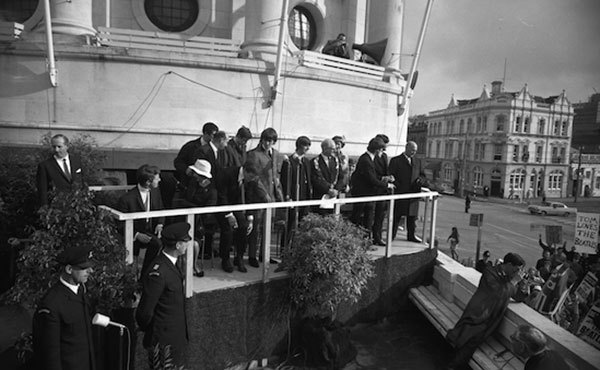
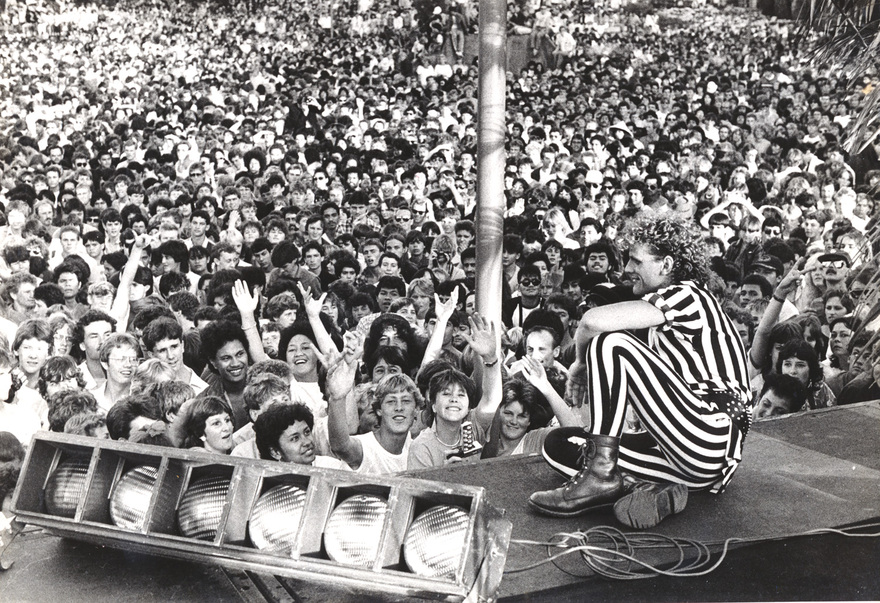
At the Beatles’ civic reception outside Auckland’s Town Hall in 1964 – how the councillors criticised Mayor Robbie for his generosity – one can glimpse the area now lost to Aotea Square. Out of sight are the 7000 fans who wagged school that morning. Instead, we spot the Market Hotel, one of many Edwardian corner pubs that are long since gone like the Vauxhall Velox seen cruising an almost empty street. Twenty years later, in the same area, a panoramic shot by Bryan Staff shows DD Smash’s drummer Peter Warren surveying a calm, peaceful crowd of thousands. The “Thank God It’s Friday” celebration to welcome the summer of 1984 will soon be renamed the Aotea Square riot.

The surprises often come from the unsung heroes who turn emotion into emulsion: the jobbing photographers rostered on for the day by a newspaper’s picture editor. At the Turnbull Library, saved from destruction, are gems from the files of deceased papers such as the Evening Post. These go beyond the requisite Maori welcome parties, the gimmick poses and the bland equivalents of rock stars kissing babies. Among the treasure are action shots of the Who, smashing their equipment on the Wellington’s Town Hall stage in 1968. Viv-Prince-from-natlib.govt.nz_thumbSomehow, the Pretty Things’ out-of-control drummer Viv Prince found time to sit for a formal portrait during the band’s notorious tour in 1965. He wears a woman’s leopard-skin hat, the coolest of rimless shades, chain bracelets of the style favoured by bodgies – and across his knuckles, a sticking plaster that testifies to his many scrapes while here.

As glamorous as some of the stars appear – the Temptations, stepping out in the 1970s’ finest flared suits; Roxy Music’s Bryan Ferry, elegant in herringbone tweed – it is the species Kiwi Rock Fan that makes these photos special. Invading the Rolling Stones’ stage in 1966 is an ecstatic fan, resplendent in homemade polka-dot mini skirt. Almost as gleeful are the navy-blue helmeted constables coming to Mick Jagger’s rescue.

Parked ostentatiously before the muslin-clad crowd waiting for Rod Stewart at Western Springs stadium in 1977 is a Ford Falcon emblazoned with Radio Hauraki’s logo. Beside it mooches a deejay in denim flares and manky long hair, while staff members or girlfriends attempt cool in satin jackets and bad posture. Their attitude: we are closer to the action than you.

StonesbyLloydGodman_thumb1The images also evoke the months of excitement that once came with the news that an overseas act was about to play “the Springs”. Long before the mammoth 1980s shows by David Bowie and ZZ Top, the Auckland speedway amphitheatre had hosted Little Richard, Elton John and Neil Diamond. For the first time we can see the Rolling Stones’ 1973 show in colour, thanks to a roll of film shot by Lloyd Godman. He didn’t need a flash – they played on a sunny afternoon – and it turns out that Jagger’s diamond-studded, low-cut, satin jumpsuit was turquoise.

Presented en masse, many of these shots have a “They walked this Earth” quality. They also answer the perennial question asked of visitors as they step off the plane: how do you find New Zealand? (It was apparently a wide-eyed Australian reporter who enquired “How many of you are there in your quartet, Mr Brubeck?”).

The Beatles look jubilant, although reports later came back that they described New Zealand as being like Britain, before the war. The Rolling Stones – specifically, Keith Richards – said of Invercargill it was “the arsehole of the World”. We remember these jibes, and almost more than the concerts we remember the interaction that these troubadours – grizzly or courteous – have with the locals.

Contrary to their surly reputation, in 1966 the Rolling Stones look cheerful, with their shirts off, enjoying the sun beside their Wellington motel swimming pool. The Guess Who play an après-gig jam at Tommy Adderley’s speakeasy Grandpa’s (sadly, no one was there to record the night in 1973 that Keith Richards turned up with a guitar and sundry other Rolling Stones).

Afterwards, when the litter has been cleared from the town halls and the paddocks that once hosted festivals, the anecdotes turn into urban legends. The Great Ngaruawahia Music Festival of 1973 is now remembered more for Corban Simpson’s nude performance than for headliners Black Sabbath headlining or the early appearance by Split Ends. Two years later, live on stage at the Te Rapa Racecourse, is Slade’s gormless Dave Hill; he is resplendent in an early mullet, a glitter-pasted forehead, a silver frock coat and platform boots. The promoter of this 1975 one-day festival – the cape-wearing Byron de Lacey – sounds almost mythological.

An Auckland school teacher friend says that every year – for nearly four decades – some 15-year-old aspiring guitar heroes in his class ask him the same question. “Sir, have you heard the Led Zeppelin song Stairway to Heaven?” Yes, he replies. “In fact, I heard them play it live at Western Springs in 1972 – before many of us had heard it on record.”

“Really?” they gasp. “Led Zeppelin played ... here?”

*

The Viv Prince shot is from the Alexander Turnbull Library’s collection of Evening Post negatives. The reference number is EP/1965/3179.

24 June 2011

Minting new coin

Larkin libraryDid Philip Larkin ever worry about key performance indicators? In Britain, there are 4500 public libraries, and government budget cuts are likely to close 500 of them. In the Observer Magazine of 1 May 2011 (not online), Ian Stringer, a retired librarian in Barnsley, said:

“The council once asked us for an assessment of outcomes, not output. Output was how many books we’d stamped out, and outcome was something that had actually resulted from someone borrowing a book. So say someone took out a book on mending cars and then drove the car back, that’s an outcome; or made a batch of scones from a recipe book they had borrowed.

“It lasted until one of the librarians told the council they’d had someone in borrowing a book on suicide, but that they’d never brought it back. The council stopped asking after that.”

The headline above comes from Larkin: 

Library Ode

New eyes each year
Find old books here,
And new books,too,
Old eyes renew;
So youth and age
Like ink and page
In this house join,
Minting new coin.

Philip Larkin

18 July 2010

The Joy of Books

Gwenyth and booksNormal transmission is about to be resumed. The books are coming out of boxes and, soon, a permanent connection to the interweb. By the looks of things Gwyneth Paltrow looks too distractible to be a good unpacker. Or perhaps she neglected to make her bookshelves earthquake secure. This image by Vogue’s Mario Testino, from the books fetishist site Book P*rn, a celebration of the bookshelf and book collecting.

22 February 2009

Going West

Jonathan Raban: the studious Englishman abroad. Discuss.

Before the topic is even broached, Jonathan Raban declares: “I absolutely detest the term ‘travel writer’.” This, from a man speaking a continent away from his English birthplace; from a writer whose accounts of trips to Arabia and the United States, of solo voyages around Britain and down the Mississippi, have been acclaimed for their originality and style. He leaves at home gimmicks such as Bill Bryson’s quips, Redmond O’Hanlon’s derring-do or Paul Theroux’s superiority complex. Instead, Raban travels as the studious Englishman abroad, taking with him a well-mannered curiosity, wry humour, a linguistic ear and interests that suggest an English Lit/History double doctorate.

rabanIn an essay 15 years ago, Raban called travel writing “a notoriously raffish open house where very different genres are likely to end up in the same bed – literature’s red-light district”. Sounding like an impatient academic pontificating from well-worn lecture notes, Raban expands on his thesis: “I’m not a travel writer, but I do believe in the travel book.” They certainly exist in the minds of booksellers and librarians, he says, but examine those books and they encompass an immense variety of writing styles.

Raban rattles off the company his books keep on the travel literature shelves. There is “the classic young person’s travel book, which is basically descended from the picaresque novel; the adventures of a rolling stone in foreign territory; the political journey; social history; some very explicit fiction writing, particularly Waugh, Greene and Robert Byron’s The Road to Oxiana; landscape writing, which is almost the verbal equivalent of landscape painting; and the travel book which belongs in the genre of memoir. That’s by no means a finite list.”

If defining Raban’s approach was a multi-choice question, the answer would be “all of the above”. He is interested in books that do many things, within the one set of covers; where the author is simply a writer, and doesn’t have to say, “I’m a historian, I’m a fiction writer, I’m an autobiographer, or I’m a travel writer.” He strives for a form which is flexible, yet maintains a single voice. “There’s nothing worse than the prospect of a book which is a bit of fiction there, a bit of history there, and a bit of criticism there,” he says. “That would be a horrible notion.”

Bad Land, Raban’s first book in six years, displays the mix of disciplines he describes. Like his last book, Hunting Mister Heartbreak, it is less a travel book than a stylish study of immigration. In Heartbreak, Raban arrived in the United States on a container ship, then spent lengthy periods in New York, small-town Alabama, in Seattle and on the Florida Keys to portray the experience of being a permanent alien. A discreet note on the dust jacket hinted at the book’s unwritten conclusion: “He is living in Seattle.”

Raban married and settled on the west coast, becoming an immigrant himself. For his new book, he looked to the nearby state of Montana, but not the Rocky Mountains and sunlit fly-fishing rivers of the tourist posters. Montana3Instead, he was interested in the vast, empty landscapes which no conventional travel writer would visit. He wanted to discover the lost stories of an earlier wave of immigration: the dispossessed of Europe who, early this century, were enticed by spurious promises of cheap farmland.

By 1908, the railroad had reached Montana, and to make it pay, the rail companies needed to populate the state, so lobbied the government to dispose of unwanted land. Glossy brochures showed fields of bounty, creating a land rush. However, the aspirant farmers soon found their dreams of cultivating the soil literally turning to dust. Years of drought saw the thin topsoil disappear in the wind. In less than a generation, most had abandoned their homes, beaten by the harsh climate, crippled by their debts.

To understand the experiences and attitudes of the homesteaders, Raban combines the skills of an archaeologist, detective and social historian with the scholarship of an academic and the imagination of a novelist. He reads old diaries, publicity handouts, ancient farming catalogues, bookkeeping ledgers and children’s textbooks. He wanders across barren fields with the pioneers’ descendants, drives along dusty roads into panoramas of nothingness. Never has bare dirt provided such literary pay dirt.

This time, Raban found that his love of language was stimulated by the written evidence of the homesteaders’ existence, rather than the peculiarities of the spoken word, “Think about that long list of farm machinery being advertised, then read it in your head aloud and see how melodic it is.”

The creative techniques of historical fiction writing were both “inevitable and necessary,” he says. “A lot of these lives were so irrecoverable that the only way of recovering them was by imagination, which I think is a legitimate weapon in any real writer’s toolkit.”

But a revealing passage in Bad Land shows how the temptation to manipulate the facts for the story’s sake can turn into flights of fancy. Montana1aHis dramatic description of an arduous trip through the Rocky Mountains in the 1920s by a Model-T Ford turns out to be wasted words. When Raban excitedly relates the difficulties of the journey to a local, he is told, “I don’t think so – Rogers Pass wasn’t built until sometime in the 1950s. You got the wrong pass, bud.” Raban goes back to his motel, to suffer “a night of chagrined dreams”, just like the homesteaders.

“That was an important moment for me,” he says. “I thought I’d achieved something in the writing of it. What I was trying to do was expose the fact that the whole of the book is a piece of artifice. Books are pieces of artifice, they’re not the unfiltered truth.”

Bad Land is subtitled “An American Romance”, a reference to Nathaniel Hawthorne’s The Blithesdale Romance (1852), about an experimental Utopia in Massachussetts. To explain the connection, Raban gives a Coles Notes summary of 19th century American literature: writers felt a responsibility to reflect the “Platonist” philosophical foundations of the United States. “But of course, there’s the other romance,” he says. “When you hear somebody is having a romance, you know that it’s all going to turn out badly.”

As he showed in For Love & Money, Raban’s 1987 collection of essays and memoirs, his writing draws on both his childhood and his early career as an English lecturer. Growing up near the Roman city of Winchester, his hobbies sound like something out of Just William. He would spend his school holidays on digs with the Winchester Archaeological Society, which was “desperately trying to excavate the remains of Roman villas before some monster in the 1950s shoved a new office block on top of them. I used to go on long, solitary treks on my bike to known Roman sites, looking around for where rabbits had dug their holes. You could find all sorts of things quite easily: Roman coins, pottery, bits and pieces.”

To Raban, his writing is too “utterly inconsistent” to call a career. Looking for a pattern in his work, he refers back to his abandoned university thesis. The title – “Immigration as a theme in the Jewish-American novel from 1870 to the present day” – may never have earned him a PhD but it provided rich background material for Hunting Mister Heartbreak. He saw the novels of Bellow, Malamud and Roth as re-enacting the old world/new world themes of the early immigrant writers.

soft-city2 Raban has written scholarly works on Mark Twain and Robert Lowell. But his first book after leaving academia was Soft City (1974), an awkward mix of sociology and “travel”. He then wrote plays for radio and television, which gave him experience at “finding voices for people, including – it turned out – a voice for myself. It taught me something about the freedoms of fiction, dealing with made up people, that I found very useful when it came to dealing with real people.”

It was Raban’s interest in immigration that provided the spark for his breakthrough book, Arabia (1979). The mid-70s influx of Arabs in London inspired him to visit the Middle East and reverse the experience of alienation. Now, after six years settled in America, Raban says he is no longer detached in his adopted home. “I’m not sitting out as a foreigner, observing the manners of a strange society any more. I’m in the middle of that society trying to figure out how I got there.”

The crucial requirement of an immigrant is to remain inquisitive about their new country. “If you’re not going to be curious about it, you’re dead. I continue to be just fascinated by America, by the daily fabric of life on the street. The restaurant, the supermarket, it all interests me. I’m not quite interested to the same degree when I’m back in London.”

His solo voyage around the British Isles was “a very deliberate act of of alienation” at the heart of Coasting (1986). “Putting oneself at sea in the first place, then nosing the boat into port after port, treating each port as both a foreign and a welcoming place – that gives you an automatic gratitude and quickening of interest towards the place. I couldn’t possibly have been interested in those places if I’d driven from London. coastingDriving to say, Rye, all you see is a picturesque, dull tourist town. Getting into Rye by water, though – which involves nearly running yourself aground 100 times and having all sorts of fatal accidents and drowning – by the time you get the ropes of your boat tethered and you step ashore, Rye is like Samarkand.”

For his next book, Raban will once more head out to sea, and further west. Another sole-charge sea voyage is right on his Seattle doorstep: the passage up to Alaska. He explains that the demanding route has been in use for thousands of years by Indians, in the 18th century by explorers Vancouver and Puget (“two utterly different men”, one of Augustan sensibility, the other a European romantic who kept very good journals). More recently, it has been plied by “fishermen, tugboats, cruise ship tourists and wilderness freaks like me. It’s an enormously culturally rich piece of sea, used as much now as it ever was before. So it’s suiting my purpose almost eerily well.”

Jonathan Raban's Bad Land: An American Romance is published by Picador. Raban pic from Granta, which has an excerpt of Bad Land here. © Chris Bourke 1996; originally published in the NZ Listener.

10 February 2009

Highway 26 Revisited

Hwy 26 The first time I went on the road with a rock band was a great adventure. University was finally over, with a whimper, not a bang, so I hitch-hiked north to join a band as a working observer. I remember every moment: the gigs, the cheap motels, the pub proprietors generous and mean-spirited, eating ham steak meals in the kitchen, the apres-gig parties, the friendly provincial music fans, the ferals who came in from the bush, the constant jokes. The tour - in a 1973 Falcon XA - started in Rotorua, took us through the Ureweras to Gisborne and across the Gentle Annie. The first day's drive out of Rotorua to Whakatane was brilliantly sunny; summer 1982-83 had begun. We were all in awe of the new song on the radio, 'Do You Really Want to Hurt Me?' - a perfect pop song - and when we caught the video on its first showing on Ready to Roll later that week, seeing the unknown, flirtatious singer was compelling if unsettling. In Whakatane the sound gear broke down and the band gave the money back to the 40 people there on a Wednesday night. The gig went ahead anyway through the monitors, and the audience put the hat around and raised $52. The barman came up afterwards with two jugs of beer in each hand, plonked them down and said, "I felt for you guys. I was on tour with a Maori showband in Europe in the 1960s. The things we got up to." Besides bad behaviour he meant the easy laughs they got from mocking Maoritanga - haka, grass skirts, tongue wagging - "We'd be shot these days."

In Napier we spent a week at the notorious Cabana. Napier was notorious because, pre-wine, there was a sleazy element to the port town; in the rock'n'roll world it seemed like New Zealand's Hamburg. But the Cabana hotel was notorious for its great welcome to musicians (captured in Lee Pritchard's book Hotel Cabana Thru the Decades). cabanaWhile there Sam Hunt and Hammond Gamble turned up to perform, and I remember the session afterwards - some food would have been a good idea - where Sam joked about the nutter who stood right in front of the stage, glaring, while Sam recited his poetry. "I felt like taking him out with my Beatle boot!"

And two guys turned up who knew one of the roadies, the legendary Keef McFrenzy; he was a generous, funny guy so indulged them, for a little while. They were on one, farting low-powered motorbike. When no one else still had long hair, their lank mullets hung down their backs. When no one else except sailors had tattoos, their arms were like Rorschach tests. Their jeans were so greasy they left oil slicks where they sat down. They were so thin they could walk through a closed door, and they talked like they were on Valium. Allegedly they were in a band: the Parasites. "Could you give us a lift in the truck?" they asked. "We're going up the Coromandel to get the bad habits out of our system."

This all came back to me as I drove out of the Waikato towards the Coromandel; as the teenage mother used to say, I've gone up north for a while. It was one of those stifling, hot, still Sundays where everything in the dry countryside - even the trees - seemed to be asleep. (Except the cicadas, which drowned out the radio.) Every landmark seemed to be music related. The Waihou Hotel, where Gerry Merito had died the week before: a classic country pub at an almost bare crossroads, probably suffering since drink-drive laws were tightened. Waitoa, just near where Highway 26 meets 27; it's a dogleg crossroad, so that Hwy 27 drivers heading to Auckland don't plough straight through drivers on Hwy 26 heading to Te Aroha. Overshadowed by a dairy factory, Waitoa is where Karyn Hay grew up. In a 1984 Listener profile she evocatively described her teenage years: "summer nights and Buddha sticks" (her novel Emerald Budgies about a hedonistic Auckland radio scene is a must read).

paeroa Forget L&P, Paeroa has an unacknowledged place in New Zealand's music history. From here in the 1930s emerged the Campbell brothers, a Maori trio who were among our best jazz players. And just to the right as you cross a narrow bridge into the town is Goldfields printing factory where for so long most of the vinyl album sleeves in New Zealand were produced. (The late record aficionado Dave Perkins - who ran Auckland's hip Taste shop in the 70s and Snake T-shirts in the 80s - pointed out to me how cheap the local record companies were back in the 60s. Festival would print the front cover in colour, then the back in B&W, even if it was the same photo wrapped around the spine. "But those heavy Green & Hall pressings ..." he'd say with the gleeful grin of a vinyl junkie. A conversation with Dave was a history of the New Zealand record business from the front end, with all the romance that Bryan Staff and Sheran Ashley's Off the Record needed.) Andrew Schmidt covers the gritty musical underworld of Paeroa often on his Mysterex blog, but by the time I get to Waihi I'm thinking way back. Radios had been manufactured here by Akrad from 1934 and, in the 1960s and 1970s, radiograms and record players by Pye. Our first stereo was a Pye from Waihi in 1972, and it cost $99, three weeks of my first holiday wage a year later.

The best New Zealand road/music book is Colin Hogg's Angel Gear, about travelling with Sam Hunt in the late 1980s (okay, it's a small genre). The first book I read when getting to the Coromandel is the last book I bought in Browsers, one of Hamilton's two excellent second-hand bookstores (the other is the Crow's Nest). Roads is written by Lonesome Dove author, Larry McMurtry, who besides writing novels, history and screenplays runs his own massive second-hand bookshop in a small Texan town. He gets the urge to drive the great roads of the US: the interstates, not the backroads, as in Blue Highways. Roads is a driving book rather than a travel book, he doesn't bother interviewing colourful locals in diners. While at the wheel, McMurtry comments on the history he is passing along the way: native American sagas and colonial devastation. Also all the novelists he knows about from the various areas, as he is a serious book reader and collector. Even though McMurtry has had great success writing (almost 30 books, including novels that inspired Hud and The Last Picture Show) he has been in the book trade since the early 1960s, scouting for gems all over the country. Despite the fast-food franchises that cluster around all the exits, Interstate USA doesn't all look the same. "There are, after all, McDonald's in both Moscow and Paris, but few would argue that Russia and France look the same."

My aim in recording these journeys is simple: to describe the roads as I find them and supplement current impressions with memories of earlier travels along some of the same routes. I'm driving for pleasure, and will consider myself quite free to ignore roads I don't like (that is, the 95) or to switch roads if I come to a stretch that bores me. My method, to the extent that I have one, is modeled on rereading; I want to reread some of these roads as I might a book. I recently reread War and Peace, skipping all of the Freemasonry and most of the philosophy of history. In the same spirit I expect to skip large chunks of the 10, the 40, and so on. Conversely, just as there are passages in Tolstoy of which I never tire, there are stretches of road whose beauty I can never exhaust ...

The book is like one of those you write in your head as you're driving long distance, full of memories, links and observations, sometimes with a soundtrack. On several treks across the Desert Road in recent months, Barry Saunders's Zodiac has been the perfect accompaniment. Now there's someone who likes a road trip, and knows how to sing about them.

paxkeithCoda: the day after posting this I heard that Keith McKenzie, roadie to the stars - Hello Sailor, Th' Dudes, the Meemees - died a year ago. The first person I ever heard use the phrase "a legend in his own lunchtime," he was an education and a friend (albeit, like a gig at the Wiri Tavern, a worry). He helped create the pub touring circuit of the late 1970s-early 1980s. From Invercargill to Kaitaia, he insisted they put in three-phase power. He should also be credited with spreading the expression "choice" over the same distance. To use his own approving description about someone, he was "rock style." For better or worse. Hard to believe his father was a policeman, and that he'd once been a teacher.

14 September 2008

Book ’em Danno

1. Peter’s Pence
This 1977 book leapt off the shelf at the library during the week. A curious specimen, as it admits in the blurb, “not an easy book to classify. Some of it is fiction, set partly in the near future; there are also many exciting, factual episodes …” Adrian Hayter was ex-career Army, and an accomplished international yachtsman (I feel a conspiracy coming on), who ended up working at Outward Bound (very useful, when you’re outward bound).

A page falls open at random (honest). Deciphering it may be difficult. The scene: a National Party meeting, only about 15 elderly people out of the 800 party members in the valley. Someone takes the floor:

‘National has entered the competition with Labour of buying votes with the promise of material rewards, what they call free benefits. National still shouts about free enterprise and individual freedom, but in fact it has left us with neither a check on advancing socialism nor an alternative to it.’

Okay, let’s turn the page:

‘It would take too long to pass the one copy around,’ continued the president. ‘But I’ll read out the main items.’ The income from subscriptions and donations came to about $2200 (in modern jargon). ‘Expenditure,’ he continued, ‘goes under the usual heading of hire of halls, postage, travelling expenses of executive members, salaries, and a few casual items under sundries.’

The salary of the paid party organiser, which is was rumoured took most of the income, was not mentioned or requested. He was a touchy individual who always threatened to resign when annoyed, and no one else was prepared to take on his job.

‘How much under sundries?’ I asked. Immediately a party stalwart leapt to his feet. ‘Mr Chairman, I’m sure we have sufficient confidence in the executive to accept the accounts as read. Discussion can be endless on this subject …’

2. The Living Daylights
Writer’s block? Isn’t that something that happens when there are no distractions? The Independent has a piece this weekend asking various people if they’ve ever suffered from it. In 1977 Time magazine ran a humorous essay on this, and suggested that one of the cures was to bail out of the office and take yourself to a James Bond movie, they’re so full of mad ideas. James Bond at the time was played by teak-in-a-safari-suit, Roger Moore. The screenwriter who worked on the Bond flicks in the 1970s wrote back to Time and said, thanks for the compliment. But what do I do when I get blocked?


Here’s what war historian Anthony Beevor told the Independent, which seems recognisable:
It’s certainly different between historians and novelists. Novelists have an excuse, whereas historians don’t. There’s always other work to be getting on with. There are moments when structure, say, can present a problem, but you just have to get on with something else, and the solution will come to you in an alternative moment. There can be times when the material you’re working on seems so appalling that you become psychologically depressed, but when it’s going well you have to follow the winning streak, often working very late to make up for the times when it isn’t going so well.

3. Remainders
Publishing in the golden age, before they banned the long lunches … now it’s not so much Mad Men as Marketing Men (or women). In the New York Times Book Review Bruce Jay Friedman considers The Time of Their Lives, Al Silverman’s memoir of US publishing in the 1950s and ’60s. When WH Auden turned up at Random House in carpet slippers, manuscript in hand, and said, “I’d like to have my money right now.” When the founder of Doubleday suffered from flatulence, so none of the characters in Doubleday books were allowed to fart. When sexism ruled:

Jane Friedman, who became president of HarperCollins, began as an assistant at Random House in 1967. “Bennett Cerf . . . would come over and pull my ponytail,” she recalled. As a board member at Harper, Ursula Nordstrom, a noted children’s book editor, was asked at an all-male meeting to make coffee and said she didn’t know how. Despite the roadblocks, women made their mark. Judith Jones, a secretary at Doubleday’s Paris bureau, was asked to write rejection letters for a pile of manuscripts. One caught her attention. In tears, she mailed it off to Doubleday in Manhattan. The Diary of Anne Frank was published in 1952.

And there are also The Ones That Got Away:

In turning down The Godfather, all three editors at Atheneum concurred: “The Mafia is coming out of our ears.” What was Mike Bessie of Harper thinking when he found his interest “flagging” and rejected Lolita? Still, one feels some sympathy for New American Library’s Victor Weybright when he learns that he might lose the reprint rights to The Catcher in the Rye and “breaks into a cold sweat.”