Showing posts with label NZ music history. Show all posts

11 November 2014

Close Encounters

Originally published in the NZ Listener in November 2010.

ROCK MUSICIANS AND photographers are natural-born partners: show-offs need an audience, and a Nikon lens loves a show-off. For some photographers, like Auckland’s Bruce Jarvis, the scent of the hunt has been a life-long quest. Shooting first as fans, many become professionals, and Jarvis’s tenacity at capturing live shows secured him access that today’s photographers can only envy.

Jarvis’s work is the backbone of a large-format book Live: Gigs that Rocked New Zealand, that portrays the flamboyant visitors in our midst. From the first international rock’n’roll tour – Johnny Cash and Gene Vincent, in 1959 – to Lady Gaga’s aerobic fashion-show earlier this year, the performers are freeze-framed at the peak of their careers. Some of the images – such as ZappaJarvis_thumb1Jarvis’s portraits of a satanic Frank Zappa, an exultant Bob Marley – belong in the rock photo hall of fame. But even more than the performers, it is the settings that resonate. In the background, a vanished New Zealand hovers like a vaguely remembered backdrop.

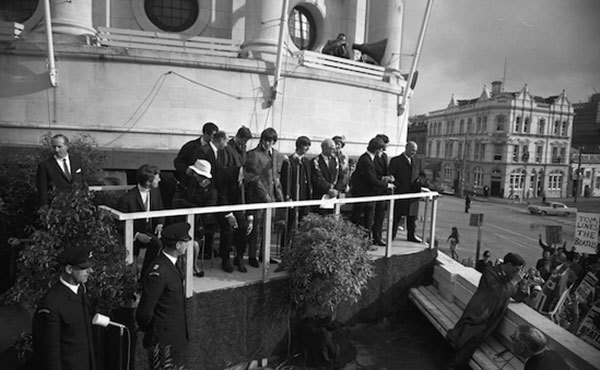
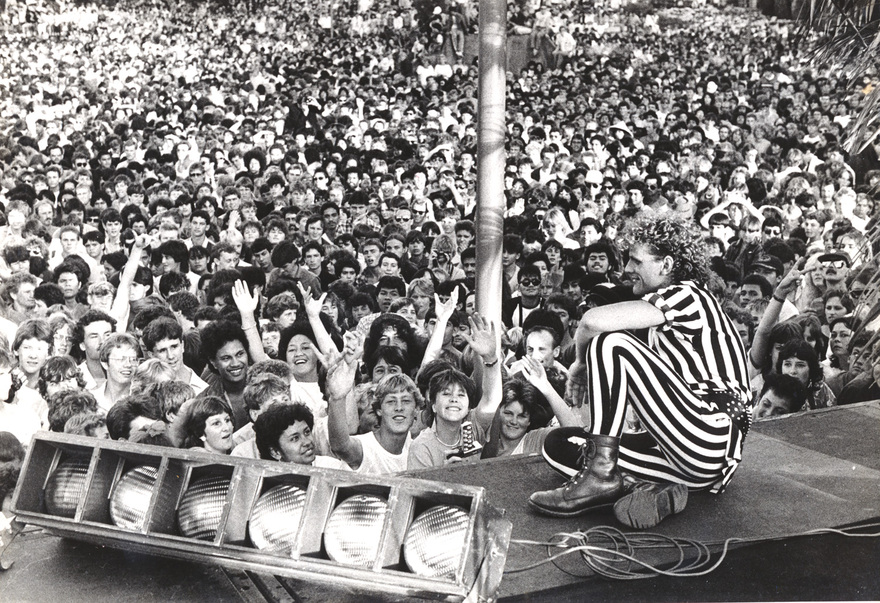
At the Beatles’ civic reception outside Auckland’s Town Hall in 1964 – how the councillors criticised Mayor Robbie for his generosity – one can glimpse the area now lost to Aotea Square. Out of sight are the 7000 fans who wagged school that morning. Instead, we spot the Market Hotel, one of many Edwardian corner pubs that are long since gone like the Vauxhall Velox seen cruising an almost empty street. Twenty years later, in the same area, a panoramic shot by Bryan Staff shows DD Smash’s drummer Peter Warren surveying a calm, peaceful crowd of thousands. The “Thank God It’s Friday” celebration to welcome the summer of 1984 will soon be renamed the Aotea Square riot.

The surprises often come from the unsung heroes who turn emotion into emulsion: the jobbing photographers rostered on for the day by a newspaper’s picture editor. At the Turnbull Library, saved from destruction, are gems from the files of deceased papers such as the Evening Post. These go beyond the requisite Maori welcome parties, the gimmick poses and the bland equivalents of rock stars kissing babies. Among the treasure are action shots of the Who, smashing their equipment on the Wellington’s Town Hall stage in 1968. Viv-Prince-from-natlib.govt.nz_thumbSomehow, the Pretty Things’ out-of-control drummer Viv Prince found time to sit for a formal portrait during the band’s notorious tour in 1965. He wears a woman’s leopard-skin hat, the coolest of rimless shades, chain bracelets of the style favoured by bodgies – and across his knuckles, a sticking plaster that testifies to his many scrapes while here.

As glamorous as some of the stars appear – the Temptations, stepping out in the 1970s’ finest flared suits; Roxy Music’s Bryan Ferry, elegant in herringbone tweed – it is the species Kiwi Rock Fan that makes these photos special. Invading the Rolling Stones’ stage in 1966 is an ecstatic fan, resplendent in homemade polka-dot mini skirt. Almost as gleeful are the navy-blue helmeted constables coming to Mick Jagger’s rescue.

Parked ostentatiously before the muslin-clad crowd waiting for Rod Stewart at Western Springs stadium in 1977 is a Ford Falcon emblazoned with Radio Hauraki’s logo. Beside it mooches a deejay in denim flares and manky long hair, while staff members or girlfriends attempt cool in satin jackets and bad posture. Their attitude: we are closer to the action than you.

StonesbyLloydGodman_thumb1The images also evoke the months of excitement that once came with the news that an overseas act was about to play “the Springs”. Long before the mammoth 1980s shows by David Bowie and ZZ Top, the Auckland speedway amphitheatre had hosted Little Richard, Elton John and Neil Diamond. For the first time we can see the Rolling Stones’ 1973 show in colour, thanks to a roll of film shot by Lloyd Godman. He didn’t need a flash – they played on a sunny afternoon – and it turns out that Jagger’s diamond-studded, low-cut, satin jumpsuit was turquoise.

Presented en masse, many of these shots have a “They walked this Earth” quality. They also answer the perennial question asked of visitors as they step off the plane: how do you find New Zealand? (It was apparently a wide-eyed Australian reporter who enquired “How many of you are there in your quartet, Mr Brubeck?”).

The Beatles look jubilant, although reports later came back that they described New Zealand as being like Britain, before the war. The Rolling Stones – specifically, Keith Richards – said of Invercargill it was “the arsehole of the World”. We remember these jibes, and almost more than the concerts we remember the interaction that these troubadours – grizzly or courteous – have with the locals.

Contrary to their surly reputation, in 1966 the Rolling Stones look cheerful, with their shirts off, enjoying the sun beside their Wellington motel swimming pool. The Guess Who play an après-gig jam at Tommy Adderley’s speakeasy Grandpa’s (sadly, no one was there to record the night in 1973 that Keith Richards turned up with a guitar and sundry other Rolling Stones).

Afterwards, when the litter has been cleared from the town halls and the paddocks that once hosted festivals, the anecdotes turn into urban legends. The Great Ngaruawahia Music Festival of 1973 is now remembered more for Corban Simpson’s nude performance than for headliners Black Sabbath headlining or the early appearance by Split Ends. Two years later, live on stage at the Te Rapa Racecourse, is Slade’s gormless Dave Hill; he is resplendent in an early mullet, a glitter-pasted forehead, a silver frock coat and platform boots. The promoter of this 1975 one-day festival – the cape-wearing Byron de Lacey – sounds almost mythological.

An Auckland school teacher friend says that every year – for nearly four decades – some 15-year-old aspiring guitar heroes in his class ask him the same question. “Sir, have you heard the Led Zeppelin song Stairway to Heaven?” Yes, he replies. “In fact, I heard them play it live at Western Springs in 1972 – before many of us had heard it on record.”

“Really?” they gasp. “Led Zeppelin played ... here?”

*

The Viv Prince shot is from the Alexander Turnbull Library’s collection of Evening Post negatives. The reference number is EP/1965/3179.

16 October 2013

Heartbreak’n’Heroism

My review of Stranded in Paradise appeared in the Listener’s 50th anniversary issue, 1 July 1989. The use of a plural verb after “trivia” is surely the input of the literary editor, Andrew Mason.

STRANDED IN PARADISE: New Zealand Rock’n’Roll 1955-1988, by John Dix (Paradise Publications, Wellington, $39.95).

NEW ZEALAND rock’n’roll, according to John Dix, began in 1955 when Johnny Copper, “the Maori Cowboy”, was asked to record Bill Haley’s ‘Rock Around the Clock’, then making waves in the States. Cooper couldn’t under­stand what the song was about, or even grasp the rhythm. His backing band of Wellington jazzers struggled to play on the beat, and Cooper muffed his lines. And when New Zealand’s first rock’n’roll record was released in October, 1955 – before anything similar had been done in Australia or Britain, claims Dix — the public couldn’t understand it either. Selwyn Toogood gave it a couple of spins on his Lever Hit Parade, but the record bombed.

They had a go, nevertheless, and that is what this book is all about: New Zealanders struggling against the odds to express themselves. John Dix has shown the same tenacity with Stranded in Paradise. For eight years there has been talk of “the book”, with sceptics doubt­ing it would ever appear. After the first two publishers dropped out, Dix finally published the book himself, with the aid of two friends. New Zealand’s rock indus­try has always been a do-it-yourself business, and this book pays tribute to the doers.

Johnny DevlinStranded in Paradise is an encyclo­pedic, entertaining work, full of stories of heartbreak and heroism. The title comes from a Hammond Gamble song: “Stranded in paradise, how can a poor boy break the ice?” Tim Finn has called it “the tyranny of distance”, Dave Dobbyn a “strange itinerary”. The frustrations of isolation are the essence of the book, It begins with the first adolescent who wanted to break out of “normality” and small-town aspirations: Johnny Devlin (above). The bank clerk from Wanganui quickly went from talent shows to town hall tours, selling a phenomenal 250,000 records in a career that peaked after 12 months.

A pattern quickly emerges: the few acts that are successful “conquer New Zealand, chalk up a few hits, and set sights further afield”. Usually on Aus­tralia, where New Zealand musicians from the Invaders to the Enz, Mi-Sex to Jenny Morris, have had considerable impact on the industry.

Dix brings alive New Zealand in the 1950s, a stultifying world of six o’clock closing, short back’n’sides and Pat McMinn on the wireless. Devlin’s flame extinguished in 1959, the country settles back with safe Howard Morrison until the Shadows, and later the Beatles, inspire the beat boom.

The book is full of long-forgotten bands and songs, but the period details and cautionary tales make it a very readable history. The Chicks as young teens visit their West Auckland neigh­bour Peter Posa for his autograph. They sing him a song, and within days are in a recording studio. The Avengers (‘Love Hate Revenge’) play a gig in Nelson on Sunday night, catch the Picton ferry to Wellington, drive to Whangarei to play on Tuesday night, then back to Lower Hutt to perform on Wednesday. The Fourmyula win a trip to Britain in a talent quest, only to find they have to play their way there – and back – on the ship.

The trivia are fascinating. The vocalist of Simple Image (‘Spinning Spinning Spinning’) later sang with Frank Zappa. Shane (‘St Paul’) spent the 1970s in England, singing with a heavy metal band. Mr Lee Grant was born Bogdan Kominowski – we knew that – but in a Nazi concentration camp?

Dix doesn’t pull his punches when musicians are the architects of their own downfall, succumbing to ego, drugs or, worse, a cabaret career. He has been writing about Australasian music since the 1960s, and has been in the right place often enough to give the book authenti­city and energy. He’s a born raconteur, and chapters on the rise and demise of such self-destructive units as Dragon, Hello Sailor and Toy Love, to whom Dix was particularly close, are some of the best. The desultory years of the 1970s, when local pop was dominated by MOR acts and most live bands were pub residencies doing cover versions, are quickly by the post-punk resurgence in New Zealand rock’n’roll.

Only a rock obsessive could have completed this book, with its band genealo­gies, obscure songs and forthright opinions. The enthusiasm is contagious, even if the fan in Dix gives his heroes – Max Merritt, Bruno Lawrence, Rick Bryant, Chris Knox – an aura of mytho­logy, and the tabloid punchiness of the writing is sometimes over the top (Max Merritt’s Meteors were as welcome in Sydney “as a busful of lepers”; Kevin Borich’s guitar playing “bit like a Queensland crocodile”; the Rumour’s “pap had wheelchairs positively burning rubber on the way to the record stores”).

There are hundreds of photos in the book’s 350 large glossy pages, and they’re as entertaining as the anecdotes. Devlin’s lame shirt and two-tone brothel creepers; the Invaders’ matching Fender guitars and monochrome lounge suits; Mr Lee Grant’s sideburns and turnover necktie; the La De Da’s tartan flares; Dinah Lee’s kiss-curls and Alison Durbin’s minis; winklepickers, cuban heels, stovepipes, bell-bottoms, pony tails, mohawks … not to mention Split Enz: three decades of dedicated followers of fashion.

Recurring themes include the reluc­tance of New Zealand’s broadcasting media to reflect their local culture, and the bland-out that occurs when they do get involved; also the chequered history of major record labels’ contribution to local music. Despite this, the valuable appendix of New Zealand acts in the charts since 1966 is testimony to what has been achieved against the odds.

The dominance of imported pop has stifled the creation of our own music. Pride in our culture is just something Michael Fay can exploit, and Mike Moore can market. Stranded in Paradise has given us our musical heritage. Let us hope that it will inspire our musicians, radio and television programmers – and their audiences – to keep on forging our own cultural identity.

10 May 2013

Never Be Blue

imageIn January 1986 in Sydney I interviewed Dinah Lee, the singer of one of the first three songs I can remember hearing (besides ‘Do the Blue Beat’, the other two are the Beatles’ ‘All My Loving’ and Nat King Cole’s ‘Ramblin’ Rose’). The interview was arranged by my friends Maxine and Bronte, who were well connected then and surely still are. It ran verbatim in the March 1986 issue of Cha-Cha, Auckland’s free fashion newspaper edited by the talented Ngila Dickson. Besides all the ads for Workshop and Zambesi, Cha-Cha ran a fascinating series of Q&A interviews that are excellent source material for social history. Among the subjects were pioneering journalist Marcia Russell, radio pirate David Gapes, broadcaster Peter Sinclair and entrepreneur Charley Gray. The two main interviewers were Wayne Washington (aka Russell Brown), and Bryan Staff. Depending on the interviewee, the tone sometimes emulated Interview magazine. After the interview, in central Sydney, I took her picture outside a mass-market boutique called Beatnik Girl. The thing that comes through is Dinah’s determination; 27 years later, she is still regularly performing.

“A chick-a-chick, a chick-a-chick a chang-chang!”

Dinah Lee will always be New Zealand’s Queen of Mod. She was our first pop superstar, wowing audiences with her effervescent personality and exuberant versions of R&B hits – at a time when the Beatles were still playing Hamburg. For many of us, the 60s began with ‘Do the Blue Beat’ at the top of the New Zealand charts, and the sight of girls training their hair with Sellotape, trying to imitate Dinah’s side-curls.

Inevitably, she made the migration to Australia, where she has been based since 1964. In June last year [1985] Dinah returned to New Zealand to appear in television’s 25th anniversary concert; she will be in Auckland this month [1986] to perform at the Easter Show. “Come-on ba-by! Do-wah yakka way!”

Mmmm I’ve been dying for this. What a good cup of coffee – some places you go and they give you little fiddly cups of cappuccino, and it’s down in a second. I’ve never got used to the heat here in Syudney. I came from Christchurch originally. I was born in Waimate – do you know where Waimate is? You do? A lot of people don’t …

Yes, I’ve been there. Norman Kirk’s buried there.

Is he? In Waimate? … (looks puzzled) … I didn’t know that.

I’ve seen a couple your records in the second-hand stores here in Sydney – Introducing Dinah Lee and The Mod World of Dinah Lee. They’ve got very expensive prices on them.

Dinah Lee LPI know, aren’t they expensive. They say they’re collector’s items now. I have a friend here who’s in a collector’s club and if I can’t find any of my singles, he’ll write all around Australia for them. I’ve got copies that way of songs I haven’t had for years, such as the songs I recorded in England, but they’re re-releases a lot of them.

‘Blue Beat’ wasn’t a big hit over here [in Australia]. No, ‘Don’t You Know Yockomo’ was No 1 and ‘Reet Petite’ was No 1, but ‘blue Beat’ was only on the flipside of ‘Reet Petite’ out here. It got quite a bit of airplay in Queensland, but ‘Don’t You Know …’ is the one. A few people know ‘blue Beat’ but I wouldn’t do it in my show here, but I have to do ‘Yockomo’ and I havae to do ‘Reet Petite’, otherwise people go, “What’s happening?” But if I go to New Zealand as I did not too long ago, it’s gotta be ‘Blue Beat’.

Where did you get your material from? ‘Reet Petite’ and so on …

That was an old Jackie Wilson song, but I found it on some album by … I can’t remember, it was so long ago … it was some girl singer doing it.

‘Don’t You Know Yockomo’ was an early R&B hit as well, by New Orleans’ singer Huey Smith.

Were you listening to those R&B records in the early 60s?

Oh yeah – into all that, cos it was sort of the Motown thing, and even before that there were your black singers like Jackie Wilson and Sam Cooke and even Little Richard. There were lots of little coffee clubs in Auckland that people used to go to hear this music. Places like the Beatle Inn, the Shiralee, the Top Twenty … there was a jazz venue near Queen Street there, the Montmartre – I used to go in there and sing pop with a jazz band. Just piano, with slap bass and drums, and I’d sing, oh, Dusty Springfield stuff. So I had all that grounding.
Dinah Lee and Max Cryer and Millie Small Playdate 1966I used to do ‘Yockomo’, ‘Reet Petite’, all those numbers, with Max Merritt and the Meteors and the Invaders even before I recorded them. We did shows all around New Zealand in the 60s with, like, Peter Posa, Lou and Simon – all these people. I don’t know if you hear of them any more … Bill and Boyd, the Howard Morrison Quartet, of course. All those people, all the time. And then I did my own shows, and shows with PJ Proby and Little Millie. [Millie Small is pictured here with Dinah Lee and Max Cryer, from Playdate magazine, 1966.]

She had ‘My Boy Lollipop’ – ‘Blue Beat’ is like an early reggae song too …

Yeah, Jamaican ska.

Where did you pick that up?

The record company [Viking] got that one for me and we just did it as we felt it should be done. Funnily enough in Australia reggae is quite big now, yet this was in the 60s when reggae wasn’t known. It’s quite unusual isn’t ‘it, how we got into reggae. I don’t know who produced that one; I’m just trying to remember … (shakes head). No, it’s just so long ago.

There’s a reggae group here called the All Nighters, and a couple of years ago they did a big show up at the Tivoli and they wanted me to do ‘Blue Beat’ with them. It was great. They all loved it, because they said, “Well, you’re one of the original reggae people we know of.” You know, I never really got into reggae after that.

Where did you get your look from? The mod style, the haircut, the Mary Quant look – you were very early with that.

Oh, yeah – that was mine. There was a girl in Auckland, a model called Jackie Holme – imageshe was an English lady. I used to have a bouffant haircut – the rocker image – and she just got me and cut my hair in the back of a boutique that used to be there. She cut my hair and put on all these clothes, and away I went. The whole image completely changed. Gone was the Diane Jacobs image – Dinah Lee appeared. As soon as I got this new image it was a completely new character that sort of took me over all of a sudden. It was like, “Yes, this is good … I like this … this is me.” [Jackie Holme, a former girlfriend of Max Merritt, moved to Australia and became a top model. This image is a detail from a 1969 photo by David Mist.]

Did you decide to take show business more seriously then?

Oh no. Serious? It was just a hoot! The madder you could look the better. We used to paint freckles on our faces and wear the weirdest clothes and the shortest mini dresses when they came out. Everything. Whatever hit, we got it, and we started the trends.

You went to England in the mid-60s and mixed with the mods there …

I went to America first, in 1965, and then to England. I recorded Shindig, the television show in America, and then I did more TV and recorded some songs in England. I was on thank Your Lucky Stars, not Ready Steady Go because you had to have a hit record, it was like Countdown is here. I lived with Little Millie and her manager in London …

Didn’t Chris Blackwell manage her?

Yes, Chris Blackwell was her manager then, and he’s still got Island records – ‘My Boy Lollipop’ was one of his first records, I think.

Was Blackwell doing some work for you as well?

Yeah, he recorded me on Island. He of course had Little Millie … Jackie Wilson … Stevie Winwood and the Spencer Davis Group. I was in London through that period, meeting people like your Jane Ashers – who was going out with Paul McCartney – your Peter and Gordons and your Stevie Winwoods, Marianne Faithfull … they all used to come to the big parties we used to have. It was all Carnaby Street fashions. And then I used to have parties over here in Australia, and we used to invite all the overseas stars to them like the Byrds and the Yardbirds. Oh, just everybody that we knew back then.

The music industry was quite different then – less sophisticated.

It was completely different. Then, it wasn’t a business – it was like a big party. Because that’s what the 60s were – it was a whole new thing. Because all of a sudden you had the introduction of English sounds and mad things and kookie things, and mod. You were just insane. They get insane now, but it’s all been done. We did it – back then.

I remember you came back to New Zealand for a visit in about 1968: your arrival was covered by the local TV news …

During that period, of course, I did the Vietnam War twice. That was pretty horrific, but we got treated pretty well because we were entertainers. We’d do shows and have to go to hospitals and entertain people that had got blown up. I can tell you what – that was hard. And the first time we went up there we didn’t even have a band, we used backing tapes. The second time, I went up there with the big ABC orchestra, which was fantastic – singing rock’n’roll with a large orchestra was great … this was in the mid-60s.

In 1964 you moved to Australia. I suppose your migration was made easier than most because you’d already had a hit there.

I remember being on a tour in New Zealand with Max Merritt and the Meteors, and all of a sudden I heard ‘Don’t You Know Yockomo’ was No 1 in Australia, and I thought, “Wow! I’ve got a No 1” – I didn’t realise till I came over here what that really meant. I mean, I worked when I came over here. I was lucky, I had a hit, so I didn’t have to start at the bottom. I had hit records, I did all the TV shows, bookings all the time.

Dinah LeeI was working 364 days a year type of thing. Okay, the realisation now is I wish I’d known a lot more than. I mean, I was very green – I got ripped off a lot, which most people in the 60s did – really ripped off. I mean, I should be very very rich now – I know in New Zealand alone, ‘Blue Beat’ sold 50-60,000 copies. In New Zealand! I mean, crazy. And I know all my albums … it just boggles my mind to think back at what I didn’t do, because you just didn’t know anything. Nowadays you have a business manager and an accountant and a public relations person – all these people who do all that and work for you, but back then you didn’t – you just trusted who it was that was looking after you.

It wasn’t until, like, 1970 that I realised that – hang on a minute – all these things went wrong. I’ve been making all this money – where is it? I got solicitors onto it, oh (sighs) we had a court case here – but a lot of things couldn’t be proved because it was just so long ago. It was only when I realised what you have to do that I started making money again – you’ve gotta do everything yourself. You’ve gotta learn, and I’ve learnt.

Also I’ve learnt, it doesn’t matter if you’ve got a job or you haven’t, you don’t just go for any job. You’ve still got to keep a reputation, and you don’t let anyone take you down at all. You can’t afford to – because you’ve already done that for a start. I’ve had a good past though, and without a past you can’t have a future. I’ve done a lot – and I aim to do a lot more.

Your popularity in Australia was across the board, wasn’t it – you were a family act.

Yes, that’s because of the different venues. You did the rock venues and then the clubs were coming up, and to make money you did those as well. Ithink, in a way, it was a mistake that I did that – to go into that club scene. I should really have stuck to the mad rock scene. I took the safe way out. Okay, I did television and became a member of the Bandstand team over here – it was great career-wise, because my name was known all around Australia as it was in New Zealand.

By 1969 I came back to Australia after another trip to Britain. I was working around the clubs, interstate venues, pubs, upmarket nightclubs, that sort of thing. And in ’73 I went to Mexico city and did a Las Vegas revue for six months. They billed me as the big Aussie broad – there were all these American girl dancers and I was the girl rock singer in it – that was fun.

Then, back in Australia I joined up with Johnny O’Keefe – the late Johnny O’Keefe, he was to Australians what Elvis was to Americans, he was so big. We did shows all around Australia called ‘the Good Old Days of Rock & Roll’ – we put Johnny Devlin, Lonnie Lee, all these Australian people together. Cleaned up. That was fantastic, people hadn’t seen anything like it in a long time. JOK died in 1978 and I’ve been working since then doing clubs and interstate gigs. But now is the time for me to move. I’ve gotta move.

Doing the club circuit has meant you’ve had a long career …

But it was very safe, and now I’m looking to get out of that safe thing. I want to start all over again and do, like, rock’n’roll. I’ve got together with Johnny Dick, who used to drum for Max Merritt and the Meteors, and we’re now going to put together a band and just do really good rock.

What sort of material will you be doing?

Oh, a couple of old numbers, but mainly contemporary, today stuff. Because here in Australia there are a few groups kicking around that are into the 50s and 60s stuff. I’ve done all that, I want to do something different. I want to do, hey, this is me, now.

I’ve recorded a song which might come out in New Zealand. It’s by an American guy called tom Scott, who was with the LA Express. It’s called ‘He’s Too Young’ – it’s about, naturally, an older woman falling for a younger guy, which is all the rage. It seems alright, I’ll see how it turns out, but I do need a record. That’s a priority.

I’m going to go back to the rock scene, but in a little bit more upmarket way. I mean, Tina Turner did it. She’s come back, but she came out here a few times and did cabaret. And now she’s come back and she can do the Entertainment Centre – a bigger band, a bigger venue, but it’s still Tina Turner. That’s the same with me – I can still do it, but will do it now with a rock band, just fly into it.

Performing is something you’ll never be able to give up, isn’t it?

No. You see, I was a pioneer in the rock industry in Australia and New Zealand. We’re a little bit funny here, they go, “Oh God, is she still around? She’s still alive?” People forget – or they like to think, “Oh, you’ve been up there, I want to get you back down” … you’ve just got to get up there and do it. Not back up there, because I don’t consider myself as ever being down, I’ve just been doing other things.

You see I’m a worker, I love to perform and I know how to entertain people It doesn’t matter if you’re 18 or 80, you’ve still got to entertain people.

We heard news that you won a prize for body building.

Yeah, that’s right. (laughs) Muscles – yeah, yeah (laughs). I got into that when I was about 35. As you roll along through life, you start looking at yourself and you think, now hang on a minute, you’re getting older, all these people are up and coming, you’ve just gotta start taking care. Cos in the 60s you just had fun – parties, booze … no drugs, cos you didn’t really know that much about drugs then. I mean the hippies were smoking pot and all that, but there were no real hard drugs. For us, bourbon and coke was like, “Wow, yeah, let’s get into bourbon and coke! And have a good time!”

But as you get older, you can’t do things like that. You see what happens to everybody, and you think, I don’t want to end up looking like that. I love the business and I want to do things. So I started getting out on the road and did a bit of running. I ran a lamp-post and collapsed at the next one. I was so unfit! But now I’m a gym junkie – that’s it, I’m gone. If I go away for a week, I think, “Oh! What am I going to do? I’m earning all this money, but I’m doing no gym!” But the money’s quite important too.

I ran for a couple of years and then I went to the gym and starting pumping iron, lifting just light weights, and I realised, I like this. I just went into that competition for a bit of fun, see how it went – it went well – and naturally got a lot of publicity out of it, which is great. Doesn’t hurt anybody. But I also wanted to prove that you’re not 40 and fat and forgettable. You can still say, hey, you’re a person, you’re still interesting and can still make it in what people put as a young scene. Because when you look at a lot of the big stars, even TV stars, they’re all getting on.

The win [Australian Women’s Body Building Champion, Over 35] got a lot of TV coverage here – Mike Willesee and the Today show and lots of newspapers and magazines. It’s funny, but there are all these young people, especially young girls of 18, 19, who say, “Oh, you’re the one who won the contest.” They don’t know I’m a singer – so it’s still kept the name there, which is important these days.

You’re very positive about your new direction.

You’ve gotta be, I’ve learnt that. Now I feel the time is right. Okay, I did it back then, but age Dinah Lee January 1986 by Chris Bourke, Cha Chadoesn’t worry me – the people down there don’t care how old you are, as long as it’s good music. Which is great. Now there’s a trend here where they’re bringing back a lot of the older stars of the 60s. I think they’ll do it in New Zealand too, so maybe a tour, or a record – who knows?

How do you feel about the revival of mod fashions?

It’s funny, because we did it and had fun doing it, and the kids of today are exactly what we were like, except it’s harder for them today – the world’s harder. But you’ve gotta have a bit of fun and that’s what we did, and sure, I think it’s fun. I have a good laugh when I see kids in their little pointy-toed shoes and mini-skirts and Wow – it’s just like looking at myself 20 years ago. I think, “Yeah – I’ve done that.”

© Chris Bourke 1986

NZ On Screen has a four-minute Dinah Lee documentary here, which includes footage of her recording ‘Do the Blue Beat’. Meanwhile …

03 October 2012

Fish wrapping

image1. I Read it in a Magazine

Salient – Victoria University’s student magazine – is these days stapled, A4 and 48 pages. It is smartly edited (Asher Emanuel & Ollie Neas) and also elegantly designed (Racheal Reeves), albeit imitative of The Believer. But whereas much of The Believer is unreadable due to its slippery, affected prose, with Salient it’s simply the typography. Grey type on bleached white paper, black type on dark grey paper, and all in 4 point. Don’t they want their writers to be read? A pity, as the content is strong, like much of the student media (see Peter McLennan’s summary of a Craccum campaign about an Auckland University scandal here) – though we are yet to see the effect of the vindictive voluntary student unionism bill. Two items from the October 1st “Power” issue:

2. ‘The Measure of a Manhire’

Rob Kelly interviews Bill Manhire the mild-mannered Superpoet on his departure from VUW. Manhire describes the 1960s at Otago, when – thanks to the university’s Burns fellowship – a few New Zealand writing role models finally entered his sphere (they weren’t part of the English curriculum at the time): Baxter (“behaving badly”), Janet Frame (“scuttling along corridors”), Maurice Gee, Hone Tuwhare. These writers “became very influential, but more as examples of people who had committed their lives to doing the thing that mattered. So it was great to go to the Captain Cook and drink beer with Hone, but also you knew that … I mean, he would arrive with poems and sort of hand them out, and all the local alcoholics would give him advice and he’d go away with a much worse poem than he arrived with. A sort of anti creative writing workshop.”

3. ‘I Moustache You Some Questions’

Chris McIntyre interviews TVNZ’s Mark Sainsbury, just prior to the news that Close Up is closing shop. Is it hard defending his throne against the likes of Hosking and Henry? “It’s one of the top jobs, so people want that job, but they can’t have it … Paul Henry made no secret he wanted that job, he’s now working on breakfast in Australia. I mean, draw what you like out of that.”

4. Must Try Harder

RS mick jagger 1968 We’ve all made mistakes, rushing to judgement on a new album, film or book, only for it later to be declared a classic. Michael Schmidt is devoting his spare time to collating “Rolling Stone’s 500 Worst Reviews of All Time”.

He actually comiserates rather than scores points as he finds Lenny Kaye dissing Exile on Main Street, Jon Landau underwhelmed by Sticky Fingers, Langdon Winner finding After the Gold Rush rushed (“I can’t listen to it at all”). And Ed Ward, who was often excellent (on the Band, Texan country rock and 1950s rock’n’roll) on Abbey Road:

Side two is a disaster ... The slump begins with ‘Because’, which is a rather nothing song ... the biggest bomb on the album is ‘Sun King’,which overflows with sixth and ninth chords and finally degenerates into a Muzak-sounding thing with Italian lyrics. It is probably the worst thing the Beatles have done since they changed drummers. This leads into the “Suite” which finishes up the side. There are six little songs, each slightly under two minutes long, all of which are so heavily overproduced that they are hard to listen to ...

Ward wasn’t alone of course, in the New York Times Nik Cohn agreed, though not about the “Suite” (“For 15 minutes, tremendous”), and two years earlier Richard Goldstein dissed Sgt Pepper, following it up in the Village Voice with a similarly well-argued piece about the reaction called “I Blew My Cool Through the New York Times.”

Rolling Stone’s response? The managing editor Evie Nagy sniffed: “I say this genuinely without bias, that person's time could have been so much better spent. At least make it funny.”

5. Gambling with Gout

Speaking of the Fabs, I remain to be convinced by Magical Mystery Tour, though the connections with Python are plausible. But just released, by the BBC’s Arena programme, are five minutes of outtakes in which the Beatles buy fish’n’chips while on their bus journey (think Ken Kesey meets Beano).

kennyIt reminds me of another fish’n’chip/musician/tour bus story, about Kenny Rogers and the First Edition. When Kenny Rogers couldn’t get arrested, he toured New Zealand often and regularly appeared on NZBC-TV. Circa 1971 Rogers and the First Edition were travelling down the West Coast; it was a Sunday night and dinner time. So the New Zealand promoter got requests from the band and stopped at a local takeaway, somewhere between Karamea and Franz Josef. When he returned with a big cardboard carton, he walked down the bus aisle, saying to Rogers and his band, “Chicken and chips? That’s $1.30. Two fish, a fritter and chips? $1.75. A hot dog and chips? $1.20 …”

There'll be time enough for countin’ when the dealin’ is done.

21 September 2012

The Maori-Memphis connection

The New Zealand Trading Company actually only traded in the United States. The band evolved out of the Maori Hi-Quins and other Maori showbands of the 1960s. The most prominent member was bass guitarist Thomas Kini, who left New Zealand in 1959 aged 16 to play with the Hi-Quins. At the time of his death aged 61 in 2004, he had become a prominent musician based in the Chicago area. (Many Maori showband musicians settled in the US after their cabaret heyday was over.) Kini worked with artists such as Duke Ellington, Stevie Wonder, Donny Hathaway, Minnie Ripperton and Herbie Hancock.

The New Zealand Trading Company released just one album, in 1970, on the Memphis label. Most of the songs are co-written by Thomas Kini, plus two by Alberto Carrion. But the song  which keeps getting requested on specialist programmes in New Zealand is their cover of “Hey Jude”. 


Update: now I’ve got my copy back again, the sparse credits say that the album was produced by N Rosenberg, and engineered by Steve Stepanian. It doesn’t say where it was recorded but in November 1970 the album was re-mixed at Universal Recording Studios, Memphis TN. Its catalogue number was MS1001, and Memphis Records was part of the Memphis Corporation, at 261 Chelsea Building, Memphis – probably an office up a few flights of stairs.

03 August 2012

Waiting On a Friend

1. Making Baby Float

With minutes to spare, the IIML twitter alerts me to a concert taking place nearby at the grandly named New Zealand School of Music. The Spaces In Between is another collaboration between pianist and composer Norman Meehan, poet Bill Manhire and singer Hannah Griffin. It’s been a couple of years since I saw them at St Andrews on the Terrace, and in that time the careful treatments have gelled into compelling art songs, and Griffin’s performance has an added depth and assuredness. The poems given musical settings include David Mitchell’s witty ‘Aesthetics’ (I last saw Wellington’s leading Beat down the road nearby in John Street), Baxter’s ‘High Country Weather’ (appropriately spare), Manhire’s ‘Buddhist Rain’ and – with a gospel vocal trio - David Bowie’s ‘Heroes’. Meehan introduced Hone Tuwhare’s ‘To Elespie, Ian & their Holy Whanau’ as “curiously named”, which would be news to the peace-loving Prior family. But he has a lovely touch on the Steinway, his arrangements having a gentle humour, and at one point guest Colin Hemmingsen’s clarinet provides an oxymoron: a joyful lament. Keith Hill’s recent documentary on this troupe is called Persuading the Baby to Float.

2. Laus Tibi Domine

Art, Keith Richards once said, is just short for Arthur. Turning poetry into songs is a risky endeavour, the results are often so arch. Denis Glover apparently grumbled at Douglas Lilburn’s 1954 settings of his ‘Sings Harry’ poems, and it has to be said something more earthy would have been more suitable. Meehan’s success reminded me of Dave Dobbyn’s deeply moving treatment of James K Baxter’s ‘Song of the Years’, which opens, “When from my mother’s womb I came / Disputandum was my name …” It was a match made in heaven, so perhaps Dobbyn should look to updating ‘Sings Harry’: like Baxter, Glover is a kindred spirit. Charlotte Yates, who commissioned Dobbyn’s song for the Baxter album, wrote that his use of repetition “turned the somewhat lad-least-likely last line of the poem ‘Laus tibi, Domine!’ into an utterly joyful and triumphant outro.”
3. True Adventures

After a gap of 27 years, I’ve been re-reading the one book about rock music that approaches literature: Stanley Booth’s classic The True Adventures of the Rolling Stones, about the 1969 US tour and so much more. First published in 1984, and recently reissued by Canongate, and I’m looking forward to reviewing it soon. It’s meant a revisit to the canon, especially Let it Bleed and Sticky Fingers (Exile got a workover at the time of its reissue in 2010). One of the standout moments is his observation, “There were no grownups among us.” I wish I could find the actual line again, but at a time when books fight to justify their space, this one has returned like a prodigal son.

4. Someone to protect

Which makes me think of a new earworm for the day, written circa 1973, released in 1981. Sax solo by Sonny Rollins.

5. Diversions

The IIML twitter also provides “A website that some folk might find handy.”

08 June 2012

50 Ways to Leave an Industry

Flexible Vinyl LoverIn 2008, I suggested that June rather than May would be a better month to celebrate New Zealand music. Although lacking the alliteration, that was the month in 1977 that Murray Cammick and Alastair Dougal began a rebirth in the industry by launching Rip It Up. This month Rip It Up – now owned by Satellite Media, with Murray as a columnist – celebrates its 35th year. To mark the occasion, special edition T-shirts of old covers are available. Last week, while looking in the June/July 2003 RIU to re-visit Murray’s obituary of the influential retailer Dave Perkins, I came across this feature and thought it epitomises how the music business has changed in nine years. The shift has been bigger than vinyl to CD, or 78 to vinyl. You expect pop stars and politicians to fade away, shops to close and media buyouts, but here it’s not so much a case of movers and shakers leaving the industry, as the industry leaving its movers and shakers.

50 Most Important People in New Zealand Music (2003)

50. James Reid – the Feelers

49. 8 Foot Sativa

48. King Kapisi

47. Brent Eccles – promoter

46. Murray Cammick – Wildside, Rip It Up co-founder

45. Teina Herzer and Aaron Dustin – founders, nzmusic.com

44. Terence O’Neill Joyce – RIANZ

43. Mike Chunn – APRA

42. Tyson Kennedy – Steriogram

41. Campbell Smith – artist manager

40. Bridgit Darby

39. Adrien De Croy – York St Studios owner

38. Chris Hocquard – lawyer, Amplifier founder, Bfm chair

37. P. Money

36. Bernie Griffin – chair IMNZ, owner Global Routes

35. Cath Anderson – NZ Music Commission

34. Sean Coleman and Shaun Joyce – Sounds

33. Terry Anderson – music buyer, The Warehouse

32. Daniel Wrightson – Juice TV

31. John Pilley – National Radio music manager

30. David Rose – MD, Satellite Media Group

29. Damian Alexander – Blindspott

28. Bic Runga

27. Pete Rainey and Glenn Common – Rockquest

26. Nesian Mystik

25. Helen Clark

24. YDNZ and Brother D – Dawn Raid

23. Kog Transmissions

22. Ian Fraser – TVNZ

21. Michael Bradshaw – BMG

20. James Southgate – Warners

19. Chris Caddick – EMI

18. Mark Ashbridge – FMR

17. Michael Glading – Sony, RIANZ chair

16. Adam Holt – Universal

15. BNET

14. David Brice – PD, ZM Network, Classic Hits

13. Leon Wratt – PD, The Edge

12. Brad King – PD, The Rock

11. Andrew Szusterman – PD, Channel Z

10. Rodger Clamp – programmer, More FM etc

9. Judith Tizard – politician

8 and 7. Dion and Jimmy – the D4

6. Dolf De Datsun – the Datsuns

5. Brent Impey, CanWest

4. Drinks: Coke, Pepsi, Red Bull, DB Export etc

3. Che Fu

2. Brendan Smythe – NZ On Air

1. Neil & Tim Finn

“Must Mentions” – Arthur Baysting – NZ Music Commission; Dave Dobbyn; DJ Presha – Subtronix label; Mai FM; Jasper Edwards, Fabric Club, London; DJ Sir Vere; Stephen McCarthy – bands.co.nz; Venue Owners: King’s Arms, the Temple, Bar Bodega.

16 February 2012

Brothers and Sisters

From New Zealand to New Orleans: the Moahunters and the Neville Brothers
Moana and Nevilles 1 Chris Bourke
Moana Maniapoto with Cyril, left, and Charles Neville; Napoleon Avenue, New Orleans. Photo: Chris Bourke
NEW ORLEANS, April, 1992 – “I’ll give you a quote for your magazine.” Cyril Neville puts his arm around me. He has a broad grin on his face, which is framed in dreadlocks. He’s dressed in a purple robe, with a cap encrusted in sequins to read “N”.
“Why isn’t more Maori music played on the radio in New Zealand?”

The rest of this article can be read at AudioCulture. 

https://www.audioculture.co.nz/people/moana-maniapoto/stories/brothers-and-sisters-1992


___________
First published in Rip It Up, June 1992. Looking back 20 years later, that Moahunters trip was trail-blazing. While Maori pop is still hardly heard on mainstream radio, so much else has changed: support from the New Zealand audience and funding bodies, and thinking global. Moana has had a very successful career taking her unique music around the world, as have Te Vaka. A couple of years later, the Proud compilation testified to the wealth of contemporary pop coming out of South Auckland (and Once Were Warriors filled cinemas). In 1996, ‘How Bizarre’ broke Polynesian pop worldwide. Simon Lynch’s compilation Rare Kiwi Soul from the Eighties (Rajon) goes back a decade to recall the musicianship present in South Auckland funk clubs such as Cleopatra’s (on Morrin Road, Panmure). The most prominent – and original – band to emerge from this scene was Ardijah, for whom Lynch played keyboards before founding D-Faction and other outfits. 

13 January 2012

Listless Summer

Children of the SunEarly in this summer which has never quite arrived, Trade Me featured a listing for the soundtrack of Children of the Sun. This cult surfing doco is New Zealand’s equivalent of Bruce Brown’s classic 1966 film Endless Summer.

The soundtrack EP – by Hamilton’s Music Convention - is regarded as a New Zealand psychedelic classic, featuring a sitar and heavily phased guitar from Rob O’Donnell. The opening track ‘Belly Board Beat’ has a stonking drum solo from Sean Kelly. It can be heard here, or on Grant Gillander’s second New Zealand psychedelia compilation, A Day In My Mind's Mind, Vol 2 (EMI).

On Trade Me, the Children of the Sun EP – water stained of course – called for opening bids from about NZ$300. But the entire film (and soundtrack) can be experienced on NZ On Screen here. It was shot by Andrew McAlpine over three years, on beaches all around New Zealand and Australia, and released in 1968. The editor was Kelvin Peach, son of the legendary Tanza sound engineer Noel Peach. The essential local surfing text is Luke Williamson’s utopian Gone Surfing: the Golden Years of Surfing in New Zealand, 1950-1960 (Penguin, 2000).

05 August 2011

Life during Wartime

The Guardian has just published a piece in which musicians describe their "worst gig ever". Among them are these items from Tina Weymouth of Talking Heads,and Suzi Quatro. Weymouth describes the Sweetwaters festival of January 1984, and Quatro a New Zealand gig when she was peaking in 1975. Monitor: KW.

tina weymouthTina Weymouth

The absolute worst gig ever was the last Talking Heads show. We were headlining this tour in Australia and New Zealand. Opening for us were bands like Simple Minds, INXS, Eurythmics, B52's, Pretenders … It was a phenomenal lineup, and we were the headliners, and it was a fantastic opportunity. But we couldn't go on stage because David Byrne, without telling anyone, had let on a couple of crazy girls – who I suppose had their hearts in the right place – who were trying to promote this freedom for Maori people thing, but it was the wrong place and the wrong time. People were booing and throwing things at them, and that was difficult enough. Anyway, we finally got on stage and we were five songs into the show when David Byrne ran off and refused to come back on. He said: "I'm not going to play for a bunch of people dancing in the mud." Go figure. David had a lot of temper tantrums when he got to be a big star. He couldn't stop it; fame and the whole diva thing was just overwhelming for him.

There was meant to be a great big party afterwards and David didn't even show up. It was just this really sad, dismal affair where people got quietly drunk in the corner. The tour ended not with a bang but a whimper. It was awful that everything we'd been working towards ended like that.

Suzie Quatrosuzie quatro

We'd been in America with Alice Cooper as special guests on his Welcome to My Nightmare tour, that was 80 shows, then we went to Scandinavia, then we flew to Japan for some shows, then to Australia for a month, then we went to New Zealand – we were on the road for about six months non-stop. You're talking tired. New Zealand was the last port of call and we were flying through the night when I noticed a little spot on my leg – I thought I'd got bitten. Then I woke up and the spot was travelling up my leg in a line: it was blood-poisoning. This was the day of the gig. The doctor had to cut me, but I still went onstage with the poison pouring out, in all my leathers! It's called being a pro. The show must go on and all that. But this was the only time I ever thought I shouldn't have gone on. It was really painful. I was on painkillers and the dressing had to keep being changed.

22 July 2011

Behind the Stage Door

New Zealand has lost so much in the way of visual and aural archives. But I’m convinced that every sub-culture has an aspirant photographer and film-maker – in love with the possibilities – who captures the action. Sometimes the results never see the light of day. Occasionally they emerge from under a bed, decades later, to be the backbone of a great documentary.

The legendary Chants R&B from Christchurch luckily had an art student friend with a movie camera. Now we can all witness the scene at Christchurch’s Stage Door in the mid-1960s. Rumble & Bang is at a film festival near you soon. It was directed by Jeff Smith, former member of the Newmatics, and Simon Ogston.

27 June 2011

Collision on State Highway 1

Originally from SH1 forestry town Tokoroa, funk band Collision emigrated to Australia in 1976 and got a gig at Les Girls in Sydney's King's Cross district. In 1978 they recorded their only album - Collision - for the Infinity label in Sydney. The producer/engineer was Richard Batchens, house producer for Festival Records. Overlooking the production was Dalvanius Prime of 'Poi E' fame. Nick Bollinger's 100 Essential New Zealand Albums (Awa Press, 2009) revived interest in the album; he reports that Lionel Richie encouraged the group to move to New York, but that was a step too far.

Collision were Harry Morgan (vocals, sax), Ali Morgan (vocals, guitar), Charley Hikuroa (vocals, bass), Colin Henry (vocals, drums), Philip Whitcher (all keyboards) and Mike Booth (vocals, trumpet). These are the first three tracks of side one:

1. You Can Dance (A. Morgan)

2 You Give Me Love (Muggleton-Nobel)

3. Love Finds Its Own Way (Jim Weatherley)

07 April 2011

Inside the cordon: 2

A Passion for Jazz coverAt least one aspect of Christchurch’s cultural history is safe: pictorial evidence of its thriving jazz scene from the 1920s to the present day. About 18 months ago I was in the central city on photo research and wandered into the great Scorpio bookshop on Hereford St (soon to re-open in Riccarton) and there was a gem of book, just published. A Passion for Jazz is a visual history of “the Christchurch scene then and now”. That means the jazz scene, and it’s the kind of book I hope that some Cantabrian will produce about the city’s rock’n’roll scene, from Max Merritt to, ah, Zed.

The wonderful photos show big bands led by the likes of Brian Marston and Martin Winiata, small combos, glamorous chanteuse, goateed 1950s hipsters, guitar heroes such as the Kahi brothers, stars such as Doug Caldwell, Harry Voice, and Stu Buchanan, satirist Rod Derrett when he was still a jazz guitarist, and more recent stalwarts such as Paul Dyne, Neill Pickard and Malcolm McNeill. They are accompanied by short biographical pieces, and photos that also show the musicians who are still living in their current environs. Many of them still playing.

A Passion for Jazz was put together by Jo Jules, under the auspices of Christchurch Polytechnic’s School of Performing Arts, which Pickard was instrumental in  founding in 1991. (There’s a great shot of him playing guitar in 1963 – wearing fetching swimming trunks – with the Undergrads at Caroline Bay, Timaru.) The School’s address  is PO Box 540, Christchurch.

There are many photos that I would love to have featured in Blue Smoke, but I wanted to avoid double-ups. Among them is this charming cover portrait of, from left, Nick Nicolson, Doug Caldwell, Harry Voice and George Campbell (the classy tuxes are for their role as Gale Garnett’s backing band, 1961). One we both feature is the shot of Martin Winiata’s 3YA big band in the late 1940s (p168 in Blue Smoke).  A Passion for Jazz got every name, no easy task. They are, from left: Wally Ransom, Bill Bailey, Lloyd Hunter, Ron McKay, Lou Warren, Bernard Winfield, Barry Warren, Cliff Inns, Bob Bradford, Ross Floyd, Brian Marston, Martin Winiata, vocalist Coral Cummins and a 3YA announcer. 

23 March 2011

Inside the cordon: 1

The 1970s are often sneered at as a dire period for New Zealand music, when covers bands played beer barns and dodgy nightclubs. Yes, that was the world that dominated live, local music – but many great musicians served their apprenticeships in those scenes.

Shannon band adIf Chants R&B are now heralded as the great Christchurch 1960s beat band after Max and Ray left town with their Fenders, who took over in the 1970s?

For evidence we can turn to a wonderful photo archive that has just been put up on the web. Kevin Hill was a music fan and tireless photographer who covered the band scene in Christchurch right through the 1970s and into the 1980s. Among those he captured before they started shaving are Barry Saunders of the Warratahs, Steve Gilpin and Kevin Stanton of Fragments of Time (evolving into Misex), Brent Parlane, Jim Hall, Rob Winch and Sharon O’Neill. Bands included such lost names as Beech, Link, the In Betweens, Shannon, Inspiration and the Newz.

The pictures of Dave Kennedy remind me of the Invercargill scrapbook music history 45 South in Concert that Neil McKelvie put together for the Southland Musicians’ Club in 2006. A few years back I suggested an equivalent was needed for Christchurch.

Have a look at Kevin Hill’s photos and wonder at the high-waisted jeans, the loon flares, the tight T-shirts and all that long, greasy hair. This advertisement is just a teaser to the Aladdin’s cave that is Hill’s photo collection. 

03 March 2011

Trouble in River City

There’s a case to be made for Christchurch being the most influential city in New Zealand music. In pop music, the American servicemen who passed through as part of Operation Deep Freeze provided R&B 45s to bands such as Max Merritt and the Meteors (Max is on the left in this picture), and Ray Columbus and the Invaders. In turn they influenced bands throughout the country. Max and MeteorsEarlier, guitarist Tommy Kahi taught hundreds of pupils, among them Billy Karaitiana (third from left) and Kevin Bayley (Rockinghorse). With his brother Mark, Kahi held court at the North Beach surf club, while beat bands competed for audiences at the Spencer St and Hibernian dances. In jazz, the Bailey-Marston big band hired the city’s best swing musicians, apart from Martin Winiata, whose own big band held down a residency at the Union Rowing Club featuring glamorous singer Coral Cummins (she can be seen here with the 3ZB Brian Marston band, and heard here with Winiata’s Quintette, along with several other Christchurch radio swing bands from the 1950s). Winiata also backed Peter Lewis on the local rockabilly classic ‘Four City Rock’. From the 1950s, musicians such as Doug Caldwell, Harry Voice and Stu Buchanan passed on their skills to countless young musicians. Caldwell backed All Black Pat Vincent on an excellent EP on local label Peak in 1960. Now in his 80s, was still teaching at the Christchurch Polytechnic jazz school the last I heard.

Also to emerge in the beat boom of the 1960s was Diane Jacobs, originally from Waimate, who performed with Phil Garland in Christchurch combos the Saints and the Playboys. She went on to become Dinah Lee; he became New Zealand’s leading folk-song collector and performer. Really, the names from Christchurch are endless: Chants R&B, the Hip Singles, Pop Mechanix, the Dance Exponents, the Gordons, the Androidss, the Jean-Paul Sartre Experience, the Narcs, the Feelers, Jody Lloyd’s Dark Tower … right through to Bic Runga, Anika Moa and Scribe. (Many of these acts were featured on a great double-CD compilation produced in 2005 by the Narcs’ bassist Tony Waine, Christchurch The Music, on EMI.)

Much earlier, and on the other side of the tracks – in classical and contemporary art music – professors such as Vernon Griffith shaped the way music is taught in this country, following a strictly British model. Among those who passed through the portals of the University of Canterbury school of music are Frederick Page and Douglas Lilburn. The latter two went on to found Victoria University’s school of music in Wellington in the late 1940s, emphasising original composition far more than Christchurch.

Still, it was Christchurch where Lilburn got his first significant formal training, while in 1930s Christchurch alongside artists in other disciplines, such as Rita Angus, Leo Bensemann, Allen Curnow and Denis Glover. This review of the award-winning Douglas Lilburn biography by Philip Norman is from the Sunday Star-Times in 2006.

Fanfare for an Uncommon Man

By Chris Bourke

DOUGLAS LILBURN: His Life and Music, by Philip Norman (Canterbury University Press, $55).

Lilburn biographyDouglas Lilburn was a man alone, and he felt it. His reputation is now secure as the “father of New Zealand composition” but it was a lonely, courageous path he chose. He had no mentors – predecessor Alfred Hill of “Waiata Poi” fame mostly lived in Australia – and when Lilburn won his first prize, for composing a symphonic tone poem, he had never heard an orchestra perform live.

The prizes came quickly, but respect came slowly. In the 1940s, the New Zealand music establishment was unused to having a composer in its midst (“meeting a composer then was like meeting a polar bear in Lambton Quay,” said Richard Campion). Some local orchestral players were reluctant to give premiere performances; when confronted with a hand-written manuscript, one musician asked, “How do we know if it’s any good?”

Eventually, Lilburn would receive every honour this society can offer: the rare Order of New Zealand, an honorary doctorate (though he never completed a music degree), a bronze plaque on his student flat in Christchurch, his Wellington home revitalised as a residence for visiting composers. Before he died in 2001, Lilburn established a trust that has hugely assisted New Zealand’s musical heritage. Now composer and musicologist Philip Norman has returned the gesture. This extraordinary biography ensures that Lilburn’s achievements are properly acknowledged. Scholarly yet compelling, with a rare mix of honesty and affection it portrays the complexities of its subject.

Lilburn was intensely private, almost a hermit in his last two decades. “Biographers,” he wrote, “are maggots on the meat of reputation.” Yet he ensured his legacy was preserved for posterity, keeping a diary for years, getting his papers in order, creating an archive. Norman, whose PhD thesis was on Lilburn’s music, has picked over the bones thoroughly, but with fairness and flair. He has resisted being cowed by his subject, or swamped by his material.

Lilburn’s isolation started early. He was born in 1915, the seventh and last child of a Scots-born farmer with vast holdings near Wanganui. His upbringing was Presbyterian-staunch and lonely, but also idyllic: the 8000-acre farm had four waterfalls and Mt Ruapehu on the horizon. A Quaker primary school gave him a Thoreau-like respect for the environment and the disposition of a gentleman and scholar. Boarding school at the other end of New Zealand – Waitaki Boys High, during the legendary regime of Frank Milner – was “utterly barbarous” but ultimately beneficial. Milner passed on a reverence for language, another teacher brought out his musical talents, and Lilburn credited the experience with giving him survival skills.

Canterbury University College did more than nourish the shortcomings in his musical education; it introduced him to a supportive artistic circle. His friends became giants in New Zealand’s cultural awakening: Rita Angus, Denis Glover, Allen Curnow, Ursula Bethell. Travelling to London he studied with Ralph Vaughan Williams, befriended Robin Hyde, and won more awards. Prodigal Country was an early prizewinner, and he returned home to become a wartime shepherd on a Taihape farm.

He resettled in Christchurch to become a freelance composer and, briefly, a critic and conductor. The book’s major surprise comes from this period. Lilburn, already aware of his homosexuality, had a relationship with Rita Angus, who miscarried their child. Lilburn’s archive contained 400 letters from Angus.

In the late 1940s, as a tutor at the summer music schools in Cambridge, Waikato, Lilburn found his musical isolation was evaporating. He was already an inspiration to a new generation: David Farquhar, Larry Pruden, Dorothea Franchi. An early champion, Frederick Page, recruited him to Victoria University’s fledgling music department, and the institution’s emphasis on composition was in place. “Conditions for a composer in New Zealand were bleak,” Lilburn recalled later, but he had no shortage of offers, or well-meaning advice. Angus scolded him for becoming an academic, thinking it would stifle his art; architect Ernst Plishke advised against taking a job as the National Film Unit’s composer: hack films would kill him.

Instead, Lilburn’s creative path was not dissimilar to Stravinsky’s. He was drawn to experimentation; by his third symphony (1961) he was using the mathematical constructions of the modernists, rather then conventional harmony. Owen Jensen wrote that the angular symphony “may never be popular, but … it represents a new and even more mature Lilburn.” Within a small circle, his music – and success – caused controversy and envy.

Lilburn electronic 2Exploration into even more unknown territory followed: the new medium of electro-acoustic music. Lilburn wanted to “exorcise the demon by meeting it on friendly terms.” Twenty years after his famous orchestral collaboration with Curnow, Landfall in Unknown Seas, in 1965 an electronic treatment of Alistair Campbell’s The Return was equally groundbreaking.

Norman captures the contradictions of Lilburn: he was given many accolades, but felt undervalued. He was a visionary intellectual, generous and erudite, but could be touchy and acerbic. He had many devoted and supportive friends, but was not beyond a feud (his professional relationship with the less-adventurous composer Edwin Carr is “worthy of a roman à clef,” says Norman).

Lilburn abandoned composition after his retirement, and spent 20 years putting his papers in order. Deafness and alcoholism hastened his natural tendency to solitude, but anonymously he was a champion and benefactor of young composers and many causes.

One of the great New Zealand lives has now been rewarded with a great biography. Norman’s dedicated scholarship is balanced by an easy narrative style, and the picture research is simply astonishing (the pedestrian use of an Angus watercolour portrait for the cover doesn’t reflect the treasure inside). Lilburn’s impact on New Zealand culture went beyond music; this biography shows that in all the arts, he was a crucial figure in a young country finding its own voice.

17 February 2011

God's empty chair

George Shearing, the great jazz pianist, has just passed away, aged 91. He was born British and born blind; from 1947 he was based in the United States. His New Zealand connection came through Julian Lee, the blind multi-instrumentalist born in Dunedin and now living in Australia. In the 1960s Shearing – along with another music legend – was instrumental in getting work for Lee in Los Angeles. Lee took quite a bit of persuading, he recalled in a 2000 interview with Radio New Zealand’s Haydn Sherley:

In 1960 George Shearing came over [to Sydney], and he worked at Channel 7 where I was staff arranger. And he being in a similar position – he doesn’t look where he’s going either – we got talking, went to lunch, and I played him a few of my arrangements. He said, ‘You gotta come over to the States man, you’re wasting your time.’ I said, ‘Not on your life, thanks, I’m doing fine.’ So I didn’t do anything about it.

But in ’62 Sinatra came over and I went to a cocktail party because I was doing some writing for what was then Coronet Records, the Australian record company, which later on became CBS. Frank said, I’d like to have a chat with you, so if you could come back stage this evening before the show, while the support act is we can spend the first hour having a talk.

So I did. I had to borrow Alan Nash’s trumpet – he was the lead trumpet player – so I could get into the place, into the back door, through the security. And Frank says, ‘I’ve heard some of your things, I want you to come over to the States, in fact you have to do that because you’re a talent we want to foster.’ So I said, Well, what senor commands I must do – so I did, in ’63, I went over.

Once in the US, Shearing sponsored Lee with the immigration department, and got him to write arrangements and Braille his parts. “Nobody else could do that, and it was easily proved.” Lee arranged tracks on the 1960s Shearing albums Deep Velvet and Here & Now! Shearing also helped Lee into production work. “And Frank opened the door to all sorts of people for me,” said Lee. “I didn’t do any actual work for him but I met a lot of very influential people, like Johnny Burke and oh Nelson Riddle.”

Here, Lee is pictured in 1976 with a stellar New Zealand rhythm section, Frank Gibson Jr and Andy Brown. In 2000 he was asked what the standard of LA session musicians was like. “Frightening,” he replied. “I can remember the first session I did for George. I thought I’d go down early to do this session, because I’m a new chum. And when I got down to the studio at 9.15am for a 10.00am recording session, the whole band was there warming up. What is this? … Then, we did the first 3 hours, and they all applauded me. Then they left, before I could say goodbye: the string players had gone to another!”

George Shearing’s biggest hit was probably ‘Lullaby of Birdland’ (1952), a swing tune so perfect it seems to have written itself. On paper it looks quite challenging, with plenty of 9ths, but playing it on the piano in E minor, your hands just seem to fall into the right chords and voicings: just as they must have when Shearing wrote it. Singers also relish the song, as this clip of Ella Fitzgerald performing it shows.

Another who celebrated George Shearing’s delicate mastery was Jack Kerouac in On the Road (written in the late 40s, published 1957). His famous description of Shearing playing in a nightclub is a classic piece of bop prosody:

Dean and I went to see Shearing at Birdland in the midst of the long, mad weekend. The place was deserted, we were the first customers, ten o'clock. Shearing came out, blind, led by the hand to his keyboard. He was a distinguished-looking Englishman with a stiff white collar, slightly beefy, blond, with a delicate English-summer's-night air about him that came out in the first rippling sweet number he played as the bass-player leaned to him reverently and thrummed the beat. The drummer, Denzil Best, sat motionless except for his wrists snapping the brushes. And Shearing began to rock; a smile broke over his ecstatic face; he began to rock in the piano seat, back and forth, slowly at first, then the beat went up, and he began rocking fast, his left foot jumped up with every beat, his neck began to rock crookedly, he brought his face down to the keys, he pushed his hair back, his combed hair dissolved, he began to sweat. The music picked up. The bass-player hunched over and socked it in, faster and faster, it seemed faster and faster, that's all. Shearing began to play his chords; they rolled out of the piano in great rich showers, you'd think the man wouldn't have time to line them up. They rolled and rolled like the sea. Folks yelled for him to "Go!" Dean was sweating; the sweat poured down his collar. "There he is! That's him! Old God! Old God Shearing! Yes! Yes! Yes!" And Shearing was conscious of the madman behind him, he could hear every one of Dean's gasps and imprecations, he could sense it though he couldn't see. "That's right!" Dean said. "Yes!" Shearing smiled, he rocked. Shearing rose from the piano, dripping with sweat; these were his great 1949 days before he became cool and commercial. When he was gone Dean pointed to the empty piano seat. "God's empty chair," he said. On the piano a horn sat; its golden shadow made a strange reflection along the desert caravan painted on the wall behind the drums. God was gone; it was the silence of his departure. It was a rainy night. It was the myth of the rainy night. Dean was popeyed with awe. This madness would lead nowhere.