Showing posts with label Rolling Stones. Show all posts

11 November 2014

Close Encounters

Originally published in the NZ Listener in November 2010.

ROCK MUSICIANS AND photographers are natural-born partners: show-offs need an audience, and a Nikon lens loves a show-off. For some photographers, like Auckland’s Bruce Jarvis, the scent of the hunt has been a life-long quest. Shooting first as fans, many become professionals, and Jarvis’s tenacity at capturing live shows secured him access that today’s photographers can only envy.

Jarvis’s work is the backbone of a large-format book Live: Gigs that Rocked New Zealand, that portrays the flamboyant visitors in our midst. From the first international rock’n’roll tour – Johnny Cash and Gene Vincent, in 1959 – to Lady Gaga’s aerobic fashion-show earlier this year, the performers are freeze-framed at the peak of their careers. Some of the images – such as ZappaJarvis_thumb1Jarvis’s portraits of a satanic Frank Zappa, an exultant Bob Marley – belong in the rock photo hall of fame. But even more than the performers, it is the settings that resonate. In the background, a vanished New Zealand hovers like a vaguely remembered backdrop.

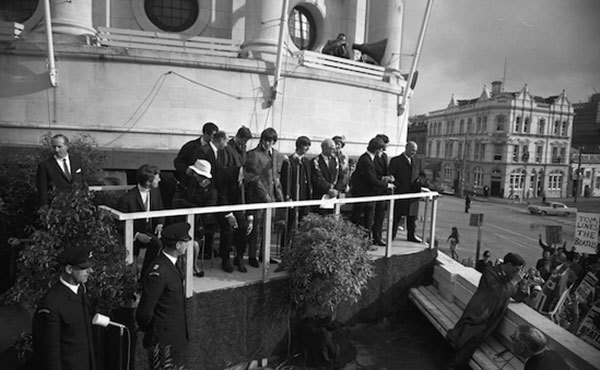
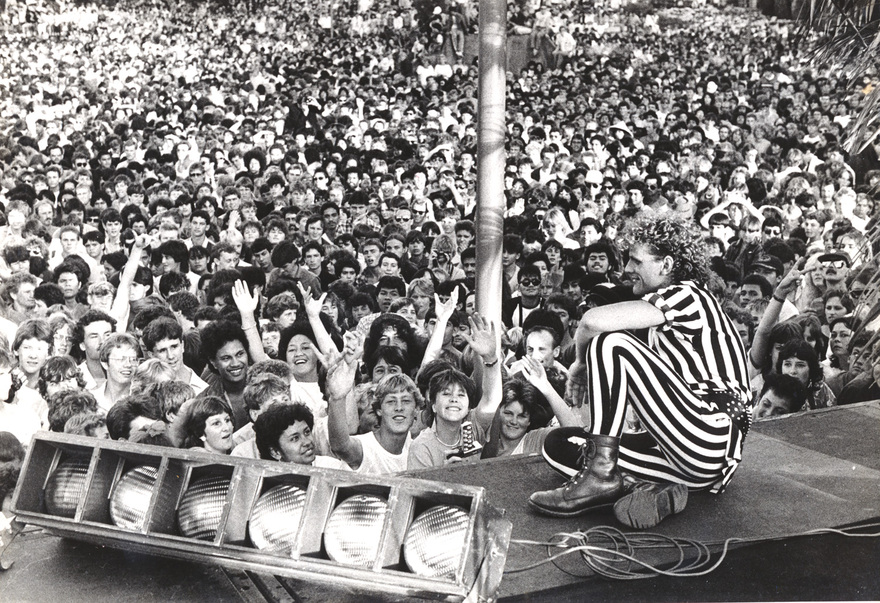
At the Beatles’ civic reception outside Auckland’s Town Hall in 1964 – how the councillors criticised Mayor Robbie for his generosity – one can glimpse the area now lost to Aotea Square. Out of sight are the 7000 fans who wagged school that morning. Instead, we spot the Market Hotel, one of many Edwardian corner pubs that are long since gone like the Vauxhall Velox seen cruising an almost empty street. Twenty years later, in the same area, a panoramic shot by Bryan Staff shows DD Smash’s drummer Peter Warren surveying a calm, peaceful crowd of thousands. The “Thank God It’s Friday” celebration to welcome the summer of 1984 will soon be renamed the Aotea Square riot.

The surprises often come from the unsung heroes who turn emotion into emulsion: the jobbing photographers rostered on for the day by a newspaper’s picture editor. At the Turnbull Library, saved from destruction, are gems from the files of deceased papers such as the Evening Post. These go beyond the requisite Maori welcome parties, the gimmick poses and the bland equivalents of rock stars kissing babies. Among the treasure are action shots of the Who, smashing their equipment on the Wellington’s Town Hall stage in 1968. Viv-Prince-from-natlib.govt.nz_thumbSomehow, the Pretty Things’ out-of-control drummer Viv Prince found time to sit for a formal portrait during the band’s notorious tour in 1965. He wears a woman’s leopard-skin hat, the coolest of rimless shades, chain bracelets of the style favoured by bodgies – and across his knuckles, a sticking plaster that testifies to his many scrapes while here.

As glamorous as some of the stars appear – the Temptations, stepping out in the 1970s’ finest flared suits; Roxy Music’s Bryan Ferry, elegant in herringbone tweed – it is the species Kiwi Rock Fan that makes these photos special. Invading the Rolling Stones’ stage in 1966 is an ecstatic fan, resplendent in homemade polka-dot mini skirt. Almost as gleeful are the navy-blue helmeted constables coming to Mick Jagger’s rescue.

Parked ostentatiously before the muslin-clad crowd waiting for Rod Stewart at Western Springs stadium in 1977 is a Ford Falcon emblazoned with Radio Hauraki’s logo. Beside it mooches a deejay in denim flares and manky long hair, while staff members or girlfriends attempt cool in satin jackets and bad posture. Their attitude: we are closer to the action than you.

StonesbyLloydGodman_thumb1The images also evoke the months of excitement that once came with the news that an overseas act was about to play “the Springs”. Long before the mammoth 1980s shows by David Bowie and ZZ Top, the Auckland speedway amphitheatre had hosted Little Richard, Elton John and Neil Diamond. For the first time we can see the Rolling Stones’ 1973 show in colour, thanks to a roll of film shot by Lloyd Godman. He didn’t need a flash – they played on a sunny afternoon – and it turns out that Jagger’s diamond-studded, low-cut, satin jumpsuit was turquoise.

Presented en masse, many of these shots have a “They walked this Earth” quality. They also answer the perennial question asked of visitors as they step off the plane: how do you find New Zealand? (It was apparently a wide-eyed Australian reporter who enquired “How many of you are there in your quartet, Mr Brubeck?”).

The Beatles look jubilant, although reports later came back that they described New Zealand as being like Britain, before the war. The Rolling Stones – specifically, Keith Richards – said of Invercargill it was “the arsehole of the World”. We remember these jibes, and almost more than the concerts we remember the interaction that these troubadours – grizzly or courteous – have with the locals.

Contrary to their surly reputation, in 1966 the Rolling Stones look cheerful, with their shirts off, enjoying the sun beside their Wellington motel swimming pool. The Guess Who play an après-gig jam at Tommy Adderley’s speakeasy Grandpa’s (sadly, no one was there to record the night in 1973 that Keith Richards turned up with a guitar and sundry other Rolling Stones).

Afterwards, when the litter has been cleared from the town halls and the paddocks that once hosted festivals, the anecdotes turn into urban legends. The Great Ngaruawahia Music Festival of 1973 is now remembered more for Corban Simpson’s nude performance than for headliners Black Sabbath headlining or the early appearance by Split Ends. Two years later, live on stage at the Te Rapa Racecourse, is Slade’s gormless Dave Hill; he is resplendent in an early mullet, a glitter-pasted forehead, a silver frock coat and platform boots. The promoter of this 1975 one-day festival – the cape-wearing Byron de Lacey – sounds almost mythological.

An Auckland school teacher friend says that every year – for nearly four decades – some 15-year-old aspiring guitar heroes in his class ask him the same question. “Sir, have you heard the Led Zeppelin song Stairway to Heaven?” Yes, he replies. “In fact, I heard them play it live at Western Springs in 1972 – before many of us had heard it on record.”

“Really?” they gasp. “Led Zeppelin played ... here?”

*

The Viv Prince shot is from the Alexander Turnbull Library’s collection of Evening Post negatives. The reference number is EP/1965/3179.

03 August 2012

Waiting On a Friend

1. Making Baby Float

With minutes to spare, the IIML twitter alerts me to a concert taking place nearby at the grandly named New Zealand School of Music. The Spaces In Between is another collaboration between pianist and composer Norman Meehan, poet Bill Manhire and singer Hannah Griffin. It’s been a couple of years since I saw them at St Andrews on the Terrace, and in that time the careful treatments have gelled into compelling art songs, and Griffin’s performance has an added depth and assuredness. The poems given musical settings include David Mitchell’s witty ‘Aesthetics’ (I last saw Wellington’s leading Beat down the road nearby in John Street), Baxter’s ‘High Country Weather’ (appropriately spare), Manhire’s ‘Buddhist Rain’ and – with a gospel vocal trio - David Bowie’s ‘Heroes’. Meehan introduced Hone Tuwhare’s ‘To Elespie, Ian & their Holy Whanau’ as “curiously named”, which would be news to the peace-loving Prior family. But he has a lovely touch on the Steinway, his arrangements having a gentle humour, and at one point guest Colin Hemmingsen’s clarinet provides an oxymoron: a joyful lament. Keith Hill’s recent documentary on this troupe is called Persuading the Baby to Float.

2. Laus Tibi Domine

Art, Keith Richards once said, is just short for Arthur. Turning poetry into songs is a risky endeavour, the results are often so arch. Denis Glover apparently grumbled at Douglas Lilburn’s 1954 settings of his ‘Sings Harry’ poems, and it has to be said something more earthy would have been more suitable. Meehan’s success reminded me of Dave Dobbyn’s deeply moving treatment of James K Baxter’s ‘Song of the Years’, which opens, “When from my mother’s womb I came / Disputandum was my name …” It was a match made in heaven, so perhaps Dobbyn should look to updating ‘Sings Harry’: like Baxter, Glover is a kindred spirit. Charlotte Yates, who commissioned Dobbyn’s song for the Baxter album, wrote that his use of repetition “turned the somewhat lad-least-likely last line of the poem ‘Laus tibi, Domine!’ into an utterly joyful and triumphant outro.”

3. True Adventures

After a gap of 27 years, I’ve been re-reading the one book about rock music that approaches literature: Stanley Booth’s classic The True Adventures of the Rolling Stones, about the 1969 US tour and so much more. First published in 1984, and recently reissued by Canongate, and I’m looking forward to reviewing it soon. It’s meant a revisit to the canon, especially Let it Bleed and Sticky Fingers (Exile got a workover at the time of its reissue in 2010). One of the standout moments is his observation, “There were no grownups among us.” I wish I could find the actual line again, but at a time when books fight to justify their space, this one has returned like a prodigal son.

4. Someone to protect

Which makes me think of a new earworm for the day, written circa 1973, released in 1981. Sax solo by Sonny Rollins.

5. Diversions

The IIML twitter also provides “A website that some folk might find handy.”

08 January 2011

Breaking the rules

mick-jaggerChristopher Isherwood on Mick Jagger:

Mick seems almost entirely without vanity. … He hardly ever refers to his career or himself as a famous and successful person and you might be with him for hours and not know what it is he does. Also, he seems equally capable of group fun, clowning, entertaining, getting along with other people, and of entering into a serious one-to-one dialogue with anybody who wants to. He talked seriously but not at all pretentiously about Jung, and about India (he has a brother who has become a monk in the Himalayas), and about religion in general. He also seems tolerant and not bitchy. He told me with amusement that the real reason why the Beatles left the Maharishi was that he made a pass at one of them: “They’re simple north-country lads; they’re terribly uptight about all that.” Am still not sure if I believe this story.

David Kelly of the New York Times writes: “In the usual telling of that gossipy anecdote, the Maharishi made a pass at a young woman — sometimes it’s Mia Farrow, sometimes not — infuriating the Fabs. True or not, Jagger’s version is more appealing. As Christopher Hitchens says in his foreword to [Isherwood’s diaries] The Sixties, regarding this attempted seduction of an unspecified Beatle, “I wonder which one, don’t you?” Indeed I do, and I wouldn’t put my money on Ringo.”

07 December 2010

11 October 2010

King Solomon

Solomon Burke, RIP – an interview from 2002.

Solomon in red When Solomon Burke makes an entrance, it’s obvious that royalty has arrived. I once witnessed the self-proclaimed King of Rock’n’Soul take the stage. It was just a few blocks from Chicago’s Chess Studios, on the fabled Michigan Avenue. Solomon was resplendent in an ecclesiastical purple cloak with gold trimmings. A crown sat atop his pompadour, but eclipsing it all was his massive scarlet suit, which needed a volume control of its own.

Solomon Burke is a giant, in all respects, as testified by the hits he rattled through that night: ‘Everybody Needs Somebody to Love’, ‘Cry to Me’ (both covered by the Stones), ‘If You Need Me’, ‘Just Out of Reach’ … he came across like an affable, hammy Don Corleone, making an offer no one could refuse: he was the Godfather of Groove.

Nearly 15 years later, I’m wondering what to call him in a conversation about his just-released Don’t Give Up On Me. Given his royal status, perhaps it should be Your Highness? “You can call me anything you want,” he says, “except James Brown and Bobby Womack.” Solomon then chuckles at his own joke; his laugh is slow and a little wheezy, but has all the hearty warmth of his legendary voice. Jerry Wexler described it as “an instrument of exquisite sensitivity”, but Solomon is also legendary for being a preacher, a bishop in the House of God for All People, a licensed mortician fond of Six Feet Under, the father of 21 children and an entrepreneur with notorious cheek.

Solomon Burke, c1968A few months back, Burke took a phone call from someone wanting him to join Fat Possum. Having just been asked to join the Big Bears, he thought it was a football team looking for a mascot – and money. Instead it was the manager of the hip blues label, offering to record Solomon singing tunes especially written for him by some fans; people with names like Dan Penn, Bob Dylan, Elvis Costello, Nick Lowe, Van Morrison and Tom Waits.

Burke was a little dubious, but agreed to meet the intended producer Joe Henry (Scar) at a Jewish deli in LA. “They have the best lox and eggs and bagels you could ever find … I’m thinking, Lord God, this guy is kinda young, can he handle it?” Then Henry ordered hash browns smothered in onions, scrambled eggs with lots of cheese. “The waitress asks, ‘What kind of cheese?’ Joe says, ‘Cheddar cheese, American cheese, whatever – and I want two pork chops fried crispie – with a side order of gravy.’ And I’m thinking, This is our producer! This is the man! He is the man!”

Henry was born in North Carolina so he could talk Southern culture with Burke: ham, grits and biscuits. And musically they clicked as well; in only four days Henry captured a greasy Southern soul sound. He knew what he wanted – “something between The Band’s Music from Big Pink and Sam Cooke’s Nightbeat” – and when Billy Preston couldn’t make the gig, he crucially augmented the young band with an organist from Burke’s church.

“Brother Rudy Copeland is 29 years old, blind but a great player with a fantastic sense of humour. He came in and made the whole session. A beautiful situation. I said just follow me babe, do what we do in church.

“If the organist feels you, they can project that spiritual reality type of feeling with whatever you do. If you’re singing …” – and here Solomon starts serenading ‘Ole Man River’ down the phone – “the organ swells and it’s like strings and flugelhorns working together all on one chord.”

Solomon Burke, Tom Dowd, Jerry Wexler, 1968Solomon Burke at the microphone with Atlantic’s Arif Mardin, Tom Dowd and Jerry Wexler, c1965

Solomon thanks the Lord, with good reason. “I’m so proud I was chosen to make this record,” he says, but the feeling was shared. Elvis Costello wasn’t satisfied with just posting in his apocalyptic art ballad ‘The Judgment’, he had to drop by the session. “He didn’t say anything to the engineers, he just came into the studio where I was and said, ‘Hi, I’m Elvis’. Everyone else was running round saying ‘Elvis is here! Elvis is here!’ I thought, these people have cracked up. I thought maybe they were seeing a reincarnation of Elvis Presley. Then with that great accent of his, he says, ‘Hi my name is Elvis Costello – did you do my song yet?’ ”

Solomon hadn’t even heard it – “For a minute it was, hold it, the guy might take the song back” – but Costello sat down and sang it for him. “I’m sitting there getting a free concert from Elvis Costello. I’m thinking, give me a camera, someone take a picture quick.” Costello described how he’d written it: with his wife, he’d taken a line from Burke’s ‘The Price’, from 1964. He said, “It’s our favourite song – ‘where the price ends, the judgment begins’. And bam! It was, Give me the song!”

Burke doesn’t have any problems combining his work in the church with his work on stage. “They’re all one. It’s all God’s music – depends on how you proclaim it and name it and how you deliver it. And I try to deliver every one of these things with a message: a song of love, a song of happiness, a song of joy. And the secret of the ministry is to preach good news: that’s the gospel, and every one of these songs has a good-news message.” As the Tom Waits song suggests, just keep a diamond in your mind. “That’s a great song. Don’t think small of yourself, think big: something that’s not going to wear out, that you can put a price on. Put a diamond in your mind; keep your diamond in your mind.”

Burke oozes sincerity – as a televangelist, he’d be bigger than Telethon – and so he should. He’s been a preacher since he first took to the pulpit in his family church at the age of seven. At 12 he was broadcasting his “radio ministry” regularly. It’s no wonder that the title song brought along by his old friend Dan Penn especially touched a chord. “For him to come up with that song was a mindblower! Because it not only says, don’t give up on me. It also says, don’t give up on you. We all fall short, we all have bad days, nobody’s perfect, but there’s always tomorrow. And as long as you believe there’s a tomorrow, there’ll be a tomorrow.”

Once again it’s time for Solomon Burke to swap his cassock for a cape and switch the altar to a stage. He thanks the Lord for his good fortune – and the rest of us can only add, Amen.

First published in Real Groove, July 2002.

30 April 2009

Gospel According to Keith

Keith Richards may never have to carry his belongings round in a supermarket bag, but he often talks like one who does. Until, that is, his bon mots - so often reminiscent of the last drunk at a party - are translated for you. The world thanks Jessica Pallington West, the codebreaker behind What Would Keith Richards Do? Daily Affirmations from a Rock'n'Roll Survivor. Here, then, is what she calls "the Tao of Keith":

11569943-11569949-slargeKeith the fatalist: “Altamont, it could only happen to the Stones, man. Let’s face it — it wouldn’t happen to the Bee Gees.”

Keith the strict constructionist: “There’s nothing wrong with the gun. It’s the people who are on the trigger. Guns are an inanimate object. A heroin needle’s an inanimate object. It’s what’s done with it that’s important.”

Keith the historian: “That Adolf. What a piece of work.”

Keith the nutritionist: “Cheese is very wrong.”

Keith the fantasist: “I’ve never turned blue in someone else’s bathroom. I consider that the height of bad manners.”

Keith the athlete: “When I was a junkie I used to be able to play tennis with Mick, go to the toilet for a quick fix and still beat him.”

Keith the scientist: “I looked upon myself as a laboratory.”

Keith the film critic (on Godard): “He was out of his depth in England. Like William the Conqueror.”

Keith the music critic (on the Beatles): “They were exactly what was needed. It was a great enema.”

Keith the fashionista: “I reckon our style came direct from the Three Stooges.”

Keith the contemplative: “Mine is a very nebulous spirituality.”

Keith the metaphysician: “It seems strange that we do the same thing with the same boys all these years later. But it’s like when you get drunk at a bar and wonder later how you got home. You know where you are — you’re home — but how did you get there? That’s the mystery.”

(Hat-tip to the NY Times' David Kelly.)

Addendum: by chance I came across this quote, that says more than any of the above ...

Keith the multi-tasker: “While I was a junkie, I learned to ski and I made Exile on Main Street.”

... and Phil K sends a link to a new Guardian interview in which he actually talks sense about music ...

07 December 2008

Aftermath

Gimme_Shelter_poster1. Just a kiss away
I hadn't heard of Baird Bryant but he was responsible for one of the most gripping images in a documentary. There were 20 cameramen at Altamont, but he was the one who filmed Meredith Hunter being murdered by the Hell's Angels. Bryant's footage captured a moment that revealed Hunter was carrying a pistol. In a brilliant idea - which would give a PR agent conniptions now - the editor of Gimme Shelter Charlotte Zwerin suggested they show the clip to Mick Jagger, and film him while he watched it. When the violence broke out at Altamont, Jagger limply said to the crowd, "Who's fighting and what for?" The Angels, who looked like extras from Planet of the Apes on PCP, didn't take a damn bit of notice of the camp limey. Still one of the greatest music documentaries - it has a real, edgy narrative that builds to a climax, and terrific music - Gimme Shelter was the Maysles brothers' masterpiece, and not equalled until Dig. But Bryant, who died recently aged 81, did more than just hold a camera on that day: he shot the folk-rock doco Celebration at Big Sur and also the trippy New Orleans sequence in Easy Rider. In the 1950s he hung out with Ginsberg and Burroughs in Paris, drafted an early translation of The Story of O and wrote erotica. Celebration at Big Sur captures the sun setting on California hippies at a festival in 1969, with early footage of Joni Mitchell and CSNY, plus John Sebastian and Joan Baez; it's cut up into bite-sized portions on YouTube. But here is Bryant's most famous moment ...

2. Standing in the shadows

Elvis at a last supper with greaseball apostles, Little Richard as circus act, Jerry Lee Lewis in all manner of sleazy incarnations, the Beatles taking tea with the Queen ... these unforgettable images were by Guy Peellaert, the illustrator of the classic Rock Dreams, who died recently. His air-brushed, hallucinogenic portraits of the rock'n'roll pioneers said more than 1000 verbose rock critics. The captions were by the master of the one-liner, Nik Cohn, Bob Dylan Guy Peellaert Rock Dreamsand as Paul Rambali said, they were "a reminder that brevity is the soul of pop." A sample: "Sam Cooke. Sam Cooke, shot dead in a motel, was black but dressed up white, sang Soul but wrote Teendreams, wagged his ass but gently, with a certain deference." Peellaert spent three years on the drawings, Cohn just a fortnight on the captions, and it sold a million copies. (What took Cohn so long? His timeless rock history Awopbopaloobop Alopbamboom only took six weeks.) Jagger hired Peellaert to paint the cover of It's Only Rock'n'Roll, Bowie for Diamond Dogs (the dog/man's testicles were later painted out), Scorsese for the poster of Taxi Driver, Wim Wenders for Paris, Texas. Michael Herr (Dispatches) wrote the foreward to a Rock Dreams reissue. For a salon of cynicism, Peellaert was court portraitist. All the images from Rock Dreams are on his website, along with his other books.

3. Woke up this morning
LOWRY_cartoon_415703a

… and wondered who is killing the graphic artists of rock’n’roll? The third to go to the great inkwell in the sky is the NME cartoonist Ray Lowry. Over many years he took the michael out of solipsistic rock musicians and their fans, and thought up endless variations on the opening line of Robert Johnson’s ‘Walking Blues’. But his most famous piece of artwork is the cover of the Clash’s London Calling, for which he took a Pennie Smith photo of Paul Simonon smashing his guitar and turned it into an update of Elvis’s first album.

11 February 2008

Paint It Black

February 11, 1973: the Rolling Stones play Western Springs, Auckland, for the first time. Oddly, it was an afternoon gig because the primitive lighting equipment was too expensive to fly over from their shows in Australia.

Seven years on from their previous appearance here – when they wrote ‘Paint It Black’ in Auckland's Royal International Hotel, demolished in the 1980s – they were on a completely different plain. The Stones' personification of the dissolute, jet-setting rockstar was complete, and they had just peaked with their three best albums: Let It Bleed, Sticky Fingers and Exile on Main Street. Mick Taylor was playing lead guitar, and Hello Sailor's Harry Lyon is one of many who remembers his solos that day. A 16 year old friend hitch-hiked down to Auckland, took acid, and went on to have an international career as a guitarist, so this was a concert that changed lives.

At the time I was in my first week at secondary school 400 miles away, so there was no way I could have been there even if I was inclined. I do remember Wellington’s only pop station 2ZM was thrashing two songs that week, the Hollies’ ‘Air That You Breathe’ and ‘Magic Woman Touch,' and I was still in awe of the Beatles after finally hearing them in stereo on the Pye we got for Christmas.

The 35th anniversary of the gig is an excuse to share this timeless poster by Australian designer Ian McCausland – who is selling reprints from the original negs – and reflect on other connections the Stones have with New Zealand. They are the music story that never fades away; just yesterday the Sunday Star-Times told the exclusive story of the Auckland surgeon who put Keith Richards’ brain back together.

Thinking of that 1973 Auckland gig reminded me of ‘Best Intentions,’ a deliciously squalid short story by Bill Payne in his book Poor Behaviour (1994). Payne's first book was Staunch, a pictorial study of New Zealand gang life; he had started to write while he was in prison on drugs charges, and died in 2005 aged 53.

Pop culture journalist and researcher Andrew Schmidt includes Poor Behaviour in his list of the 10 best New Zealand rock books. He describes the story as a “barely fictionalised” account of a journey to the concert from Wellington, in which “Payne and his gang of junkie Stones’ fans burgle a chemist, OD, and get caught with a motel full of hard drugs, and make the concert. At least most of them do.”

Schmidt’s blog Mysterex is a treasure chest of underground Kiwi rock’n’roll history. It shows his flair for mixing deep research, his knowledge of garage and punk, and his love of gritty after-hours anecdotes from the wrong side of town. All these qualities were displayed in the two magazines he has been involved with publishing, Social End Product and Mysterex, and he shares much of the content from these collectors’ items on his blog. (The second Social End Product was never printed.) Like his friend John Baker, who was also behind Social End Product, he shows remarkable energy at tracking people down and recording their untold stories.

An example is his fascinating profile of Dave Hogan, who for years has been a leading blues harp player in Melbourne. But he grew up in Invercargill, and was a key member of the local R&B band the Unknown Blues, who got their name from a Pretty Things song after the UK band had passed through town. Shortly before the Prettys shocked Invercargill in 1965, the Stones had visited and Keith Richards famously described it as "the arsehole of the world”, which for some reason the city fathers have never taken up as a slogan. By a strange twist of fate, Hogan now plays in a Melbourne group with ex-Pretty Things bassist John Stax.

In 1965 Hogan was at the Invercargill airport in his school uniform to greet the Stones, with his mum as chaperone. This photo shows Bill Wyman and Charlie Watts coming off the NAC plane (the uncropped version also shows Ray Columbus's Invaders disembarking). It comes from another recent gem of New Zealand music history, 45 South In Concert, published by the Southland Musicians Club.

45 South is a very thorough scrapbook history of music from the deeper Deep South: Invercargill. It is in the style of Roger Watkins's When Rock Got Rolling (Wellington 1960s pop) and Hostage to the Beat (Auckland), but even more completist, going right back to dance bands of the 1920s. (With Gordon Spittle’s Beat Groups and Courtyard Parties evocatively covering 1960s Dunedin, Christchurch is letting its history down: a job for Jim Wilson?)

I have wanted to know more about the Pretty Things’ notorious visit to New Zealand since Ken Williams revived the story in the short-lived magazine Rock Express (like an amateur Mojo wanting to take on Rip It Up, it lasted five issues in 1979). In 2006 the hilarious book of the Pretty Things' tour arrived, Don’t Bring Me Down … Under, and it makes Spinal Tap look like the Osmonds.

Left: Pretty Thing reprobate Viv Prince burning down the house in New Plymouth, 1965.

But for a diverting few hours, check out Mysterex. The Sunday Star-Times may think it got a scoop with its catty story about the alleged bad debts of magazine magnate Barry Colman’s new girlfriend, but Mysterex got the real scoop: the story of Colman’s 1960s’ Rotorua R&B band the Plague.

I had always wondered what lay behind his quick decision to buy Rip It Up off Murray Cammick in 1994, when the magazine was still strong creatively but in trouble financially. A mix of business, generosity and romance, obviously.

Mile High Club

Speaking of romance, congratulations to Flight of the Conchords for taking out the Grammy today for the best comedy album of 2007. One person who will be happy is Polly Vernon, who was beside herself with excitement interviewing them in Los Angeles for yesterday’s Observer.

“Jet-lagged and sweaty-palmed,” she wrote, “I enter the room of the hotel in West Hollywood, where the Conchords are waiting …” But Vernon realised that to go any further would have been unprofessional and risk angering the duo’s chic hometown chaperones:

While I was loitering in the hotel lobby, waiting for my allotted slot with Clement and McKenzie, I spotted two girls. Two good-looking, hipster girls, with excellent haircuts, sharp coats - and New Zealand accents. Two girls who, it transpires, are McKenzie and Clement's fiancées.
Roll over Isabella Blow and tell Versace the news.