Showing posts with label journalism. Show all posts

05 February 2013

Victors and history

Reg Presley1. You make my heart sing

Farewell, then, Reg Presley, lead singer of the Troggs, a group memorable for ‘Wild Thing’ one of the great dumb songs in rock’n’roll history – a well-stocked subset – and also participant in the scatological bootleg classic, The Troggs Tapes. In this, the eloquent, lubricated group take time out in the studio to discuss how to make a hit record: “Just add some f***in’ fairy dust.”

We can also thank the Troggs for Chris Knox’s mid-80s stint as a music critic. In Rip It Up he covered a late Troggs gig at the Gluepot, circa 1984-85, and described seeing Presley, his hard-working hero – aged a shocking 43, and still rocking – aprés gig in the backstage room, “fat and sweaty in his Scants”. That unforgettable image led to further work.

Update: In the comments, below, Joe W has written with what I’m sure is a more accurate memory of that Knox line. And I’ve changed the first link to go to the Independent’s obit of Presley, which shows how much more there was to him than ‘Wild Thing’. That song was written, of course, by Chip Taylor – Angelina Jolie’s uncle. Another song provided a late-career payday for Presley. I love it when that happens to songwriters.

2. Ascension Day

Angel Eve “guiding Holmes through”

“He’ll be with Eve now” opens an especially memorable story in the vast coverage of the recent death of broadcaster Paul Holmes. And in this morning’s Herald, headlined “Holmes gets haka as body heads to Auckland”, we are told that the funeral is a moveable feast:

The body of Sir Paul Holmes left his Hawkes Bay home this morning in a moving ceremony that included an emotional haka. A convoy of about seven cars is taking his body to Auckland for his funeral.

3. Academic rigour

NixonIn the February 4 New Yorker, Thomas Mallon writes an essay on Richard Nixon, and his relationship with his colleagues, competitors and the media. It concentrates especially on the 1952 “Checkers” speech, in which Nixon denied inappropriate funding or gifts – apart from a coat for his wife, and the family dog, neither of which he was giving up. Mallon reviews a recent book about the speech, by Kevin Mattson: Just Plain Dick: Richard Nixon’s Checkers Speech and the ‘Rocking, Socking’ Election of 1952 (Bloomsbury).

In this new work, Professor Mattson seems to believe that he’s again playing fair, summarizing Nixon’s response to the charges as a “bizarre mix of authenticity and performance art,” but the author’s thumb is never long off the side of the scale on which he piles up evidence of Nixon’s political and personal awfulness.

… Mattson makes clear from the first page of Just Plain Dick that he would really rather be writing a novel. “If the brain waves of Richard Nixon,” he begins, “had been read between September 18 and 22, 1952, they might have gone like this.” What follows is a four-page italicized and wholly implausible internal monologue in which Nixon sounds like a cross between Andy Hardy and Bela Lugosi. … When Mattson does consent to work within the normal confines of nonfiction, he operates like an academic with dreams of a mass audience, or, at least, the hope of receiving teaching evaluations that will commend him as an especially with-it prof.

4. Tone Deaf

In Thesis Eleven, May 2007, Australian music writer Clinton Walker – who wrote Buried Country, an excellent history of Aboriginal country music – expressed his problem with academics writing about popular music.

When the academy finally discovered that popular music and culture might be a useful measure of history and society, it was like a dam wall breaking. The problem was that fashionable obscurantist deconstruction became the orthodoxy. That’s why Australian music studies has given us too much information on current local hip-hop, say, because it ticks the correct boxes – post-modernism, globalism, multi-culturalism – at the expense of fast disappearing histories.

As a music professor friend of mine said of this species, “I looked in at one of their conferences, and it was like they weren’t talking about – or had even listened to – music at all.”

26 October 2012

Retreat may be masterly

Newsweek 1943The demise of Newsweek was almost inevitable. While it is not complete – the 79-year-old magazine will only be available in digital form from 1 January 2013 – the thinning of the once-powerful newsweeklies has been dismal to watch. To be on the cover of Newsweek – and more especially, its older rival, Time – was to be on a billboard throughout the world.

Even to the late 1960s, when TV news footage of important events such as the moon landing had to travel in film canisters to New Zealand, the newsweeklies could be up to date with a week’s events. For all their regurgitated prose, there was some great writing: Newsweek journalists were awarded bylines first, while at Time, Jay Cocks on film and music, and Robert Hughes on art, were stylists at the height of their game. Newsweek may have had a circulation of 3,130,600 in 2006, falling to 1,524,989 by 2011, but it has been on the ropes for years. Sometime in the 1980s, the Australian and New Zealand edition was subsumed into The Bulletin, itself now dead for five years.

Time 1944In my archive I have a collection of “pony” Time and Newsweek magazines from the Second World War. They were given to me in 1977 by Bill Alexander, a friend of my father. These are miniature versions of the real thing, just 21cm x 15.5cm, that were available to Allied troops on subscription. As a clever reaction to a changing market, they are not unlike the decision to go digital. (Though whether the subscription model will work is doubtful.) The Newsweek featuring the Allied leaders comes from 13 December 1943, while the Time with Field-Marshal Fritz Von Manstein is dated 10 January 1944. (The cover caption reads, in Time-ese: “Retreat may be masterly, but victory is in the opposite direction.”) Click on the image to see Boris Chaliapin’s great illustration in detail: he turned out one of these most weeks.

Janis NewsweekBoth magazines were slow to cover the pop music revolution of the 1960s. The Beatles didn’t appear on the cover of Time until 1967, although Jay Cocks wrote an excellent cover story on the Band at the time of Stage Fright in 1970, and an influential cover featuring James Taylor would follow in 1971. Both Time and Newsweek famously featured Bruce Springsteen on the cover in the same week in 1975, which must have caused some boardroom teeth-gnashing. My favourite story of pop and the newsweeklies comes from 1969, when a planned cover story on Janis Joplin was bumped from Newsweek when the former President Eisenhower died. Joplin wailed: “Fourteen f----- heart attacks and he had to die in my f------ week. In MY week!” She eventually made the cover two months later, on 26 May 1969.

05 October 2012

Town v Country

Crump 130661p38 Finding this was the original reason for posting about the Barry Crump index the other day: a piece from New Zealand Truth, 13 June 1961.

He is playing his persona to the hilt – getting kicked out by bookshops, giving his dogs away, landlady issues – but gives Kevin Ireland credit for turning him into a writer: “Twenty-five times he made me write my first story and then he published it. That was the start.”

And there is a reference to a comment about his success that was apparently quoted often: “The dough’s got into me blood.”

03 October 2012

Fish wrapping

image1. I Read it in a Magazine

Salient – Victoria University’s student magazine – is these days stapled, A4 and 48 pages. It is smartly edited (Asher Emanuel & Ollie Neas) and also elegantly designed (Racheal Reeves), albeit imitative of The Believer. But whereas much of The Believer is unreadable due to its slippery, affected prose, with Salient it’s simply the typography. Grey type on bleached white paper, black type on dark grey paper, and all in 4 point. Don’t they want their writers to be read? A pity, as the content is strong, like much of the student media (see Peter McLennan’s summary of a Craccum campaign about an Auckland University scandal here) – though we are yet to see the effect of the vindictive voluntary student unionism bill. Two items from the October 1st “Power” issue:

2. ‘The Measure of a Manhire’

Rob Kelly interviews Bill Manhire the mild-mannered Superpoet on his departure from VUW. Manhire describes the 1960s at Otago, when – thanks to the university’s Burns fellowship – a few New Zealand writing role models finally entered his sphere (they weren’t part of the English curriculum at the time): Baxter (“behaving badly”), Janet Frame (“scuttling along corridors”), Maurice Gee, Hone Tuwhare. These writers “became very influential, but more as examples of people who had committed their lives to doing the thing that mattered. So it was great to go to the Captain Cook and drink beer with Hone, but also you knew that … I mean, he would arrive with poems and sort of hand them out, and all the local alcoholics would give him advice and he’d go away with a much worse poem than he arrived with. A sort of anti creative writing workshop.”

3. ‘I Moustache You Some Questions’

Chris McIntyre interviews TVNZ’s Mark Sainsbury, just prior to the news that Close Up is closing shop. Is it hard defending his throne against the likes of Hosking and Henry? “It’s one of the top jobs, so people want that job, but they can’t have it … Paul Henry made no secret he wanted that job, he’s now working on breakfast in Australia. I mean, draw what you like out of that.”

4. Must Try Harder

RS mick jagger 1968 We’ve all made mistakes, rushing to judgement on a new album, film or book, only for it later to be declared a classic. Michael Schmidt is devoting his spare time to collating “Rolling Stone’s 500 Worst Reviews of All Time”.

He actually comiserates rather than scores points as he finds Lenny Kaye dissing Exile on Main Street, Jon Landau underwhelmed by Sticky Fingers, Langdon Winner finding After the Gold Rush rushed (“I can’t listen to it at all”). And Ed Ward, who was often excellent (on the Band, Texan country rock and 1950s rock’n’roll) on Abbey Road:

Side two is a disaster ... The slump begins with ‘Because’, which is a rather nothing song ... the biggest bomb on the album is ‘Sun King’,which overflows with sixth and ninth chords and finally degenerates into a Muzak-sounding thing with Italian lyrics. It is probably the worst thing the Beatles have done since they changed drummers. This leads into the “Suite” which finishes up the side. There are six little songs, each slightly under two minutes long, all of which are so heavily overproduced that they are hard to listen to ...

Ward wasn’t alone of course, in the New York Times Nik Cohn agreed, though not about the “Suite” (“For 15 minutes, tremendous”), and two years earlier Richard Goldstein dissed Sgt Pepper, following it up in the Village Voice with a similarly well-argued piece about the reaction called “I Blew My Cool Through the New York Times.”

Rolling Stone’s response? The managing editor Evie Nagy sniffed: “I say this genuinely without bias, that person's time could have been so much better spent. At least make it funny.”

5. Gambling with Gout

Speaking of the Fabs, I remain to be convinced by Magical Mystery Tour, though the connections with Python are plausible. But just released, by the BBC’s Arena programme, are five minutes of outtakes in which the Beatles buy fish’n’chips while on their bus journey (think Ken Kesey meets Beano).

kennyIt reminds me of another fish’n’chip/musician/tour bus story, about Kenny Rogers and the First Edition. When Kenny Rogers couldn’t get arrested, he toured New Zealand often and regularly appeared on NZBC-TV. Circa 1971 Rogers and the First Edition were travelling down the West Coast; it was a Sunday night and dinner time. So the New Zealand promoter got requests from the band and stopped at a local takeaway, somewhere between Karamea and Franz Josef. When he returned with a big cardboard carton, he walked down the bus aisle, saying to Rogers and his band, “Chicken and chips? That’s $1.30. Two fish, a fritter and chips? $1.75. A hot dog and chips? $1.20 …”

There'll be time enough for countin’ when the dealin’ is done.

25 September 2012

Tour de Farce

1. Dot Comedy of Errors

The D*tc*m saga seems destined to channel surf through the popular culture possibilities, from the Keystone Cops to SWAT. Now, it’s Austin Powers. Scriptwriters would turn away in horror from such a polyglot set up, in which a government (led by Mr Magoo) chases Pleasancefruitlessly after a baddie who looks like a Teletubby. So perhaps it is time to acknowledge the professionalism of someone who is more used to dealing in this spooky territory. Nicky Hager’s 2011 book Other People’s Wars (Craig Potton Publishing) is remarkably readable, considering the obfuscating jargon beloved by its characters: defence departments and spy agencies. Hager has taken an enormous amount of fresh research and built a compelling case out of unpromising material. Military acronyms and bureaucratic phrasemaking don’t trip up the narrative. Much of the material comes from reluctant, obstructive, leaked or anonymous internal sources, but Hager’s cross-checking and referencing is exemplary. Much of the criticism has been personal or politically driven, dismissing Hager rather than addressing his points. Hager was courageous to take on this topic, not just personally but to achieve some clarity out of the material. His strengths as a researcher are well-known, but his abilities as story teller and scene setter kept me captivated, against the odds. Other People’s Wars addresses issues of lasting importance to the community: how governments treat the truth, how bureaucrats and the military abuse language, and a relationship between the military and its politicians can veer between loyalty and manipulation.

2. Citizen Pope

In just 74 years, Jeremy Pope achieved an enormous amount: for New Zealand, and internationally. A lawyer, he spent much of his life campaigning for human rights and the environment, and against corruption. At Te Ara’s Signposts blog, Jock Phillips has posted a tribute that details much of it: his work on the Save Manapouri campaign, as a legal adviser to the 1975 Maori land march, and editing – with his wife Diana – the hugely successful Mobil travel guides to the North and South Islands, which ran to several updated editions. Pope left New Zealand in about 1981, one of many refugees from the reign of Muldoon (he had been involved with the “Citizens for Rowling” lobby). New Zealand’s temporary loss was the world’s gain: Pope co-founded the anti-corruption organisation Transparency International. A 2009 interview with him can be heard at Radio New Zealand below.


3. Hang on a Minute

crump I can’t imagine two more different characters stuck in a hut together than bushman-writer Barry Crump, and Alex Fry, an elegant if irascible essayist for the New Zealand Listener for over 30 years. While Crump acknowledged poet Kevin Ireland for encouraging him to start writing, it was Fry who knocked his manuscript into shape. Crump’s debut story collection A Good Keen Man went on to become one of New Zealand’s best-selling books ever. Fry was recruited by Reed’s editor Ray Richards after at least two other publishers had rejected the manuscript, which Richards described as arriving “grubby and single spaced but with a ‘magic’ about it”. After the book’s massive success, Fry was rewarded with a percentage of the royalties – and a punch in the nose from Crump. Victoria University’s Electronic Text Centre has a fascinating annotated index of material about A Good Keen Man’s publishing history. The bibliography reminded me of the cold sweat experienced when reading the chilling 1962 story ‘That Way’ (later published in Crump’s Warm Beer and Other Stories). James K Baxter described it as “a story by Barry Crump far more hard-hitting than anything he has turned out for money”.

4. Publish and Be Damned

OxAmHW An email arrives from Oxford American magazine in Alabama, saying its new editor is a Brooklyn, New York-based ex-editor of Harpers who grew up in Texas. I noted his trimmed beard, and wondered what happened to the founding editor Marc Smirnoff: for over 20 years he was the driving force behind the always troubled, occasionally pretentious, but deep-hearted and lively quarterly. Besides its generous website, the magazine’s award-winning annual music issue features a savvy CD compilation, alongside often inspirational editing, design and writing (except for the pieces that were all about the author rather than the music). Smirnoff could be verbose himself, and had a predilection for too much memoir-as-fiction from creative writing grads; it was also noticeable that the mag seemed to employ lots of interns with good teeth.  The Oxford American’s latest rescuer was new to publishing, and his puff pieces read like tone-deaf mission statements from an aspirant Republican candidate. Googling Smirnoff’s name, the computer instantly filled in another word": "Fired". Popular electronicsAn hour was quickly lost reading the results: sexual harrassment is alleged, and Smirnoff and his life/work partner – the magazine’s managing editor – were both sacked. Smirnoff has responded with a new website which features a massive document responding passionately to his accusers and employers, the OA board. Publishing this was perhaps unwise; calling the site Editors in Love certainly is. Perhaps this was a board waiting for its moment. Still there must be some other opportunities out there for experienced editors who are musically minded.

04 September 2012

Sleepin’ on the Job

San jose1. Royalty
Sinatra lyricist Sammy Cahn was often asked, Which came first – the words or the lyrics? His answer: “The phone call”. As a listener, for me it’s always the melody, but Paul Hester once pointed out how that’s not so for everyone (particularly women). “There’s a reason lyricists get half the royalties.” With the passing of Hal David late last week,  we farewell a certain style of lyricist whose smarts never elbowed out accessibility. The team of Bacharach and David was an anomaly in the so-called Swinging Sixties: Burt Bacharach may have looked ready for the Playboy mansion, while David dressed for the golf club. But on over 700 songs David’s skill with a lyric harked back to Johnny Mercer, yet touched millions unmoved by psychedelics but by pure human emotions. A testimony to David’s breadth is the number of different songs that obit headline writers have used. Every song has a surprise that makes them unforgettable: an everyday image, an unexpected metre or rhyme. ‘I Say a Little Prayer’ sees the female singer rushing to her day job, putting on her makeup, running for the bus; ‘I’ll Never Fall in Love Again’ rhymes pneumonia with phone yer. In ‘Raindrops Keep Falling on My Head’, a casual guy’s feet are too big for his bed; nothing seems to fit. Davis makes a clever segue from “cryin’s not for me” to the internal rhymes of “nothing’s gonna stop the rain by complainin’”, and “the blues he sends to meet me won’t defeat me”. In the middle eight of ‘Do You Know the Way to San Jose’ David seems to take the baton from Roger Miller’s ‘King of the Road’ – “LA is a great big freeway / put a hundred down and buy a car” – and pass it to Guy Clark: “If I get off of this LA freeway / without getting killed or caught.” But ‘Jose’ also shows how teamwork was essential to their craft: where the emphasis falls in “and parking cars and pumping gas” is crucial to making simple imagery profound.
2. Prodigal
statueJesus Christ was found last week in Taranaki, after more than 10 years in the wilderness. Jim Allen’s mahogany sculpture of Christ was the centrepiece of John Scott’s 1961 design of the Futuna Chapel in Wellington, which is regarded as one of New Zealand’s architectural masterpieces. A mention on RNZ’s Saturday Morning programme by architect David Mitchell led one listener to recall seeing it in someone’s lounge. This week the Wellington detective who discreetly explored the lead drove up to Taranaki to bring the statue back. In a perfect world, a film crew would follow him on the journey, Christ sitting up in the back of a convertible; the soundtrack playing is from Jim White’s doco Searching for the Wrong-Eyed Jesus.
3. Show time
vikings showbandThe much-missed Word magazine offered a weekly podcast in which the editors told anecdotes, reflected on music and modern life, and interviewed the occasional guest. It was a great way of connecting with their readers, far more genuine than some gimmick thought up by a marketing department. The Word didn’t have one of those, nor did it have enough paying advertisers. A podcast earlier this year was a gem: their guests were the authors Paul Charles and Stanley Booth. Charles has worked in the UK music business and written a series of mystery novels, but his new bookThe Last Dance (New Island) is different. It’s a novelised history of the 1960s’ Irish showband phenomenon, told as a fictional biography of an invented band, the Playboys of Castlemartin. These showbands are often spoken of with derision by the rock star children whose parents may have met at their dances: I have heard Bono and Bob Geldof almost bust blood vessels describing their naffness and their place in an earlier, oppressed Ireland. We invented hipness is the message, ignoring that without the Irish showbands, there would be no Van Morrison, who served his time in the Monarchs (where he learnt his chops arranging brass). What was intriguing about the podcast was the way Charles’s description suggested connections between the Irish and Maori showbands. Both were prominent simultaneously in the early 1960s, and both shared an eclectic approach to music that emphasised humour, dancing and musicianship over originality. The Last Dance is flawed: for a novel it desperately needs a fact checker, Charles too often places the important clause of a sentence right at the very end, and the plot often veers into soap opera. But in its own naive way it captures a lost world, and is great craic. Pictured are the Vikings from Dundalk.
4. Pop sociology
Pat Long’s History of the NME (Portico) sketches out the roller-coaster tale of what was once the world’s most influential pop paper. Long is no stylist, but his book is more interesting that the solipsistic recent memoir of the paper’s 1970s junkie star, Nick Kent (Apathy for the Devil).  From its NME_FC-661x1024beginnings championing Vera Lynn through to the troubled post-Britpop digital era, the NME has had many periods of boom, and never quite succumbed to bust. But Long, a recent staff writer, captures well the era in which the paper lost its way: the early 1980s, when NME writers Ian Penman and Paul Morley made up for their ignorance about music, history, earlier rock journalism and satisfying readers by
“… attempting to write in a way that was alternately brave and baffling, employing punctuation like a weapon, conjuring images that were abstract and evocative and occasionally downright meaningless. It was gloriously provocative but at times very long-winded and egocentric writing, inspired by French philosophers Michel Foucault, Roland Barthes and Jacques Derrida and the work of the Frankfurt School of dissident Marxist social theoreticians. Whether this approach had any place in a weekly music paper is a moot point, but suddenly the pages of NME assumed something of the atmosphere of the staff common room of the philosophy department of a small provincial university.”
5. Warped
Part of the NME’s success - especially in the mid to late 1970s - was that it covered more than music. This undoubtedly influenced The Word, whose editor Mark Ellen and co-founder David Hepworth both worked the NME under the editorships of Nick Logan and Neil Spencer. Perhaps the only positive to come from the demise of The Word is that David Hepworth is finding more time to update his reflective blog, which covers not just music but sport, literature, history, media, publishing and parenting (from the perspective of someone who came of age in the era of Harold Wilson). Here are his Ten Laws of Record Collecting.

26 October 2011

Gigantism

1900
Novecento
1976
Real. : Bernardo Bertolucci
Robert De Niro
Dominique Sanda

Collection Christophel

In 1978, I experienced my first foreign epic, Bertolucci’s 1900 (Novacento). A propagandistic saga about class and coming of age, at a shortened 4.25 hours it was still a luxurious, grand folly. De Niro and Depardieu as childhood friends then competitors; the gorgeous Dominique Sanda; Burt Lancaster as a family patriarch; Donald Sutherland playing a Fascist as “only a very dedicated liberal” could: “hyperbolic … grotesque … curling of lips, baring of jagged teeth, and flashing of demented eyes …”

Next day, I found a copy of the New Yorker at the local library with “Hail, Folly!”, a review that praised Bertolucci’s “crazed utopian romanticism” while still being appalled by his vision, its flaws and the occasional horrific scene (one featuring Sutherland and a cat, hence that line above). The review was equally epic, flamboyant and unforgettable. The final lines were: “… a grand visionary folly. Next to it, all the other new movies are like something you hold up at the end of a toothpick.”

The critic was Pauline Kael, the issue was 31 October 1977, but the review is collected in her 70s anthology When the Lights Go Down. A new Kael collection and the first biography are about to be published, and the New Yorker has marked the occasion with an essay by Nathan Heller. The magazine’s astute sub-editor of its film reviews Richard Brody also blogs about Kael’s foibles, includes links to other tributes, and directs the reader to her collection of capsule reviews 5001 Nights at the Movies for the nearest she ever got to declaring her canon. When Kael died 10 years ago, Brody provided links to other tributes, at Salon and The Cooler; on her 80th birthday in 1999 Salon published “A Gift for Effrontery”, a profile of Kael, and they have just published a slideshow of their selections of great film books.

Without visiting the library though, we can spend half an hour in the company of the woman herself:

17 January 2011

Live a little, Alice

alice cooperThe sentimental US columnist Bob Greene – now in the journalistic dogbox – once wrote a piece about having dinner with Alice Cooper in the late 80s. When Cooper was at his Billion Dollar Babies height c.1972, Greene went on the road with his band, and his article became a book. Cooper was not biting heads off chickens the night they had dinner, he was talking more about his golf handicap.

He recalled the time he met Elvis Presley. When he put out his hand for a shake, Elvis took hold, then did a swift judo move and tossed Cooper over his head. Cooper ended up on the ground, facing up. Elvis had his foot pressed firmly on his neck. And the shock rocker knew that he was living in a virtual reality when his first thought was, “What a great album cover this would make!”

At that point, the dessert menu arrives, and Cooper ponders whether he can get the sundae or the tiramisu. His wife puts her hand on his, and gently says, “Live a little, Alice.”

That’s the headline explained. It came to me when thinking of the personality change the New Zealand Herald has each summer. Don’t worry about the Nanny State, this is the Nanny Fourth Estate. Every day there’s some new warning about the dangers of daily life: put on your skin cream, wear your water wings, burnt sausages cause cancer, don’t leave your dog tied to its kennel without water or your baby in the SUV. Surveys have proved these things are bad for your health, and the economy.

So I enjoyed coming across this clip which shows that sometimes you can get through life without training wheels, though it takes some luck. Click – carefully – on the arrow. 

11 January 2011

From the land down under

Toy Love NME review 1979

From the New Musical Express file labelled “Colonials” …

IT'S GOOD to be sitting in a pub courtyard with the pleasingly craggy Max Merritt.

It would be good just to pass somebody in the street exhibiting the obvious signs of mellow satisfaction, that, in Max's case, overflow into laughter and repeated exhortations for another Carlsberg Special.

If you were Max, you'd also be happy.

’Cos after a chequered career that began at the Christchurch, Australia, Teenage Club, Max is now one of the hottest artists on the shiny new Arista label. In this capacity he's won the approval of all, from his hordes of fans from sunny Oz to none other than Clive Davis.

Like many another musician who's paid his dues more often than he cares to remember, Max isn't keen on talking about the past …

- Vivien Goldman, ‘It’s Almost Like Art’, New Musical Express, 23 August 1975. At right, a review from the NME’s singles column, 13 October 1979.

15 November 2009

Cultural Crusader

The history of music magazines in New Zealand goes back to colonial times, and of course became more complex from the late 1970s. Triad’s connection with Rip It Up is provided by Charles Baeyertz’s grandson Simon, who was a key supporter while at Festival Records, and a Cha-Cha contributor; his brother Paul briefly played keyboards in Space Waltz and taught me acoustics at university.

FACING THE MUSIC: Charles Baeyertz and the Triad, by Joanna Woods (Otago University Press, Dunedin: 2008)

baeyertz cover Charles Baeyertz was New Zealand’s critic-at-large, and larger than life. As founder and editor of the Triad, for more than 30 years he championed and excoriated New Zealand culture like a megalomaniacal polymath. He was a crusader for the arts, indefatigably travelling the country in pursuit of excellence. If he found it, no practitioner could have a more enthusiastic advocate. But if his standards weren’t met – especially by professionals – he wasted no breath on politesse in his disapproval. His criticism was delivered with a swashbuckling relish. Late-Victorian New Zealand is usually portrayed as being dominated by pragmatic pioneers and philistines, and a small society in which feelings and reputations could so easily be bruised that discretion was a synonym for discourse. Publish and be damned could have been his motto: he did, and he often was.

Caution was never likely. Baeyertz was born in Melbourne in 1866 to parents who had alienated their families: his father for marrying a Jewish bride, his mother for marrying a non-Jew. Charles senior was the bank manager in a rural settlement, quickly becoming a big man in a small town. But at the age of 28 he died in a hunting accident; his widow Emilia had little family support to raise two children under five. Having half-heartedly converted to Christianity on her marriage, the grieving widow now embraced her new faith with a dramatic intensity. Putting the precocious Charles into boarding school, she became internationally renowned as an evangelical preacher.

In a biography of scrupulous accuracy, Joanna Woods only alludes to the paternal influence on Baeyertz. With little evidence as to his father’s character, Woods makes no more than a suggestion that he may have inherited his father’s risk-taking and flamboyance. Discussing the influence of Baeyertz’s mother, however, she is on more certain ground:

[The] lasting impact of Emilia’s intensity, and the extent to which Charles followed her example, are demonstrated by the ‘Apostolic fire’ which imbued his cultural mission to New Zealand and prompted him to found his critical magazine, the Triad. Strains of his mother’s evangelism resound through its pages, not only in his exacting musical and literary reviews, but also in this many pronouncements on the moral dangers of ‘a prevalence of bad English’ and his dire warnings on the evils of faulty diction. (pp21-22)

Friends say that Baeyertz was ‘maddeningly good at everything’. He had a formidable memory, vast expertise in music and was conversant in many languages. Boarding school is where he made his debut as a journalist and publisher, in a style to which his followers would become accustomed.

Baeyertz launched a school magazine, the Collegian Herald, and edited it with ‘a ready wit and scant regard for the feelings of others.’ In a parody of a court report he mocked the school’s German master, especially for his lapses in hygiene. The headmaster responded with wisdom: the idea of a school magazine was worthwhile, but it would be produced by the school (which it is to this day).

Largely self-educated, but with a sense of humour that owed little to his earnest upbringing, Baeyertz had few career ambitions other than a desire to be involved in music. His German name helped, and he became a church choirmaster and organist. He was lucky to be a young adult in the 1880s, when Melbourne was at a cultural peak and booming economically. Many overseas performers were visiting, and there was a wide variety of light opera, theatre and vaudeville on offer; Gilbert and Sullivan operettas were especially popular.

Property speculation was also rife, and when the bust occurred, Baeyertz was an early victim. With a young wife and three children, he decided to start again in Dunedin, a city enjoying the cultural after-effects of the 1889-1890 New Zealand and South Seas Exhibition. He was determined to establish himself in a career that would make use of his love and knowledge of music. Although his talents – in an era when much social interaction revolved around music – were not exceptional, and he had no formal qualifications, he had a profound understanding of music, especially the technical aspects of performance.

Dunedin had a surfeit of music teachers, however, and Baeyertz didn’t have the gravitas to suit the university, so he decided to promote himself through music journalism. A series of wide-ranging, well-informed articles for the Otago Witness led to his appointment as a music and theatre critic of the Otago Daily Times. He quickly picked a fight with a prominent columnist, showing off his superior technical knowledge of music.

Baeyertz saw a gap in the market for an arts magazine, concentrating especially on music. His timing was good: New Zealand was enjoying a period of prosperity under the Liberals, and was about to receive many visits from international opera companies and musicians. His only competition was the ‘dignified’ New Zealand Music Monthly published out of Balclutha, which concentrated on brass bands – and failed after three years.

He may have had worthy aspirations for improving the quality of the arts in New Zealand, but in contrast to many others driven by their passion, Baeyertz was a businessman: above all, he wanted his magazine to sell. Unlike the recent, short-lived, Zealandia – or Australia’s successful Bulletin ­– Baeyertz didn’t pander to the nationalistic sentiments of his readers. His magazine would be international in its outlook, and to this end he quoted liberally from overseas magazines.

Triad Launched in 1893, the Triad was an arts magazine, not a literary journal, with an emphasis on music in particular. Baeyertz was a critic interested mostly in lifting standards, rather than promoting cultural nationalism in a fledgling colony. He enjoyed being a judge, and was an enthusiastic supporter of the amateur speech and music competitions beginning to flourish on both sides of the Tasman. Being an adjudicator was the perfect secondary career: he could reward effort, promote standards – and himself – and people were forced to listen. When it came to professional performers, even international stars such as Nellie Melba, Baeyertz took delight in socialising with them but didn’t pull his punches when the time came to cast judgement. His manifesto shared his mother’ crusading spirit:

The critic who [n]ever expresses outright satisfaction with anything but the best in art fails in his duty to himself, to the artist and the art concerned, and to the public ... The highest standards are the only true criteria of intelligent and honest criticism. The critic should judge always as though he heard the artist for the first time in his life, in some city in which he was a stranger. It is not for him to inquire who Mr Noodle’s relatives are, or who taught Miss Shrill to make such offensive noises. He is to judge the artist, as a craftsman judges a machine, by comparison with the best of its kind. (p86)

Baeyertz was proud that he (almost) never accepted reviewer’s tickets to a concert. That way, his freedom of speech was uncompromised. He especially enjoyed deflating the pompous and over-hyped, a famous example being the 1908 tour by the statuesque Australian contralto Clara Butt. She came supported – financially and on the stage – by her wealthy jeweller husband, the baritone Kennerly Rumford. Baeyertz was offended by their commercialism and exploitation of the family angle, and ranted as if confronted by Posh and Becks singing ‘Nessun Dorma’: ‘The masses, the philistine, the satiated bourgeois were prepared: and for them everything was arranged. No feeling of disgust was awakened by this display of home and family life, exhibited as a draw for the populace, not even when the latest baby was put on the placards’ (p123). If the pre-publicity was repellent, the actual music turned him almost apoplectic:

The whole programme was a concession to the bourgeois. A snack of Schumann, a gout of Gluck, and happy handful of Handel [... and then] the joy-filled audience paddled in the shallow water of English drawing-room songs. [...] Mrs Rumford owns a big voice, organ-like in quality, but inferiorly played. There is a bad break in the voice. Her notes are coarse and lack polish and roundness. There is no continuous flow of sound [...] she makes mincemeat of a song. (p124)

The uproar that followed saw the Triad’s sales boom, but inevitably a policy of outspokenness would bring trouble. The magazine’s most famous day in court was in 1913 after the singer and vaudeville promoter John Fuller was accused of having a voice like a ‘pig’s whistle’. The courtroom scene could have been from Gilbert and Sullivan: Fuller appeared in the witness box with a tuning fork and some sheet music. Observing was the complete cast of Pink Dandies, and the room ‘rocked with laughter’ for three hours. Baeyertz’s main defence – that a ‘pig’s whistle’ was defined as merely meaning ‘a low whisper’ – won him the case, and the Triad received wonderful publicity.

The writer of the ‘pig’s whistle’ line was Frank Morton, a hard-drinking, Australian womaniser who happened to craft stylish prose. Baeyertz first came across Morton criticising the Triad, and saw the possibility of ‘a splendid enemy’. Soon, Morton would become the magazine’s star writer, boosting circulation just as Baeyertz’s energy was flagging. Morton was prolific, versatile and outrageous. He brought a more literary quality to the magazine, in his writing and the topics he chose to cover. Women readers in particular loved the persona portrayed by Morton (and his many pseudonyms), and he wasn’t shy of using his fame.

Understandably, Woods has concentrated on the Baeyertz that emerges from the Triad, which is where he left a paper trail. His vigorous, unfettered writing displays his passions, but little about the man himself. But thanks to Woods’s determined research, Baeyertz the person is shown to be as colourful as his prose: tragedy, drama and romance were all set to a grandiose soundtrack, though destructive to his family. Woods writes with wry humour, though her discretion occasionally undersells the narrative. An example is when Baeyertz, his first marriage over, sets off on a voyage to the United States with the love of his life. The year is 1919, the influenza pandemic has just peaked. Although he and Mildred Carey-Wallace never married – and scandalously had a child out of wedlock – the trip was to be like an extended honeymoon. It was also an opportunity for Baeyertz, like Charles Foster Kane, to further his de facto wife’s musical career. They would have been in high spirits, writes Woods ...

Their feelings, however, are not recorded. Instead, all that remains is a terse entry in Charles’s diary in which he noted, without comment, the sequence of devastating events that followed:

4.6.1919 Left for America. Sonoma.

9.6.1919 Mildred died. 11.45pm.

10.6.1919 Mildred buried. Pango Pango. (p186)

Undoubtedly Baeyertz was devastated; certainly, the reader is stunned. He ‘carried on doggedly with his programme,’ his feelings only being reflected in his jaundiced reports for the Triad. With his journalism as the sole available source, Woods sensibly avoids speculation or melodrama, but it is not the only occasion when a climax could support a more emphatic cadence.

What legacy did Baeyertz leave behind in New Zealand culture? Directly, not much, especially when compared to another largely forgotten, autocratic cultural gatekeeper, James Shelley of the National Broadcasting Service. The amateur string orchestras would have kept scratching away without Baeyertz, but Shelley gave them a goal in the National Orchestra. The musty editions of the Triad reveal its era to have a cultural excitement which is rarely portrayed. Perhaps the magazine’s lasting influence was literary: both Katherine Mansfield and bookish newspaperman Pat Lawlor admired Frank Morton, and Robin Hyde was a dedicated reader.

Alan Mulgan described Baeyertz walking the streets ‘with the standing and authority of an institution.’ In the last 40 years, essayists such as Monte Holcroft, Hamish Keith and John M Thomson have celebrated Baeyertz and the Triad but such a colourful character deserves more widespread notoriety. Now that Woods has dedicatedly sifted the archives for an engrossing biography, a television costume drama is in order (and pigs will whistle). The pitch could be ‘The Governor meets My Fair Lady’.

(First published in JNZL: Journal of New Zealand Literature, #26, 2008)

12 November 2009

Grooving With Moog

When Rip It Up celebrated its 10th anniversary in 1987, publisher Murray Cammick suggested that we run a story about New Zealand’s earlier rock magazines. I interviewed Des Dubbelt, then in his 60s, and Roger Jarrett, in his mid-30s. Both had sharp, curious minds, more interested in the present than the past. Their homes suited their lifestyles. Dubbelt’s house in West Auckland was full of books and his Bechstein piano had a Bach prelude ready to play; he had a free-flowing garden that was a work of art, and a source of food. Jarrett, a keen surfer, was renting a flat on Takapuna Beach; his workroom was neatly cluttered with graphic art in progress, while the latest Prince record played. Sadly, both erudite men – who contributed so much to New Zealand music and journalism – are now dead.
Grooving With Moog: New Zealand’s Music Press
By Chris Bourke (Rip It Up, July 1987)
Two things were different about going to a movie in the 1960s. First, you were obliged to stand up for ‘God Save the Queen.’ And at half-time, there were advertisements for Playdate, only 2/- at the Nibble Nook bar.
Owned by Kerridge Odeon, Playdate developed out of their house organ Cinema in 1960. Very similar to Shake! in format and content, its coverage extended to music and other youth topics. Playdate is New Zealand’s most successful young person’s magazine ever. The magazine lasted 12 years, and in its heyday had a circulation of 75,000 copies, with a readership of four or five times that number.
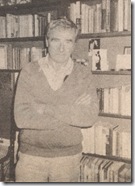
Des DubbeltAlthough Playdate was the idea of Cinema’s editor Sid Bevan, he left shortly after the magazine started, and for most of its life Des Dubbelt (right) was the editor. “I felt that to go anywhere, the magazine had to shed the feel of a handout, it had to have a consumer feel,” he says. Dubbelt describes his employer Sir Robert Kerridge as “a true impresario, not an accountant” – so the magazine was not limited to KO films, but also covered Amalgamated’s releases and television stories, with genuine criticism, not just publicity. “Kerridge saw you’ve got to go with the flow. If you’re in show business, it doesn’t make sense to ignore your competition.”
The magazine was aimed equally at males and females, though the healthy advertising (some issues nearly reached 200 pages!) was mainly cosmetics and clothes (Slimryte Rolls! Bri-Nylon!) for the young Slenderella. “We followed our own interests a lot,” says Dubbelt. “We thought if it interested us, it would interest our readers. There were no readers’ surveys. We were enthusiasts.”
With Dubbelt at Playdate was Tom McWilliams as assistant editor (later executive chief sub-editor at the Listener), and young reporter Sally (who later worked for the Beatles at Apple in London).
Reflecting the explosion of the decade, music became a major part of the magazine. “It was a natural progression,” says Dubbelt. “The pop films started happening. Cliff Richard and so on, bolstered by personal visits. When the Beatles arrived, it was like the millennium.” Dubbelt remembers taking Gene Pitney to Kerridge’s Pakatoa Island resort for a story, and accompanying Tom Jones to a nightclub after his Town Hall concert – and Tommy Adderley singing ‘It’s Not Unusual’ as Jones entered.
The burgeoning local music scene was covered, particularly the summer package tours. “Mr Lee Grant was mobbed in a way comparable with any visiting big name.” Shows such as C’mon made New Zealanders pop stars. “Any TV show wouldn’t have done it,” says Dubbelt. “Kevan Moore was a brilliant producer – those shows were excellent.”
As any magazine should, Playdate’s layout reflects the design of the era. The change from hot metal to offset printing meant some radical layouts were possible: white type on black, photos bled to the edge. “We were dealing with a visual market: movies, fashion, rock, and this technology meant we could look different from the things the Woman’s Weekly were doing. The readers saw this – they didn’t want something that reminded them of their mother’s magazine.”
The innovations of Playdate meant the magazine attracted work from the “young, adventurous” photographers of the day, such as Max Thomson, Rodney Charteris, and Roger Donaldson. “We couldn’t have afforded them, but they liked the type of layouts we used, and to see their work well presented.” While they were using Mondrian grid layouts and plenty of white space, Dubbelt and McWilliams looked with envy at overseas magazines – the San Francisco Oracle even had psychedelic inks!
But the times eventually caught up with Playdate. By the early 1970s music and movies had got more permissive, and the magazine could reflect that in its illustrations – to a point. “It was just the way things were going. Take Woodstock. It was a pretty raunchy film, with a permissive attitude towards drugs and lifestyle. Tom and I felt we couldn’t cover the way the rock scene was going.
“That was about the time Rolling Stone came on the scene. They seemed to have no ‘no-nos,’ with star writers such as Hunter Thompson who seemed to be doing all the drugs, too. The youth market had diversified into heavy rock, with the accompanying drug scene, and teenybopper pop. We couldn’t and didn’t want to go into those areas.”
Playdate’s circulation was still healthy when the magazine was sold to the Auckland Star in 1972, but six months later the new owners decided to close the magazine down. Ironically, on the day Rip It Up interviewed Des Dubbelt, the Star’s parent company New Zealand Newspapers announced the closure of their 1980s teen magazine, Dolly.


New Zealand’s first rock paper of significance started in October 1967 – a month before Rolling Stone. Called Groove, it was edited in Wellington by Dene Kellaway for the publishers Lucas Print. He’d been the editor of Teenbeat, which had closed down the month before.
Efforts to trace Kellaway (left) didn’t succeed, but in 1968 an interview with him appeared in another short-lived New Zealand music magazine Third Stream (a curious mix of mainly classical music, plus folk and pop; it lasted four issues). Its headline read, “EDITOR RELUCTANTLY GIVES UP GROOVE.” Kellaway’s reasons were pure 1960s: his own pop career was getting off the ground … and he’d been drafted.
While Dene did his 14 weeks of national service at Waiouru, the magazine appears to have gone into recess. What happened to his pop career (NZBC didn’t buy his first single, ‘I’m Going Nowhere,’ reported Groove) is also a mystery.
When Groove reappeared in August 1968, it continued its hip coverage of the overseas and local pop and rock scenes. Although the Monkees were on the first cover, Jimi Hendrix and Pink Floyd were also cover stories in the magazine’s first year – using illustrations drawn by readers.
For their 10 cents each fortnight, each Groove reader got a 16-page tabloid with plenty of pix and pinups, reviews and news, of pop stars and movies. Except for the paper’s news from Sydney – where Dalvanius was their correspondent – most of its overseas coverage was taken from press releases, or syndicated from other music mags. But what’s remarkable is the paper’s coverage of local music. As the nostalgists keep reminding us, then we had pop stars: Simple Image (“will they keep ‘Spinning Spinning Spinning’ till 1968’s Loxene Golden Disc?”), the Avengers, the Fourmyula, the Underdogs, Hi-Revving Tongues, Ray Columbus, John Rowles, and especially Mr Lee Grant (who wore suede boots laced at the side to an interview!).
Radio DJs were also stars, and one of Groove’s bandwagons was pirate station Radio Hauraki, with their “good guys.” When the bill legalising private radio was passed in 1968, Kellaway wrote: “Groove is very pleased about the new bill and will be giving full support to any new stations that start up. In the long run it is going to be a good thing, and with the heavy competition it will bring the standard of our local productions will improve and more local talent will local talent will be uncovered and given a good fighting chance.”
But interviewed on the way to Waiouru, Kellaway talked of giving up Groove, as his contract with Apollo Records required him to be free to travel around the world. He was going to cut singles with his band the Vibrons while on weekend leave.
“I ran Groove alone, and did most of the writing myself. I did all the record reviews too, so it was a bit hectic,” he said. “I was doing Groove for the love of the work. I wasn’t drawing a wage off it; I had another part-time job on which I was living. Because I had been trying to sing for so long, I realised just how difficult it is, and how important, for the groups to get recognition in this country. I was plugging that side, trying to help the New Zealand scene. It wasn’t really a paying proposition. It could be, but I had gone as far as I could as a one-man band; it was a 24-hour-a-day job. I had about two days a week to myself.”
In August 1969, Kellaway moved on to concentrate on his recording career. The paper’s blues columnist Barry Francis Jones took over as editor, but that’s where RIU’s collection of Groove ends.
One year after the imported Rolling Stone magazine contributed to Playdate’s demise, New Zealand had its own edition of the San Francisco mag. Published by Alister Taylor of Little Red Schoolbook fame, the NZ RS lasted six issues in 1973.
But in February 1974 an all New Zealand owned rock magazine arrived. It had the delightfully 1970s name Hot Licks.
roger jarrett by CB Hot Licks was started by Aucklanders Kerry Thomas, of Direction Records, and Radio Hauraki co-founder David Gapes. They asked graphic designer Roger Jarrett to edit the paper. “They thought of the idea of a free music mag, thinking it would be in their interest to promote music,” says Jarrett (right). “They said, ‘go for it’ – the first couple of issues I virtually wrote myself, then I found other writers. It was a different industry then for music. As far as marketing went, it wasn’t nearly as sophisticated.”
The magazine featured the best of 1970s music, from Bowie and Lou Reed to Little Feat and Joni Mitchell. “It was an enthusiast’s not a journalist’s magazine: a lot of the critical writing was blatantly biased towards favourite acts. But occasionally you got people who could actually write, such as Tim Blanx, who went off to England with Roxy Music. He was into the pre-punk music of the mid-70s, like Roxy, the Velvets and the New York Dolls, whereas I liked the more country influenced American music, and dance music.”
Split Enz were the first local cover story, followed by Mark Williams and Waves. But local music was difficult to cover, says Jarrett, “because we never had any journalists employed, so the only person who could go out and do interviews was me, and there wasn’t the time. There’s far more consciousness about a New Zealand identity now.”
Because of Jarrett’s background, the graphics were a crucial part of Hot Licks. As photographs didn’t reproduce well on newsprint, covers were done by illustrators such as Frank Womble, Dick Frizzell and Colin Wilson, and the page layout was extremely complex. Although the magazine quickly had a weighty masthead of contributing writers, Jarrett found himself doing everything else: subbing, proofing, paste-up, “the whole shebang. It was very time-consuming, and visitors would come in constantly. Very soon people thought I was an authority.”
Advertising was slow in the early months. “For a start, the record companies had to have their arms twisted to advertise.” They thought [the record store] Taste and Radio Hauraki were calling the shots. “There was a lot of politics involved,” says Jarrett. “Far too much. The whole record industry’s like that. But after six issues, they realised it wasn’t going to go away.”
Hot Licks lasted 27 issues, “quite an achievement, with no budget,” says Jarrett. But towards the end the magazine charged 40 cents an issue. That was a mistake, really, but not the reason it folded. It was still all down to me to do everything, and I was exhausted by the whole process. Plus I had family commitments.”
The circulation reached 8000, distributed through record stores around the country, though in Auckland, through Direction shops only. “It was a bit of a political football, between the purchase of records in the stores, and the amount of publicity in the mag, and advertising. Also, Direction became a distributor of overseas labels like Virgin, Casablanca, ECM – that got right up the noses of the record companies. It became too political – that’s where I lost interest.”
With the management of Direction and Hauraki having changed, there also wasn’t the commitment from above, the returns being difficult to evaluate.
“The only thing about Hot Licks that I believe is of value is that it’s an accurate reflection of its age, and what people thought about at the time,” says Jarrett. “I hate nostalgia. I’m not nostalgic about the magazine at all. It was good self-expression, and I really enjoyed it, but I really like being now, being current.”
© Chris Bourke 1987
Russell Brown writes a detailed tribute to Des Dubbelt and Playdate here. Quotes and information from the above article have appeared elsewhere without attribution (once by a senior academic who should have known better). Feel free to use it, with acknowledgement of the original source.

28 April 2009

Yesterday’s Papers

1. Sliver of hope

IF Stone New York Times columnist Maureen Dowd compares this gloomy era in journalism to the film Sunset Boulevard, rewriting the famous quote of aging actress Norma Desmond: “Papers are still big. It’s the screens that got small.” She asks Phil Bronstein, editor of the troubled San Francisco Chronicle, to take her on a “justify your existence” tour. Bronstein drives her past the journalists’ bar, now empty, the police headquarters where they uncovered corruption, the SF General Hospital, once teeming with Aids patients. In magazines, when the circulation department receives its returns marked “Subscriber deceased: please cancel,” it’s a stark reminder that one’s readership is aging. But this is now a good thing, reasons Bronstein:

His tour ended with cold comfort, as he observed that longer life expectancies may keep us on life support. “For people who still love print, who like to hold it, feel it, rustle it, tear stuff out, do their I. F. Stone thing, it’s important to remember that people are living longer,” he said. “That’s the most hopeful thing you can say about print journalism, that old people are living longer.”

The reference to crusading journalist I.F. Stone (pictured above) was heartening - the Seymour Hersh of his day, for years he ran his own I.F. Stone's Weekly - and intriguing. I don't think he was a relative of Bronstein's short-term wife, Sharon Stone.

2. Cold beer, hot type

Ballantyne There are few books written about New Zealand novelists, but even fewer about its journalists. After the Fireworks is both, a biography of novelist and Auckland Star leader writer David Ballantyne, who died in 1986. It’s an evocative portrait of the loneliness of a writer in a hostile culture, diverted by the hard-drinking, hard-bitten but strongly bonded world of newspapermen in the 1940s and 1950s. Ballantyne’s first novel The Cunninghams was written when he was just 23, in 1947, and published in the US; it would be another 15 years before he published another.

Long sessions at the Occidental in Vulcan Lane were part of the reason, but he managed to get off the bottle in 1973 and produce a late flurry of work. After the Fireworks captures the smoky newsrooms, the pride and wisdom of the long-serving reporters and sub-editors, the daily post-deadline binges, the hidden subcultures such as the rundown flat at 301 Willis Street, Wellington, where journalists, poets, novelists (and even Douglas Lilburn) would come and go, knowing they could get a beer after six o’clock closing. Under the circumstances, the Aucklanders’ productivity is extraordinary:

“… visits to Willis Street were sporadic and impulsive excursions, usually involving drinking in Auckland on a Friday after work, catching the overnight train to Wellington, drinking at various Wellington watering-holes … partying on at 301, then catching the Sunday night train back to Auckland in time for work at the Star on Monday morning.”

The biography was written by Ballantyne’s friend Bryan Reid; the pair started at the Star on the same day in 1943. The book slipped under my radar when it came out in 2004 but – like Ballantyne’s best, Sydney Bridge Upside Down, from 1968 – is recommended.

3. Quality of Mercer

dom1 The Dominion Post runs the country’s best obituaries, but didn't quite get the tone right with a recent tribute to the former Dominion editor, Jack Kelleher. Portraying him as a cardigan-wearing conservative – and concentrating on the brief tabloid folly of Rupert Murdoch – doesn’t tell the whole story. A quick glance at Kelleher's journalism suggests he moved in a broad circle. His ghost-writing of forensic pathologist PP Lynch’s memoir No Remedy For Death is mentioned; erudite, stubborn, patrician, Lynch did not suffer fools. Kelleher could work the public bar as well: he was close enough to the “hermit of Hawera,” novelist Ronald Hugh Morrieson, to be a key source for Julia Millen’s biography. His history of Upper Hutt reveals a rapport with Wellington’s hippest post-war bandleader, Fred Gore. And his sensitive obituary of Ruru Karaitiana in 1970 – the only one the ‘Blue Smoke’ songwriter received – indicates a newspaperman who never stopped working his beat (in this case, Wellington’s inner-city music precinct of the late 1940s: Mercer, Willis, Manners and Bond streets). Maybe not Clark Kent, but a very effective mild-mannered reporter.

4. A comic sign of health

The same week of Kelleher's death, I found Ballantyne's biography in a small town sale bin. Both reminded me of Julia Millen's biography of Morrieson, from 1996, which also hasn't reached the audience it deserves. The pair had quite a bit in common: their era, their profession, their obscurity, and their alcoholism. Unlike Ballantyne, Morrieson didn't leave a swag of diaries, letters and manuscripts, which made Millen's task more difficult. But by weaving in anecdotes from his fiction, and putting in plenty of leg work, she captured his drive and his demons, in that closed Taranaki world.

“Herbert had told me on the quiet that he reckoned Uncle Athol had got his teeth from Mr Dabney, the undertaker.” (The Scarecrow)

Landfall 98 hanly“What is this thing called gothic?” asked Morrieson, after a rare literary review during his lifetime. Just months before Morrieson died - yes, “another one of those buggers” who only became famous afterwards - Robin Dudding published two “appreciations” in Landfall 98 (June, 1971). Morrieson's champions were Frank Sargeson and CK Stead, and the issue had a cover design by Pat Hanly. Sargeson wrote:

We hear sometimes of somebody who intends a march on Parliament in order to emphasise some fact of human nature or human society. It would be a comic sign of health in the community (not to mention an immense compliment to Mr Morrieson, and his skill in revealing to us much about the inner nature of human life in our country), if Parliament were to march upon him and his home town.

23 January 2009

How many roads

dylanobama_p465

And we'll walk down the avenue in style

And we'll walk down the avenue and we'll smile

And we'll say baby ain't it all worthwhile

When the healing has begun

(Picture editor: Hendrik Hertzberg; pics by Don Hunstein, 1963, and Doug Mills, 2009; song by Van Morrison; pic below, MAD).

barack virgin Postscript: if the messianic euphoria is starting to be a worry, a reality check is at the always-brilliant radio programme This American Life. The show just on the eve of the inauguration was thoughtful and all-inclusive, capturing voices from around the US and their attitudes as the new administration was about to start. It began at a climate-change conference, stunned by Obama's emphatic embrace of the issue. They talked to young Marines back from three tours to Iraq and still Bush supporters, then the Veteran's Administration who were stunned to get phone call from the transition team asking what they needed and offering full funding for the first time. Customers in a New Orleans bar, and a button factory where business has gone gang-busters making Obama badges ... and also a retired 93-year-old journalist from small-town Florida, where he had covered Ku Klux Klan meetings in the 1930s only to see 20,000 supporters of all races turn out for a Obama rally there last year. You can listen to it here, free for how long I don't know but even from the archive for 95c US it's a bargain and they need the money.

14 January 2009

Dancing Gershwin's blues

Rhapsody_in_Blue_cover In the 1920s, if New Zealand newspapers reviewed records they were usually opera, classical or the light classics. I'm surprised the New Zealand Herald covered Gershwin's Rhapsody in Blue at all, so can forgive the reviewer for hedging his bets:
Gershwin's Rhapsody in Blue is almost a new art form - a sort of symphonic jazz. Stravinsky and some of the French "six" have attempted something of the kind; but their compositions are far too self-conscious to be successful, and their knowledge of the peculiar kind of scoring needed, inadequate. The medium is of far greater interest than Mr Gershwin's music, which is extremely derivative. Rimsky-Korsakoff is drawn upon in the opening section, Debussy and Grieg toward the end. There are also many pure and captandum* effects. But something undoubtedly individual emerges. The composer plays the piano brilliantly; the whole thing has the air of an improvisation. The saxophones would prove useful as ordinary members of the orchestra. The tenor instrument is very similar in tone to a clarinet, only more supple; the baritone to a cello, but full and rounder. However, the orchestra of the future will perhaps be no settled body. Instead, we shall have chamber orchestras of varying content. This example may well be a portent. It is well recorded and of peculiar interest.
- New Zealand Herald, 24 July 1926. * captandum: 'a specious argument "for capturing" the gullibility of the naive among the listeners"
Here is what the New York Times' reviewer said of Rhapsody in Blue the day after its premiere, performed by Gershwin at the piano, with Paul Whiteman and his Orchestra on 12 February 1924:
This composition shows extraordinary talent, as it shows a young composer with aims that go far beyond those of his ilk, struggling with a form of which he is far from being master ... His first theme ... Paul Whiteman advert 080928is no mere dance-tune ... it is an idea, or several ideas, correlated and combined in varying and contrasting rhythms that immediately intrigue the listener. The second theme is more after the manner of some of Mr Gershwin's colleagues. Tuttis are too long, cadenzas are too long, the peroration at the end loses a large measure of the wildness and magnificence it could easily have had if it were more broadly prepared, and, for all that, the audience was stirred and many a hardened concertgoer excited with the sensation of a new talent finding its voice ... There was tumultuous applause for Gershwin's composition. [the edits are Wikipedia's]
Right-click to hear Gershwin performing it with an orchestra or, for better audio, on a piano roll. Above right: an advertisement for Whiteman's records from the New Zealand Herald in September 1928.